Total Lunar Eclipse
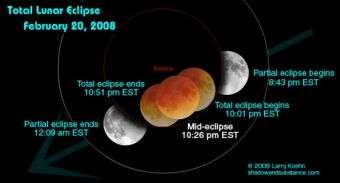
On Wednesday evening, February 20th, the full Moon over the Americas will turn a delightful shade of red and possibly turquoise, too. It's a total lunar eclipse—the last one until Dec. 2010.
The Sun goes down. The Moon comes up. You go out and look at the sky. Observing the eclipse is that easy. Maximum eclipse, and maximum beauty, occurs at 10:26 pm EST (7:26 pm PST).
A lunar eclipse happens when the Moon passes through the shadow of Earth. You might expect the Moon to grow even more ashen than usual, but in fact it transforms into an orb of vivid red.
Why red? That is the color of Earth's shadow.
Consider the following: Most shadows we're familiar with are black or gray; step outside on a sunny day and look at your own. Earth's shadow is different because, unlike you, Earth has an atmosphere. The delicate layer of dusty air surrounding our planet reddens and redirects the light of the sun, filling the dark behind Earth with a sunset-red glow. The exact tint--anything from bright orange to blood red is possible--depends on the unpredictable state of the atmosphere at the time of the eclipse. "Only the shadow knows," says astronomer Jack Horkheimer of the Miami Space Transit Planetarium.
Transiting the shadow's core takes about an hour. The first hints of red appear around 10 pm EST (7 pm PST), heralding a profusion of coppery hues that roll across the Moon's surface enveloping every crater, mountain and moon rock, only to fade away again after 11 pm EST (8 pm PST). No special filter or telescope is required to see this spectacular event. It is a bright and leisurely display visible from cities and countryside alike.
While you're watching, be alert for another color: turquoise. Observers of several recent lunar eclipses have reported a flash of turquoise bracketing the red of totality.
"The blue and turquoise shades at the edge of Earth's shadow were incredible," recalls amateur astronomer Eva Seidenfaden of Trier, Germany, who took the picture at right during the European lunar eclipse of March 3-4, 2007. Dozens of other photographers have documented the same phenomenon.
The source of the turquoise is ozone. Eclipse researcher Dr. Richard Keen of the University of Colorado explains: "During a lunar eclipse, most of the light illuminating the moon passes through the stratosphere where it is reddened by scattering. However, light passing through the upper stratosphere penetrates the ozone layer, which absorbs red light and actually makes the passing light ray bluer." This can be seen, he says, as a soft blue fringe around the red core of Earth's shadow.
To catch the turquoise on Feb. 20th, he advises, "look during the first and last minutes of totality." That would be around 10:01 pm EST and 10:51 pm EST (7:01 and 7:51 pm PST).
Blood red, bright orange, gentle turquoise: it's all good. Mark your calendar in vivid color for the Feb. 20th lunar eclipse.
This story is written for an American audience, but not only Americans can see the eclipse. People in Europe and western Africa are also favored. International maps and timetables may be found here.
Source: by Dr. Tony Phillips, Science@NASA


