Teams battle to on-screen victory
Feb 08, 2008
Teams battle to on-screen victory
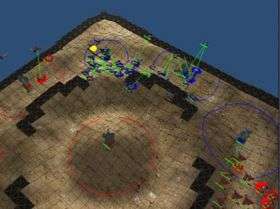
A screenshot of pre-programmed strategies for a match between two of the teams participating in MIT's BattleCode programming competition held during IAP.

Tanks, soldiers, snipers, mortars and bombers fanned out rapidly over unfamiliar undulating terrain, searching for their enemy counterparts and trying to seize control of battle towers. Some armies swarmed frenetically over the land, searching and fighting as they went, while others moved cautiously while staying huddled in a tight group, building their strength slowly and methodically.

Hundreds of spectators watched and cheered Feb. 1 as the rival armies battled it out on giant screens in Kresge Auditorium. Out of 150 teams that signed up to write the programs controlling those battle swarms during IAP, the best eight, chosen after a full day of one-to-one matches earlier in the week, slogged it out for the final victory in a double-elimination tournament.

The BattleCode software competition has become an annual tradition at MIT, and this year's battle was the fastest, most complex and most detailed yet. As second-year computer sciences student Joel Stein, one of the event's organizers, explained before the final tournament, the 300 students who participated ended up writing a total of 350,000 lines of computer code.

The BattleCode contest has become an even bigger event than MIT's fabled 6.270 annual autonomous robot competition, Stein said.

Although the teams who wrote the code stood on the stage and narrated the action while the battles unfolded, they had no control over the action at that point--everything was determined by the strategies built into the software ahead of time, and by the vagaries of the undulating terrain, filled with obstacles, whose contours were different in each round of the contest.

In the end, adaptability and responsiveness won the day. A team called "in memory of James Albrecht," whose program was especially adept at discerning its opponents' strategies and modifying its own accordingly, swept to victory in a record about as strong as that of the New England Patriots. The team, named in honor of an MIT senior who died last summer and had been a former teammate, lost only a single game out of the 16 played through to the finals.

The four-member winning team walked away with the $5,000 first prize, as well as several additional prizes, but overall more than 20 teams ended up with cash prizes, certificates and trophies by the evening's end, and even the hundreds of spectators got a free T-shirt just for watching the action. In addition to cash awards totaling $40,000 for the top 16 teams (donated by a long list of corporate sponsors), prizes were awarded for everything from cleverest strategy and most-unusual formation (one team had its soldiers dash out onto the field to form the letters "LOL" before actually beginning to fight) to the best team name.

BattleCode is also known as course 6.370, and contestants whose code was good enough to overcome a basic reference program and who wrote up descriptions of the strategy they used earned six credits for participating.

Following last week's final tournament, there is also an open version of the contest that can be entered by anyone outside the MIT community. That final competition will be held in March.

Source: MIT, by David Chandler

Explore further: Mobile app to help fight against racism in France

add to favorites email to friend print save as pdf

Related Stories

Challenging the public's view of gender and science

May 24, 2013

According to She Figures 2012, which analyses gender equality in research, in 2010 women accounted for only 10 % of university rectors in Europe and 15.5 % were heads of institutions of the higher education ...

Recommended for you

Mobile app to help fight against racism in France

21 hours ago

A French anti-racism association is launching a mobile application it hopes will help eradicate racist graffiti by enabling users to take photos of offensive tags, geo-locate them and get them removed.

Google Drive sports new view and scan enhancements

May 23, 2013

(Phys.org) —Google Drive has a new look and functions. The makeover in Google Drive features scanning and interface enhancements that put the user into "card" mode. The enhancements make it easy for the ...

Model will unlock mysteries of the voice

May 22, 2013

Swedish researchers are leading the development of the world's first comprehensive model of the human voice, which could contribute to better voice care, voice prosthetics, talking robots and teaching opportunities.

Patented system better secures digitally stored data

May 21, 2013

(Phys.org) —Arizona State University computer scientist Gail-Joon Ahn has been granted a U.S. patent for a novel identity management system that helps protect personal identity information stored on digital devices.

UC Davis startup changes listening experience

May 20, 2013

Fifteen years of research at the University of California, Davis, is being turned into commercial products by Dysonics, a startup company based in San Francisco. Since becoming the first "graduate" from the Engineering Translational ...

User comments : 0

More news stories

Yahoo, pay-TV operators among Hulu bidders

Online video site Hulu is again up for sale, with Yahoo and pay TV operators DirecTV and Time Warner Cable among the seven bidders, according to a person with direct knowledge of the matter.

Radiation leak at Japan lab; small impact expected

An atomic research lab in northern Japan has reported a radiation leak that may have affected about 50 people, though none were hospitalized and no impact was expected outside the facility, the lab's operator ...

Google eyes emerging markets networks

Google has become deeply involved in a series of projects to build and operate wireless networks in emerging markets including sub-Saharan Africa and Southeast Asia, a report said Friday.

Facial-recognition technology proves its mettle

(Phys.org) —In a study that evaluated some of the latest in automatic facial recognition technology, researchers at Michigan State University were able to quickly identify one of the Boston Marathon bombing ...

Galaxies fed by funnels of fuel

(Phys.org) —Computer simulations of galaxies growing over billions of years have revealed a likely scenario for how they feed: a cosmic version of swirly straws.