Baffin Island ice caps shrink by 50 percent since 1950s, study
Jan 28, 2008
Baffin Island Ice Cap
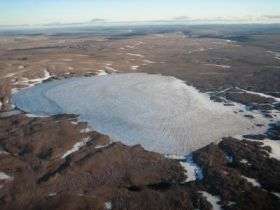
Ice caps on the northern plateau of Baffin Island in the Canadian Arctic have shrunk by 50 percent in recent decades as a result of warming temperatures. Credit: Gifford Miller, University of Colorado at Boulder

A new University of Colorado at Boulder study has shown that ice caps on the northern plateau of Baffin Island in the Canadian Arctic have shrunk by more than 50 percent in the last half century as a result of warming, and are expected to disappear by the middle of the century.

Radiocarbon dating of dead plant material emerging from beneath the receding ice margins show the Baffin Island ice caps are now smaller in area than at any time in at least the last 1,600 years, said geological sciences Professor Gifford Miller of CU-Boulder's Institute of Arctic and Alpine Research. "Even with no additional warming, our study indicates these ice caps will be gone in 50 years or less," he said.

The study also showed two distinct bursts of Baffin Island ice-cap growth commencing about 1280 A.D. and 1450 A.D., each coinciding with ice-core records of increases in stratospheric aerosols tied to major tropical volcanic eruptions, Miller said. The unexpected findings "provide tantalizing evidence that the eruptions were the trigger for the Little Ice Age," a period of Northern Hemisphere cooling that lasted from roughly 1250 to 1850, he said.

A paper on the subject was published online in Geophysical Research Letters and featured in the Jan. 28 edition of the American Geophysical Union journal highlights. Authors on the study included Miller, graduate students Rebecca Anderson and Stephen DeVogel of INSTAAR, Jason Briner of the State University of New York at Buffalo and Nathaniel Lifton of the University of Arizona.

Located just west of Greenland, the 196,000 square-mile Baffin Island is the fifth largest island in the world. Most of it lies above the Arctic Circle.

The researchers also used satellite data and aerial photos beginning in 1949 to document the shrinkage of more than 20 ice caps on the northern plateau of Baffin Island, which are up to 4 miles long, generally less than 100 yards thick and frozen to their beds. "The ice is so cold and thin that it doesn't flow, so the ancient landscape on which they formed is preserved pretty much intact," said Miller.

In addition to carbon-dating plant material from the ice edges, the researchers extracted and analyzed carbon 14 that formed inside the Baffin Island rocks as a result of ongoing cosmic radiation bombardment, revealing the amount of time the rocks have been exposed, he said. The analysis of carbon 14 in quartz crystals indicated that for several thousand years prior to the last century, there had been more ice cover on Baffin Island, Miller said.

The increase of ice extent across the Arctic in recent millennia is thought to be due in large part to decreasing summer solar radiation there as a result of a long-term, cyclic wobble in Earth's axis, said Miller. "This makes the recent ice-cap reduction on Baffin Island even more striking," he said.

Funded primarily by the National Science Foundation, the study is among the first to use radiocarbon samples from rocks for dating purposes, Miller said. The radiocarbon portion of the study was conducted at INSTAAR and the University of Arizona.

Temperatures across the Arctic have been rising substantially in recent decades as a result of the build up of greenhouse gases in Earth's atmosphere. Studies by CU-Boulder researchers in Greenland indicate temperatures on the ice sheet have climbed 7 degrees Fahrenheit since 1991.

Source: University of Colorado at Boulder

Explore further: Alaska volcano shoots ash 15,000 feet into the air

add to favorites email to friend print save as pdf

Related Stories

Image: IceBridge flight over Baffin Island

Apr 18, 2013

(Phys.org) —IceBridge closed out the fourth week of its Arctic campaign with a flight over the striking landscape of eastern Greenland's Geikie Peninsula and a survey of a Canadian ice cap before taking ...

Ancient DNA sheds light on Arctic whale mysteries

Oct 19, 2012

Scientists from the Wildlife Conservation Society, the American Museum of Natural History, City University of New York, and other organizations have published the first range-wide genetic analysis of the ...

How fast can glaciers respond to climate change?

Sep 13, 2012

A new Arctic study in the journal Science is helping to unravel an important mystery surrounding climate change: How quickly glaciers can melt and grow in response to shifts in temperature.

What do killer whales eat in the Arctic?

Jan 30, 2012

Killer whales (Orcinus orca) are the top marine predator, wherever they are found, and seem to eat everything from schools of small fish to large baleen whales, over twice their own size. The increase in hun ...

Ocean cacophony a torment for sea mammals

Dec 07, 2011

With the constant churn of freighter propellers, the percussive thump of oil and gas exploration and the underwater din of military testing, ocean noise levels have become unbearable for some sea mammals.

Recommended for you

Alaska volcano shoots ash 15,000 feet into the air

May 18, 2013

(AP)—One of Alaska's most restless volcanoes has shot an ash cloud 15,000 feet into the air in an ongoing eruption that has drawn attention from a nearby community but isn't expected to threaten air traffic.

NASA sees Cyclone Mahasen hit Bangladesh

May 17, 2013

NASA's Tropical Rainfall Measuring Mission satellite known as TRMM measured Cyclone Mahasen's rainfall rates from space as it made landfall on May 16. Mahasen has since dissipated over eastern India.

Rapid climate change ruled out ice age trees

May 17, 2013

Short, sharp fluctuations in the Earth's climate throughout the last ice age may have stopped trees from getting a foothold in Europe and northern Asia, scientists say.

Earth's iron core is surprisingly weak, researchers say

May 17, 2013

The massive ball of iron sitting at the center of Earth is not quite as "rock-solid" as has been thought, say two Stanford mineral physicists. By conducting experiments that simulate the immense pressures deep in the planet's ...

User comments : 2

Adjust slider to filter visible comments by rank

Display comments: newest first

DGBEACH
not rated yet Jan 29, 2008
This is not news.
lengould100
not rated yet Nov 17, 2008
DG. Explanation?

More news stories

Russia retrieves mice, newts from space

A Russian capsule filled with 45 mice and 15 newts along with other small animals returned from a month's mission in orbit on Sunday with data scientists hope will pave the way for a manned flight to Mars.

Galaxy's Ring of Fire

Johnny Cash may have preferred this galaxy's burning ring of fire to the one he sang about falling into in his popular song. The "starburst ring" seen at center in red and yellow hues is not the product of ...

Honeybees trained in Croatia to find land mines

(AP)—Mirjana Filipovic is still haunted by the land mine blast that killed her boyfriend and blew off her left leg while on a fishing trip nearly a decade ago. It happened in a field that was supposedly ...

German energy shift faces headwinds

Tense engineers have their eyes peeled on complex colour-coded diagrams on a wall-sized screen that makes their control room look like the inside of a spaceship.