Light speed communications for supercomputers
Dec 17, 2007
Light speed communications for supercomputers
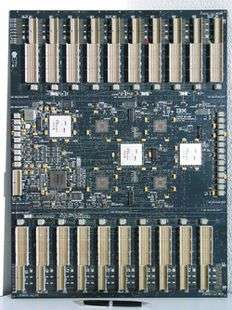
OSMOSIS controller. Credit: IBM

The performance of tomorrow’s supercomputers will be dictated by their ability to exchange large volumes of data instantly between the hundreds of thousands of processors of which they are built.

Using optical networks to transfer data throughout the system using light, researchers at IBM and Corning Inc., under a project sponsored by the US Department of Energy/NNSA, have succeeded in demonstrating the world’s most advanced and powerful optical packet switch. This novel switch is capable of transmitting 2.5 Terabits of data—equivalent to 20 high-definition movies—in a single second.

Today’s supercomputers, such as IBM’s Blue Gene system, are based on tens of thousands of relatively simple and power-efficient processors that work in parallel to solve a problem collectively.

To grow future supercomputing performance and accommodate the resulting spiking data flows in the system, IBM researchers have been investigating the use of light for data transmission—on the chips themselves, between two processors and throughout complex communication networks. Optical data transmission is very promising by virtue of its high capacity, the ability to transfer data with minimum losses over larger distances and low power consumption.

Motivated by these prospects, a team of computer scientists at the IBM Zurich Research Laboratory and optical engineers at the US-based company Corning Inc. set out to design and develop a high-performance optical communication network by focusing on the most critical components—the switches. The function of a switch is to control data flows and prevent congestion within the complex network of data highways.

As a result of the joint four-year project entitled OSMOSIS (Optical Shared MemOry Supercomputer Interconnect System), IBM and Corning researchers have now demonstrated the most powerful optical packet switch. It combines 64 optical data links, each running at 40 Gigabit per second, which transmit up to 2.5 Terabits per second. For comparison, this corresponds to 20 HD DVD movies in a single second.

“We will need such powerful optical interconnect systems in the future if we want to scale supercomputing capabilities and efficiency well beyond the petaflop range,” explains Ronald Luijten, OSMOSIS project leader at IBM’s Zurich Research Lab. “Such systems could, for example, accelerate discoveries in the fields of biomedicine and biology, and may even empower computers to design such complex, large-scale systems as new drugs.”

One of the main challenges in the development of the optical packet switch is the lack of optical memory, as it is not yet known how to store and retrieve optical data bits easily and in a cost-effective manner. Luijten’s team, which was responsible for the switch design, overcame this issue by adopting a hybrid electro-optical approach using electronics to buffer and schedule data and optics—leading-edge Corning semiconductor optical amplifiers—for the transmitting and switching processes. They developed a state-of-the-art electronic controller that can compute an optimal switch configuration during each packet slot of 51.2 nanoseconds, thereby operating practically bufferless while maximizing throughput and reliability.

“The function of the controller, which is the intelligence of the switch, is to perform scheduling and resolve contention,” explains Luijten. The controller board—one of the most complex designs ever developed—was awarded the 2007 Mentor Graphics Award for outstanding circuit board design.

Source: IBM Zurich Research Laboratory

Explore further: EUROnu project recommends building Neutrino Factory

add to favorites email to friend print save as pdf

Related Stories

End of the line for Roadrunner supercomputer

Mar 31, 2013

It's the end of the line for Roadrunner, a first-of-its-kind collection of processors that once reigned as the world's fastest supercomputer. The $121 million supercomputer, housed at one of the premier U.S. ...

Graphene applications in electronics and photonics

Nov 02, 2011

Graphene, which is composed of a one-atom-thick layer of carbon atoms in a honeycomb-like lattice (like atomic-scale chicken wire), is the world's thinnest material – and one of the hardest and strongest. Indeed, the ...

50 Years Of Lasers

May 17, 2010

This weekend marked the 50th anniversary of the invention of the first working laser. Today, lasers can be found almost everywhere, from telephone lines to cutting edge scientific research, supermarket scanners, ...

Recommended for you

EUROnu project recommends building Neutrino Factory

2 hours ago

(Phys.org) —The European Union's Seventh Framework Programme, EUROnu, has submitted its findings to a panel at CERN. Charged with choosing a project to study the nature of matter and antimatter, the project ...

RHIC's perfect liquid a study in perfection

Jun 18, 2013

(Phys.org) —When heavy ions (the nuclei of heavy atoms such as gold and lead) collide at high energies at Brookhaven National Laboratory's Relativistic Heavy Ion Collider (RHIC) and Europe's Large Hadron Coll ...

User comments : 3

Adjust slider to filter visible comments by rank

Display comments: newest first

earls
3 / 5 (2) Dec 17, 2007
"This novel switch is capable of transmitting 2.5 Terabits of data%u2014equivalent to 20 high-definition movies%u2014in a single second."

"It combines 64 optical data links, each running at 40 Gigabit per second, which transmit up to 2.5 Terabits per second. For comparison, this corresponds to 20 HD DVD movies in a single second."

Department of Redundancy Department

But otherwise, sounds great. If it's 2.5 tb a second with the technology in it's infancy, imagine how it will scale with maturity!
Reaper6971
not rated yet Dec 18, 2007
You forgot this one you didn't mention:

Using optical networks to transfer data throughout the system using light
pravuil
not rated yet Dec 18, 2007
Sounds like it might clear up that Internet Tube Congestion we've all been hearing about.

Actually, I've been waiting for this since the whole "using light for processing idea" came up several years back. Surprised they've tested the idea for four years already. I'm also surprised that IBM was the one to do the testing. Makes sense but still it's different.

More news stories

EUROnu project recommends building Neutrino Factory

(Phys.org) —The European Union's Seventh Framework Programme, EUROnu, has submitted its findings to a panel at CERN. Charged with choosing a project to study the nature of matter and antimatter, the project ...

Tech companies eye security that goes beyond passwords

In late February, a thief or thieves cracked into Evernote's digital vault filled with log-ins, passwords and email addresses belonging to 50 million users. It was a shocking cyberattack considering the Redwood City, Calif., ...

Validating maps of the brain's resting state

Kick back and shut your eyes. Now stop thinking. You have just put your brain into what neuroscientists call its resting state. What the brain is doing when an individual is not focused on the outside world ...

Prehistoric rock art maps cosmological belief

It is likely some of the most widespread and oldest art in the United States. Pieces of rock art dot the Appalachian Mountains, and research by University of Tennessee, Knoxville, anthropology professor Jan ...