Ancient Egyptian glassmaking recreated
Dec 14, 2007
Ancient Furnace
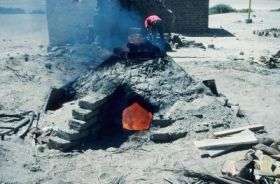
The reconstructed kiln built by Dr. Paul Nicholson of Cardiff University and Dr. Caroline Jackson of Sheffield University. Credit: Cardiff University

A team led by a Cardiff University archaeologist has reconstructed a 3,000-year-old glass furnace, showing that Ancient Egyptian glassmaking methods were much more advanced than previously thought.

Dr Paul Nicholson, of the University’s School of History and Archaeology, is leader of an Egypt Exploration Society team working on the earliest fully excavated glassmaking site in the world. The site, at Amarna, on the banks of the Nile, dates back to the reign of Akhanaten (1352 - 1336 B.C.), just a few years before the rule of Tutankhamun.

It was previously thought that the Ancient Egyptians may have imported their glass from the Near East at around this time. However, the excavation team believes the evidence from Amarna shows they were making it themselves, possibly in a single stage operation. Dr Nicholson and his colleague Dr Caroline Jackson of Sheffield University demonstrated this was possible, using local sand to produce a glass ingot from their own experimental reconstruction of a furnace near the site.

The team have also discovered that the glassworks was part of an industrial complex which involved a number of other high temperature manufacturing processes. The site also contained a potter’s workshop and facilities for making blue pigment and faience - a material used in amulets and architectural inlays. The site was near one of the main temples at Amarna and may have been used to produce materials in state buildings.

Dr Nicholson, who has been working at Amarna since 1983, said: “It has been argued that the Egyptians imported their glass and worked it into the artefacts that have been discovered from this time. I believe there is now enough evidence to show that skilled craftsmen could make their own glass and were probably involved in a range of other manufacturing industries as well.”

Source: Cardiff University

Explore further: Actor Johnny Depp immortalized in ancient fossil find

add to favorites email to friend print save as pdf

Related Stories

Recommended for you

Tiny ancient bandicoot shines light on future

4 hours ago

(Phys.org) —A 20 million-year-old fossil skull identified as a 'pocket-sized' ancestor of the bandicoot will give insights into the future of Australia's modern endangered animals.

The eloquence of the otoliths

May 16, 2013

Fish fossils that are about 23 million years old give unprecedented insight into the evolutionary history of the gobioid order, one of the most species-rich groups among the modern bony fishes.

Light cast on lifestyle and diet of first New Zealanders

May 16, 2013

(Phys.org) —A University of Otago-led multidisciplinary team of scientists have shed new light on the diet, lifestyles and movements of the first New Zealanders by analysing isotopes from their bones and teeth.

User comments : 0

More news stories

Relaxed tourists share more

Tourists set on relaxing and socialising when they reach their holiday destination tend to do little advance research on the internet before making their trip, but are more likely to share travel information and photos on ...

Tiny ancient bandicoot shines light on future

(Phys.org) —A 20 million-year-old fossil skull identified as a 'pocket-sized' ancestor of the bandicoot will give insights into the future of Australia's modern endangered animals.

Daylight Saving Time spurs drop in crime rate

(Phys.org) —Researchers are no longer in the dark about when criminals are most likely to attack. William & Mary economist Nicholas Sanders teamed up with the University of Virginia's Jennifer Doleac to study the connection ...

Slow earthquakes: It's all in the rock mechanics

(Phys.org) —Earthquakes that last minutes rather than seconds are a relatively recent discovery, according to an international team of seismologists. Researchers have been aware of these slow earthquakes, ...