Virtual factory on the tabletop
Dec 03, 2007
Virtual factory on the tabletop
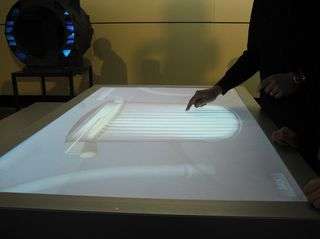
Multi-Touch Tables can be operated intuitively with the fingers by means of multi-touch sensing. The new displays can be used in factories to observe production processes, or in museums to provide visitors with even more instructive information. © Fraunhofer IGD

Many industrial processes involve reactions in places that are difficult to see directly. A novel tabletop touch screen allows hidden sequences of events to be observed in progress. It can be operated intuitively using a combination of fingers and recognizes swiping movements.

A crowd of people is gathered around a large table with an illuminated surface, on which images of a journey through pipes and machines in a factory are being displayed. Users can select individual components by touching the corresponding image with a finger. The objects can be rotated and observed by swiping a finger over them – and the same method can be used to watch a process in slow motion.

By drawing apart their two index fingers on the table surface, users can enlarge the image and zoom in on a detail, such as a bay wheel scooping up hundreds of thousands of plastic granules. The Multi-Touch Table provides a tangible virtual replication of processes that normally take place hidden inside networks of pipes: How does the process work? What are its advantages?

The large, industrial-scale display table was developed by researchers at the Fraunhofer Institute for Computer Graphics Research IGD in Darmstadt. “The table is already being used by the Coperion Group of companies,” relates IGD project manager Michael Zöllner. “It allows customers to observe the entire process chain of plastics manufacturing and processing. They can watch in real time as the granulate flows through the pipes and regulate the speed by swiping a finger over the image.” The researchers worked with colleagues at the Steinbeis Institute Design and Systems on the development of this application.

So how does the touch screen work? Infrared LEDs emit light into the Plexiglas® surface of the display at a horizontal angle. This light is internally totally reflected within the acrylic sheet, which allows none of the light to escape. A finger placed on the surface changes its reflective properties, enabling light to emerge. This light is captured by an infrared camera installed beneath the table. Although the system is based on well-known principles, various challenges still had to be overcome.

“The surface of acrylic sheets is too smooth to resolve finger movements. Our solution was to apply a special coating,” says Zöllner. Another problematic aspect was how to project the images. “To obtain a large, bright, undistorted image, the optical path has to be relatively long – something that is difficult to achieve within the confines of the table below the display. We had to affect the optical path itself, by using mirrors to keep it short,” the research scientist explains. As for the user interface, the researchers made sure that it could be used easily and intuitively. After all, nobody wants to have to follow complicated technical instructions when meeting with customers or visiting a museum.

Source: Fraunhofer-Gesellschaft

Explore further: NASA: Austin, calling Austin. 3-D pizzas to go

add to favorites email to friend print save as pdf

Related Stories

Review: Tablet-PC hybrids a study in trade-offs

Mar 27, 2013

Since Windows 8's debut in October, there have been a range of hot-looking devices that try to combine elements of tablets and traditional PCs. These hybrids seem as if they would be great both for relaxing ...

Super-tiger backgrounder: The case of the cosmic rays

Dec 27, 2012

(Phys.org)—Grade-school science teachers sometimes hand out "mystery boxes" containing ramps, barriers and a loose marble. By rotating the boxes and feeling the marble hang up or drop, the students try ...

UV ray of hope for safer drinking water

Dec 24, 2012

(Phys.org)—A group of researchers from PML's Sensor Science Division is part of a project that will have a direct effect on improved safety of the nation's drinking water.

Illuminating the no-man's land of waters' surface

Nov 27, 2012

Sylvie Roke, scientist in EPFL's Bioengineering Institute, is refuting previously held theories and offering a new explanation of electrochemical phenomena occurring at the interface between water and a hydrophobic ...

Recommended for you

NASA: Austin, calling Austin. 3-D pizzas to go

15 hours ago

(Phys.org) —The idea of living with 3-D printed food is neither unthinkable nor new; designers and futurists have been looking to 3-D printing as food's next frontier. In 2012, there was news that the Thiel ...

Student-built innovations to help improve and save lives

May 20, 2013

Nanyang Technological University (NTU) students have developed new and practical life-saving innovations inspired from everyday problems, including improving the safety of cyclists on the roads and keeping ...

User comments : 0

More news stories

Solar plane sets distance record on US tour

The first manned aircraft that can fly day and night powered only by solar energy set a new distance record Thursday when it landed after the second leg of a cross-country US tour.

Unlocking secrets of cell reproduction

Research published in Open Biology today identifies, for the first time, nearly all the genes required for reproduction of a cell in a living organism.

US teen birth rate drops to record low

US teen births have dropped to a record low, but the country still has one of the highest rates among developed nations, the US Centers for Disease Control and Prevention said Thursday.

Very Large Telescope celebrates 15 years of success

(Phys.org) —With this new view of a spectacular stellar nursery ESO is celebrating 15 years of the Very Large Telescope—the world's most advanced optical instrument. This picture reveals thick clumps ...

US House sends message on Keystone pipeline

US lawmakers agreed to a bill that would speed construction of a Canada-US oil pipeline and circumvent the need for President Barack Obama's approval for the $5 billion project.