Scientists solve cosmological puzzle
Nov 29, 2007
Scientists solve cosmological puzzle
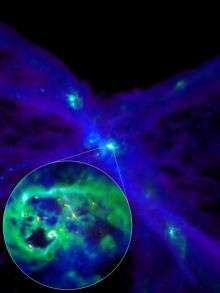
It is a picture of a dwarf galaxy forming one billion years after the Big Bang. The background image shows the large-scale cosmic context (the panel is approximately 100,000 light years across); the inset shows the central 2,000 light years of the dwarf galaxy where powerful feedback from newly born star clusters drives bulk motions in the gas. Stars are shown in yellow; colours from violet to blue to green to white correspond to gas of increasing density. Credit: S. Mashchenko, J. Wadsley, and H. M. P. Couchman

Researchers using supercomputer simulations have exposed a very violent and critical relationship between interstellar gas and dark matter when galaxies are born – one that has been largely ignored by the current model of how the universe evolved.

The findings, published today in Science, solve a longstanding problem of the widely accepted model – Cold Dark Matter cosmology – which suggests there is much more dark matter in the central regions of galaxies than actual scientific observations suggest.

“This standard model has been hugely successful on the largest of scales—those above a few million light-years—but suffers from several persistent difficulties in predicting the internal properties of galaxies,” says Sergey Mashchenko, research associate in the Department of Physics & Astronomy at McMaster University. “One of the most troublesome issues concerns the mysterious dark matter that dominates the mass of most galaxies.”

Supercomputer cosmological simulations prove that indeed, this problem can be resolved. Researchers modeled the formation of a dwarf galaxy to illustrate the very violent processes galaxies suffer at their births, a process in which dense gas clouds in the galaxy form massive stars, which, at the ends of their lives, blow up as supernovae.

“These huge explosions push the interstellar gas clouds back and forth in the centre of the galaxy,” says Mashchenko, the lead author of the study. “Our high-resolution model did extremely accurate simulations, showing that this ‘sloshing’ effect – similar to water in a bathtub— kicks most of the dark matter out of the centre of the galaxy.”

Cosmologists have largely discounted the role interstellar gas has played in the formation of galaxies and this new research, says Mashchenko, will force scientists to think in new terms and could lead to a better understanding of dark matter.

The simulations reported in the research paper were carried out on the Shared Hierarchical Academic Research Computing Network (SHARCNET).

Source: McMaster University

Explore further: As chaos celebrates its 50th birthday, biophysicist develops a new method to visualize it

add to favorites email to friend print save as pdf

Related Stories

'Space warps' project needs your help

May 08, 2013

(Phys.org) —Astronomers are asking volunteers to help them search for "space warps." More commonly known as "gravitational lenses," these are rare systems with very massive galaxies or clusters of galaxies that bend light ...

Upgrade of LHC underway paving way for new discoveries

Apr 04, 2013

(Phys.org) —The Large Hadron Collider (LHC) has been shut down so that it can be upgraded, a process that is expected to take at least two years. Researchers on the project hope the upgrade will allow the ...

Basic science in evaporating droplets

Apr 18, 2013

What happens if you slowly evaporate a droplet containing dissolved particles? The question sounds simple, but it involves a surprising amount of basic physics and mathematics. Hanneke Gelderblom of the University ...

Recommended for you

Engineers pioneer flat spray-on optical lens

53 minutes ago

A University of British Columbia engineer and a team of U.S. researchers have made a breakthrough utilizing spray-on technology that could revolutionize the way optical lenses are made and used.

How do cold ions slide

3 hours ago

Things not always run smoothly. It may happen, actually, that when an object slides on another, the advancement may occur through a 'stop and go' series in the characteristic manner which scientists call ...

User comments : 2

Adjust slider to filter visible comments by rank

Display comments: newest first

seanpu
not rated yet Nov 30, 2007
gas gas gas, all they see is gas! Where's all the plasma gone?
quantum_flux
not rated yet Nov 30, 2007
plasma and gas are sometimes used interchangeably in astronomy. This is exciting.

More news stories

Engineers pioneer flat spray-on optical lens

A University of British Columbia engineer and a team of U.S. researchers have made a breakthrough utilizing spray-on technology that could revolutionize the way optical lenses are made and used.

Researchers forward quest for quantum computing

Research teams from UW-Milwaukee and the University of York investigating the properties of ultra-thin films of new materials are helping bring quantum computing one step closer to reality.

How do cold ions slide

Things not always run smoothly. It may happen, actually, that when an object slides on another, the advancement may occur through a 'stop and go' series in the characteristic manner which scientists call ...

Major human drug trial underway for Alzheimer's

A potentially ground-breaking human drug trial is currently underway, which aims to discover whether blood pressure medication can slow or halt the progression of Alzheimer's Disease (AD). This is the latest ...

Chemists find new compounds to curb staph infection

(Phys.org) —In an age when microbial pathogens are growing increasingly resistant to the conventional antibiotics used to tamp down infection, a team of Wisconsin scientists has synthesized a potent new ...