Researchers present new solution for miniaturized organic lasers
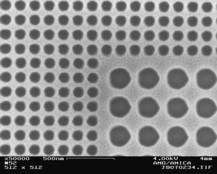
AMO GmbH, Aachen and IBM Research GmbH, Rüschlikon were able to realize and characterize optimized photonic feedback structures for miniaturized organic lasers.
Efficient organic lasers with small footprint structures demonstrate the key components of future integrated photonic devices for both, communication and sensing applications. Furthermore, they offer an attractive packaging possibility for light-emitting arrays coupled to high-density optical interconnects.
AMO, IBM and the University of Wuppertal investigated mixed-order two dimensional photonic crystal laser structures in combination with a high-gain organic polymer in terms of lasing threshold and device footprints. Based on a thin film of high-index tantalum pentoxide (Ta2O5), mixed-order structures were identified as superior compared to second-order structures. By combining first-order and second-order photonic crystal structures, losses occurring at the edge of the second order structure could be reduced dramatically, leading to a lower laser threshold and to a much smaller footprint of the laser.
Owing to their excellent optical properties and their huge potential for display, sensing, and solar-cell applications, organic semiconductor materials have attracted increasing interest in recent years. These materials exhibit low lasing thresholds and a spectrally broad gain enabling the emission wavelength to be tuned across the entire visible spectrum.
The research activities of the project partners are based on the 6 FP project OLAS (Organic electrically pumped LASer by engineering of heterojunctions in field-effect devices). The project aims at achieving foundational research on Organic Electrically Pumped Laser.
First results have been published in Applied Physics Letters.
Citation: Kristian Baumann, “Organic mixed-order photonic crystal lasers with ultrasmall footprint”, Applied Physics Letters 91, 2007.
Source: AMO GmbH


