Micro Microwave Does Pinpoint Cooking for Miniaturized Labs
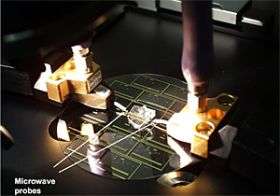
Photograph of the NIST micro microwave oven. The gold traces on the glass circle are microwave transmission lines. The 1.25 cm wide polymer block over the transmission line in the center houses a miniature chamber in which a pinhead-sized drop of fluid is heated. Credit: NIST
Researchers at the National Institute of Standards and Technology and George Mason University have demonstrated what is probably the world’s smallest microwave oven, a tiny mechanism that can heat a pinhead-sized drop of liquid inside a container slightly shorter than an ant and half as wide as a single hair. The micro microwave is intended for lab-on-a-chip devices that perform rapid, complex chemical analyses on tiny samples.
In a paper in the November 2007 Journal of Micromechanics and Microengineering, the research team led by NIST engineer Michael Gaitan describes for the first time how a tiny dielectric microwave heater can be successfully integrated with a microfluidic channel to control selectively and precisely the temperature of fluid volumes ranging from a few microliters to sub-nanoliters.
Sample heating is an essential step in a wide range of analytic techniques that could be built into microfluidic devices, including the high-efficiency polymerase chain reaction (PCR) process that rapidly amplifies tiny samples of DNA for forensic work, and methods to break cells open to release their contents for study.
The team embedded a thin-film microwave transmission line between a glass substrate and a polymer block to create its micro microwave oven. A trapezoidal-shaped cut in the polymer block only 7 micrometers across at its narrowest—the diameter of a red blood cell—and nearly 4 millimeters long (approximately the length of an ant) serves as the chamber for the fluid to be heated.
Based on classical theory of how microwave energy is absorbed by fluids, the research team developed a model to explain how their minature oven would work. They predicted that electromagnetic fields localized in the gap would directly heat the fluid in a selected portion of the micro channel while leaving the surrounding area unaffected.
Measurements of the microwaves produced by the system and their effect on the fluid temperature in the micro channel validated the model by showing that the increase in temperature of the fluid was predominantly due to the absorbed microwave power.
Once the new technology is more refined, the researchers hope to use it to design a microfluidic microwave heater that can cycle temperatures rapidly and efficiently for a host of applications.
The work is supported by the Office of Science and Technology at the Department of Justice’s National Institute of Justice.
Citation: J.J. Shah, S.G. Sundaresan, J. Geist, D.R. Reyes, J.C. Booth, M.V. Rao and M. Gaitan. Microwave dielectric heating of fluids in an integrated microfluidic device. Journal of Micromechanics and Microengineering, 17: 2224-2230 (2007)
Source: NIST
-
From lemons to lemonade: Reaction uses carbon dioxide to make carbon-based semiconductor,
33 comments
-
Thioridazine kills cancer stem cells in human while avoiding toxic side-effects of conventional cancer treatments,
3 comments
-
SpaceX private rocket blasts off for space station (Update),
42 comments
-
Landmark calculation clears the way to answering how matter is formed,
55 comments
-
Research team claims to have found evidence Lake Cheko is impact crater for Tunguska Event,
18 comments
-
Global temperature anomaly and photosynthesis.
31 minutes ago
-
Is the Strong Force causing any of the effects of a Black Hole?
34 minutes ago
-
Question about the Normal Force
38 minutes ago
-
Help Solving Gravitational Constant Equation
1 hour ago
-
How to isolate the mass?
2 hours ago
-
Why does a boiled egg rotates while a raw egg doesn't?
7 hours ago
- More from Physics Forums - General Physics
More news stories
Is a classical electrodynamics law incompatible with special relativity?
(Phys.org) -- The laws of classical electromagnetism that were developed in the 19th century are the same laws that scientists use today. They include Maxwell’s four equations along with the Lorentz la ...
Landmark calculation clears the way to answering how matter is formed
(Phys.org) -- An international collaboration of scientists, including Thomas Blum, associate professor of physics, is reporting in landmark detail the decay process of a subatomic particle called a kaon ...
May 25, 2012 |
4.3 / 5 (24) |
55
|
Lying in wait for WIMPs: Researchers seek to dramatically increase sensitivity of Large Underground Xenon detector
Although it's invisible, dark matter accounts for at least 80 percent of the matter in the universe. No one knows what it is, but most scientists would bet on weakly interacting massive particles, or WIMPs.
May 23, 2012 |
4 / 5 (7) |
19
|
Hawaii lab turns laser-powered bubbles into microrobots
(Phys.org) -- A team of scientists from the University of Hawaii are working on microrobots created from bubbles of air in a saline solution. The bubbles take on their title of robots as a laser ...
Sound increases the efficiency of boiling
Scientists at the Georgia Institute of Technology achieved a 17-percent increase in boiling efficiency by using an acoustic field to enhance heat transfer. The acoustic field does this by efficiently removing vapor bubbles ...
May 24, 2012 |
5 / 5 (2) |
2
Stunning image of smallest possible five-ringed structure
Scientists have created and imaged the smallest possible five-ringed structure about 100,000 times thinner than a human hair and you'll probably recognise its shape.
'Unzipped' carbon nanotubes could help energize fuel cells, batteries
Multi-walled carbon nanotubes riddled with defects and impurities on the outside could replace some of the expensive platinum catalysts used in fuel cells and metal-air batteries, according to scientists at ...
Change in developmental timing was crucial in the evolutionary shift from dinosaurs to birds: study
At first glance, it's hard to see how a common house sparrow and a Tyrannosaurus Rex might have anything in common. After all, one is a bird that weighs less than an ounce, and the other is a dinosaur that ...
Computer model used to pinpoint prime materials for efficient carbon capture
When power plants begin capturing their carbon emissions to reduce greenhouse gases and to most in the electric power industry, it's a question of when, not if it will be an expensive undertaking.
T cells 'hunt' parasites like animal predators seek prey, study shows
By pairing an intimate knowledge of immune-system function with a deep understanding of statistical physics, a cross-disciplinary team at the University of Pennsylvania has arrived at a surprising finding: T cells use a movement ...
Yale study concludes public apathy over climate change unrelated to science literacy
Are members of the public divided about climate change because they don't understand the science behind it? If Americans knew more basic science and were more proficient in technical reasoning, would public consensus match ...