Engineers Teach Nature to 'Grow' Computer Components
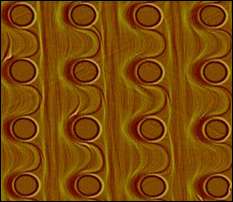
Credit: Clark School of Engineering
Computers don't grow on trees, but with a little prodding from engineers, nature can produce computer components.
At the University of Maryland's A. James Clark School of Engineering, Ray Phaneuf, associate professor of materials science and engineering, has developed a template that nature can follow to produce "self-assembling" structures. The template causes atoms to be arranged in a defined pattern that can serve a variety of purposes - a semiconductor in a laptop, a component in a cell phone or a sensor in a wearable device.
The idea of self-assembly in nature has long been known - crystallization is one such process; the formation of shells into spirals is another. However, researchers have been limited to the designs that nature already knows how to make. Phaneuf's work introduces a man-made template that nature then follows, addressing a number of manufacturing difficulties.
While we understand how to make working nanoscale devices, making things out of a countable number of atoms takes a long time," Phaneuf said. "Industry needs to be able to mass-produce them on a practical time scale."
The template process can be used by device manufacturers to mass-produce tiny components rapidly and efficiently, reduce costs, shrink device sizes, and improve devices' functionality in ways previously not possible.
"The same template can be used thousands of times," Phaneuf said. "This results in enormous savings."
Phaneuf says his work is one step in a "cocktail" approach to computer assembly - an engineer's dream in which one could "mix-up" a computer the same way one mixes a drink.
"Imagine you shake up a cocktail and spill it onto a table," Phaneuf said. "The liquid will collect in pools in a manner designated by nature.
"Now imagine that first you coated the table with wax and scraped a pattern into it. Now when you spill the liquid onto the table, it collects in the pattern you scraped into the wax - it assumes the form you want it to take. When we apply this idea to manufacturing nanoscale computer components, collections of atoms become ordered, accessible, controllable and reproducible - characteristics crucial to their use in high-tech devices."
These devices could include those used in the growing field of quantum computing, which is believed to hold promise for tasks requiring massive computing power such as carrying out exceptionally difficult mathematical processes, Phaneuf said. An application of the templates might be self-assembly of coupled quantum dots to form "qubits," the building blocks of quantum computers. According to Phaneuf, templating could be used to make the manufacture of this highly complicated system more feasible: "Addressing individual qubits might be done optically, to get around the problem of trying to wire them all up."
Phaneuf's work focuses on silicon and gallium arsenide components. Silicon is the prevalent material for components in computers while gallium arsenide is used more often in cell phones.
The templates are created using photolithography (a process akin to photography, in which the template is chemically developed after being exposed to light) and etching, or by "nanoscraping," in which an atomic force microscope is used to selectively scrape the pattern into the template.
Source: University of Maryland
-
New nanostructure for batteries keeps going and going,
28 comments
-
Penn astrophysicists zero in on gravity theory,
202 comments
-
Engineer thinks we could build a real starship enterprise in 20 years,
49 comments
-
Sugar makes you stupid: Study shows high-fructose diet sabotages learning, memory,
13 comments
-
Brain oscillations reveal that our senses do not experience the world continuously,
10 comments
-
magnetic moment of a bar magnet
2 hours ago
-
Nuclear Physics - Difference between electron capture and beta plus decay
2 hours ago
-
A question on Coulomb's Law
4 hours ago
-
Can I see sea-level sunset if something lower than me is blocking my sight?
8 hours ago
-
The point in the D and H fields
8 hours ago
-
Negative index of refraction with anisotropy, quick question
9 hours ago
- More from Physics Forums - General Physics
More news stories
Full control of plastic transistors
In an article in the highly ranked interdisciplinary journal PNAS, Loïg Kergoat, a researcher at Linköping University, describes how transistors made of plastic can be controlled with great precision.
5 hours ago |
5 / 5 (1) |
0
New nanostructure for batteries keeps going and going
(Phys.org) -- For more than a decade, scientists have tried to improve lithium-based batteries by replacing the graphite in one terminal with silicon, which can store 10 times more charge. But after just a ...
May 11, 2012 |
4.8 / 5 (62) |
28
|
Research group creates highly sensitive photodetector from graphene and quantum dots
(Phys.org) -- Researchers in Spain have succeeded in building a photodetector that is a billion times more sensitive than other such detectors based on graphene and could herald the use of graphene based light ...
Ultrasensitive biosensor promising for medical diagnostics
(Phys.org) -- Researchers have created an ultrasensitive biosensor that could open up new opportunities for early detection of cancer and "personalized medicine" tailored to the specific biochemistry of individual ...
May 15, 2012 |
5 / 5 (1) |
0
|
Researchers generate electricity from viruses
Imagine charging your phone as you walk, thanks to a paper-thin generator embedded in the sole of your shoe. This futuristic scenario is now a little closer to reality. Scientists from the U.S. Department of Energy's Lawrence ...
Nanotechnology / Bio & Medicine
May 13, 2012 |
5 / 5 (10) |
1
|
IPhone to get larger screen: A report to take with a grain of salt?
Apple has begun preparing to launch an iPhone with a larger screen than its previous models, according to a report in the Wall Street Journal.
Healthy eating can cost less, study finds
Is it really more expensive to eat healthy? An Agriculture Department study released Wednesday found that most fruits, vegetables and other healthy foods cost less than foods high in fat, sugar and salt.
"Social Network" writer to pen Steve Jobs film script
Sony Pictures Entertainment on Wednesday said that the Academy Award winning screenwriter behind "The Social Network" will write the script for a film about Apple co-founder Steve Jobs.
NY tech fest heralds Silicon Valley of the East
The Big Apple may not have California's weather, but tech fans at New York Internet Week say that in every other way the city is on course to become Silicon Valley 2.0.
How do consumers achieve self-affirmation when purchasing products?
People who feel good about themselves are less likely to choose an attractive product than a functional one, according to a new study in the Journal of Consumer Research. But choosing highly aesthetic products may make p ...
Why do consumers dislike corporate brands that get too familiar?
Although it is tempting to use the word "we" to make consumers feel like part of the family, people react negatively when brands overstep their boundaries, according to a new study in the Journal of Consumer Research.