Scientists Create Quantum Cascade Laser Nanoantenna
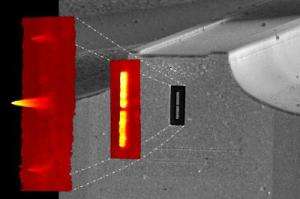
In a major feat of nanotechnology engineering researchers from Harvard University have demonstrated a laser with a wide-range of potential applications in chemistry, biology and medicine. Called a quantum cascade (QC) laser nanoantenna, the device is capable of resolving the chemical composition of samples, such as the interior of a cell, with unprecedented detail.
Spearheaded by graduate students Nanfang Yu, Ertugrul Cubukcu, and Federico Capasso, Robert L. Wallace Professor of Applied Physics, all of Harvard's School of Engineering and Applied Sciences, the findings will be published as a cover feature of the October 22 issue of Applied Physics Letters. The researchers have also filed for U.S. patents covering this new class of photonic devices.
The laser's design consists of two gold rods separated by a nanometer gap (a device known as an optical antenna) built on the facet of a quantum cascade laser, which emits invisible light in the region of the spectrum where most molecules have their tell tale absorption fingerprints. The nanoantenna creates a light spot of nanometric size about fifty to hundred times smaller than the laser wavelength; the spot can be scanned across a specimen to provide chemical images of the surface with superior spatial resolution.
"There's currently a major push to develop powerful tabletop microscopes with spatial resolution much smaller than the wavelength that can provide images of materials, and in particular biological specimens, with chemical information on a nanometric scale," says Federico Capasso.
While infrared microscopes, based on the detection of molecular absorption fingerprints, are commercially available and widely used to map the chemical composition of materials, their spatial resolution is limited by the range of available light sources and optics to well above the wavelength. Likewise the so-called near field infrared microscopes, which rely on an ultra sharp metallic tip scanned across the sample surface at nanometric distances, can provide ultrahigh spatial resolution but applications are so far strongly limited by the use of bulky lasers with very limited tunability and wavelength coverage.
"By combining Quantum Cascade Lasers with optical antenna nanotechnology we have created for the first time an extremely compact device that will enable the realization of new ultrahigh spatial resolution microscopes for chemical imaging on a nanometric scale of a wide range of materials and biological specimens," says Capasso.
Quantum cascade (QC) lasers were invented and first demonstrated by Capasso and his group at Bell Labs in 1994. These compact millimeter length semiconductor lasers, which are now commercially available, are made by stacking nanometer thick layers of semiconductor materials on top of each other. By varying the thickness of the layers one can select the wavelength of the QC laser across essentially the entire infrared spectrum where molecules absorb, thus custom designing it for a specific application.
In addition by suitable design the wavelength of a particular QCL can be made widely tunable. The range of applications of QC laser based chemical sensors is very broad, including pollution monitoring, chemical sensing, medical diagnostics such as breath analysis, and homeland security.
Source: Harvard University


