Focus images instantly with Adobe’s computational photography
Oct 09, 2007 by Lisa Zyga weblog
Adobe 3D Lens
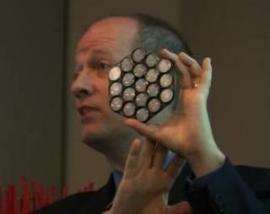
Dave Story demonstrates the only prototype of Adobe´s 3D camera lens, part of the company´s newest computational photography technique. (Image credit: Audioblog.fr)

Adobe has recently unveiled some novel photo editing abilities with a new technology known as computational photography. With a combination of a special lens and computer software, the technique can divide up a camera image in different views and reassemble them with a computer.

The method uses a lens embedded with 19 smaller lenses and prisms, like an insect’s compound eye, to capture a scene from different angles at the same time. As Dave Story, Vice President of Digital Imaging Product Development at Adobe, explained, this lens can determine the depth of every pixel in the scene.

This means that, after the photo is taken and transferred to a computer, people can edit certain layers of the photo within seconds. If a user wants to eliminate the background, the new software can simply erase everything in the image that appears at or beyond a certain distance.

Further, people can use a 3D focus brush to “reach into the scene and adjust the focus,” Story explained during a news conference, in a video posted by Audioblog.fr. At the conference, he uses the focus brush to bring a blurry statue in the foreground of an image into focus simply by dragging the tool over the area on the image. Alternatively, he switched to a de-focus brush to bring a second statue located further back in the image out of focus.

“This is something you cannot due with a physical camera,” he said. “There’s no way to take a picture with just this section in focus and everything else out of focus. It’s not physically possible to make a camera that does that. But with a combination of that lens and your digital dark room, you have what we call computational photography. Computational photography is the future of photography.”

Knowing the 3D nature of every pixel also enables people to view photos from different angles after they are taken, which Story demonstrated. Months after a photo is snapped, people can “move the camera” as if traveling through a scene in Google Earth. Story suggested that this ability would be useful if background objects were accidentally aligned in undesirable positions, such as a lamp post appearing to stick straight out of a person’s head. In that case, you could rotate the image slightly to one side, in order to view the scene from a different angle.

“We can do things that people now have to do manually, much more easily,” Story said. “But we can also use computational photography to allow you to accomplish physically impossible results.”

Audioblog.fr via CNet

Explore further: Drones may violate international law

add to favorites email to friend print save as pdf

Related Stories

Landslides and lava flows at Olympus Mons on Mars

May 03, 2013

(Phys.org) —Giant landslides, lava flows and tectonic forces are behind this dynamic scene captured recently by ESA's Mars Express of a region scarred by the Solar System's largest volcano, Olympus Mons.

Your next phone camera might be able to sense depth

Apr 12, 2013

The camera in your smartphone may soon have a new trick: depth perception. Toshiba, Samsung and Silicon Valley startup Pelican Imaging are developing image sensors and software that would allow cameras to detect the distance ...

Recommended for you

Drones may violate international law

May 24, 2013

(Phys.org) —As President Obama gives a speech on national security—including defending U.S. use of drones to combat terrorism—Leila Sadat, JD, international law expert and professor of law at Washington University in ...

Text in on smarter phones

May 22, 2013

Alternative input methods for smart phones, such as Swype and SwiftKey, offer substantial benefits to users and are comparable with common typing speeds found on computer keyboards, according to a report published by researchers ...

AP probe further strains Obama, press rapport

May 20, 2013

Reports emerged last week that the Department of Justice had secretly obtained two months' worth of phone records of journalists at The Associated Press as part of a larger investigation into a failed al-Qaida ...

User comments : 3

Adjust slider to filter visible comments by rank

Display comments: newest first

KB6
3.7 / 5 (3) Oct 09, 2007
With all that extra data I'm wondering how much bigger those files would be in your camera.
Would they be 19x bigger (an image for each lens) making your SD card, memory stick, etc. effectively 19x smaller?
SLam_to
4.5 / 5 (2) Oct 09, 2007
The files will probably be the same size as your camera normally produces, but lower resolution.

The concept sounds similar to a plenoptic camera.
http://graphics.s...lfcamera
Ragtime
3 / 5 (2) Oct 09, 2007
The concept sounds similar to a mushfly eye.

More news stories

Yahoo, pay-TV operators among Hulu bidders

Online video site Hulu is again up for sale, with Yahoo and pay TV operators DirecTV and Time Warner Cable among the seven bidders, according to a person with direct knowledge of the matter.

Radiation leak at Japan lab; small impact expected

An atomic research lab in northern Japan has reported a radiation leak that may have affected about 50 people, though none were hospitalized and no impact was expected outside the facility, the lab's operator ...

Google eyes emerging markets networks

Google has become deeply involved in a series of projects to build and operate wireless networks in emerging markets including sub-Saharan Africa and Southeast Asia, a report said Friday.

Facial-recognition technology proves its mettle

(Phys.org) —In a study that evaluated some of the latest in automatic facial recognition technology, researchers at Michigan State University were able to quickly identify one of the Boston Marathon bombing ...

Galaxies fed by funnels of fuel

(Phys.org) —Computer simulations of galaxies growing over billions of years have revealed a likely scenario for how they feed: a cosmic version of swirly straws.