Menace in a bottle: Detecting liquid explosives
October 2, 2007

Liquids and Gels

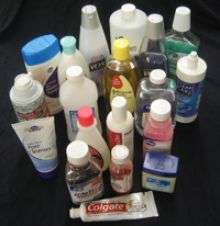
The DHS Science & Technology Directorate's SENSIT research will detect liquids and gels such as these. Credit: DHS

After the plot to blow up trans-Atlantic airlines with liquid explosives was uncovered in London in August 2006, there has been pressure on the airline industry, and Homeland Security, to find new ways to not only detect liquids in baggage and on airline passengers, but also to figure out what they are. Now, the DHS Science & Technology Directorate (S&T) is teaming with scientists at the Los Alamos National Laboratory to find a possible solution.

“Having to place your consumable liquids through the baggy routine when going through airport security may one day be history,” says S&T Program Manager on the project, Mr. Brian Tait, “and that’s going to make a lot of people very happy. This is a new screening prototype that definitely shows promise.”

In late June, Los Alamos National Laboratory team successfully completed proof of concept of an extremely sensitive future screening technology. The new technology scans the magnetic changes of individual materials at the molecular level and stores them in a database, which then allows the differentiation and identification of many materials that may be packaged together or separately as they go through the screening process.

It uses the same technology that brain scans are performed with, and is based on ultra-low field magnetic resonance imaging (MRI) which is already being used in medical field for advanced brain imaging. The end goal is to eventually put it next to the current x-ray screener.

The SENSIT technology has already demonstrated the ability to differentiate more than four dozen materials considered “safe” for carrying onto aircraft –from everyday personal items like toothpaste to mouth wash – to those that are considered hazardous .

“With the MRI signal, we want to distinguish between harmful items, and many common carry-on liquid consumables,” says Tait. “The goal is reliable detection of liquids, with high throughput, that is non-contact, non-invasive, requires no radiation, produces no residue and uses the existing airport security portal.”

SENSIT is one of S&T’s Homeland Innovation Prototypes (HIPS) projects – high-impact innovative technologies that have shown great promise and are on their way to being transitioned to industry for manufacturing and distribution.

"We're working hard on getting the SENSIT technology to an airport near you very soon," says S&T's Innovation Director, Roger McGinnis.

Source: US Department of Homeland Security

4.5 /5 (2 votes)  

Rank 4.5 /5 (2 votes)
Tags

Relevant PhysicsForums posts

More news stories

Browser wars flare in mobile space

The browser wars are heating up again, but this time the fight is for dominance of the mobile Internet.

Technology / Software

created 19 hours ago | popularity 4 / 5 (4) | comments 3

Probability of contamination from severe nuclear reactor accidents is higher than expected: study

Catastrophic nuclear accidents such as the core meltdowns in Chernobyl and Fukushima are more likely to happen than previously assumed. Based on the operating hours of all civil nuclear reactors and the number ...

Technology / Energy & Green Tech

created May 22, 2012 | popularity 3.6 / 5 (25) | comments 56 | with audio podcast

HyperSolar shows dirty water no barrier to power world

(Phys.org) -- The Santa Barbara, California, company, HyperSolar, is set to transparently share the ups and downs of its research experiences toward the company’s ultimate vision, successfully producing ...

Technology / Energy & Green Tech

created May 24, 2012 | popularity 4.8 / 5 (16) | comments 17 | with audio podcast report

Tesla to launch electric sedan in US on June 22

Tesla Motors said Tuesday it would begin deliveries of "the world's first premium electric sedan" on June 22, slightly ahead of schedule.

Technology / Energy & Green Tech

created May 22, 2012 | popularity 4.5 / 5 (12) | comments 18

SpotterRF debuts Radar Backpack Kit (w/ Video)

(Phys.org) -- SpotterRF has announced a special radar backpack kit designed to enhance situational awareness for soldiers on the ground. The company says its special radar is designed for warfighters as part ...

Technology / Hi Tech & Innovation

created May 26, 2012 | popularity 5 / 5 (5) | comments 13 | with audio podcast report


Stunning image of smallest possible five-ringed structure

Scientists have created and imaged the smallest possible five-ringed structure – about 100,000 times thinner than a human hair – and you'll probably recognise its shape.

'Unzipped' carbon nanotubes could help energize fuel cells, batteries

Multi-walled carbon nanotubes riddled with defects and impurities on the outside could replace some of the expensive platinum catalysts used in fuel cells and metal-air batteries, according to scientists at ...

Change in developmental timing was crucial in the evolutionary shift from dinosaurs to birds: study

At first glance, it's hard to see how a common house sparrow and a Tyrannosaurus Rex might have anything in common. After all, one is a bird that weighs less than an ounce, and the other is a dinosaur that ...

Computer model used to pinpoint prime materials for efficient carbon capture

When power plants begin capturing their carbon emissions to reduce greenhouse gases – and to most in the electric power industry, it's a question of when, not if – it will be an expensive undertaking.

T cells 'hunt' parasites like animal predators seek prey, study shows

By pairing an intimate knowledge of immune-system function with a deep understanding of statistical physics, a cross-disciplinary team at the University of Pennsylvania has arrived at a surprising finding: T cells use a movement ...

Yale study concludes public apathy over climate change unrelated to science literacy

Are members of the public divided about climate change because they don't understand the science behind it? If Americans knew more basic science and were more proficient in technical reasoning, would public consensus match ...