Saturn's moon Iapetus is the yin-yang of the solar system
Sep 13, 2007
Saturn's moon Iapetus is the yin-yang of the solar system
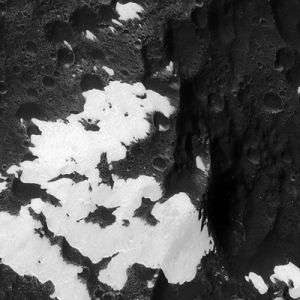
Cassini zooms in, for the first time, on the patchy, bright and dark mountains on Saturn's two-toned moon, Iapetus. The mountains were originally identified in images from the NASA Voyager spacecraft taken more than 25 years earlier. The image was acquired during Cassini's only close flyby of Iapetus. The terrain seen here is located on the equator of Iapetus at approximately 199° West, in the transition region between the moon's bright and dark hemispheres. North is up in the image. The image was taken on 10 September 2007, with Cassini's narrow-angle camera at a distance of approximately 9240 km from Iapetus. Image scale is 55 m per pixel. Credits: NASA/ JPL/ Space Science Institute

Cassini scientists are poring through hundreds of images returned from the 10 September fly-by of Saturn's two-toned moon Iapetus.

The pictures show the moon's yin and yang - a white hemisphere resembling snow, and the other as black as tar.

Images returned late Tuesday and early Wednesday show a surface that is heavily cratered, along with the mountain ridge that runs along the moon's equator. Many of the close-up observations focused on studying the strange 20-km high mountain ridge that gives the moon a walnut-shaped appearance.

"The images are really stunning," said Tilmann Denk, Cassini imaging scientist at the Free University in Berlin, Germany, who was responsible for the imaging observation planning. "Every new picture contained its own charm. I was most pleased about the images showing huge mountains rising over the horizon. I knew about this scenic viewing opportunity for more than seven years, and now the real images have suddenly materialised."

This flyby was nearly 100 times closer to Iapetus than Cassini's 2004 flyby, bringing the spacecraft to about 1640 km from the surface. The moon's irregular walnut shape, the mountain ridge that lies almost directly on the equator and Iapetus’ brightness contrast are among the key mysteries scientists are trying to solve.

"There is never a dull moment on this mission," said Bob Mitchell, Cassini programme manager, NASA's Jet Propulsion Laboratory, USA. "We are very excited about the stunning images being returned. There is plenty here to keep many scientists busy for many years."

"Our flight over the surface of Iapetus was like a non-stop free fall, down the rabbit hole, directly into Wonderland! Very few places in our solar system are more bizarre than the patchwork of pitch dark and snowy bright we have seen on this moon," said Carolyn Porco, Cassini imaging team leader at the Space Science Institute, USA.

The return of images and other data was delayed early Tuesday due to a galactic cosmic ray hit which put the spacecraft into the so-called safe mode. This occurred after the spacecraft had placed all of the flyby data on its data recorders and during the first few minutes after it began sending the data home. The data flow resumed later that day and concluded on Wednesday. The spacecraft is operating normally and its instruments are expected to return to normal operations in a few days.

"Iapetus provides us with a window back in time, to the formation of the planets over four billion years ago. Since then its icy crust has been cold and stiff, preserving this ancient surface for our study," said Torrence Johnson, Cassini imaging team member at JPL.

Cassini's multiple observations of Iapetus will help to characterise the chemical composition of the surface; look for evidence of a faint atmosphere or erupting gas plumes; and map the night-time temperature of the surface. These and other results will be analysed in the weeks to come.

Source: European Space Agency

Explore further: NASA's STEREO detects a CME from the sun

add to favorites email to friend print save as pdf

Related Stories

Collision course? A comet heads for Mars

Mar 28, 2013

Over the years, the spacefaring nations of Earth have sent dozens of probes and rovers to explore Mars. Today there are three active satellites circling the red planet while two rovers, Opportunity and Curiosity, ...

MESSENGER sees a smoother side of Mercury

Mar 22, 2013

During its two years in orbit around Mercury—as well as several more years performing flybys—the MESSENGER spacecraft has taken over 150,000 images of the innermost planet, giving us a look at its incredibly ...

Cassini returns images of battered Saturn Moon

Mar 12, 2013

(Phys.org) —Following its last close flyby of Saturn's moon Rhea, NASA's Cassini spacecraft captured these raw, unprocessed images of the battered icy moon. They show an ancient, cratered surface bearing ...

Cassini makes last close flyby of Saturnian moon Rhea

Mar 08, 2013

(Phys.org) —NASA's Cassini spacecraft will be swooping close to Saturn's moon Rhea on Saturday, March 9, the last close flyby of Rhea in Cassini's mission. The primary purpose will be to probe the internal ...

Asteroid whizzes safely past Earth (Update)

Feb 15, 2013

A closely tracked asteroid, about 150-feet (45-meters) wide, whizzed safely past Earth on Friday, the same day a much smaller, previously undetected meteor hit Russia, injuring nearly 1,000 people.

Recommended for you

Mars rover Opportunity examines clay clues in rock

11 hours ago

(Phys.org) —NASA's senior Mars rover, Opportunity, is driving to a new study area after a dramatic finish to 20 months on "Cape York" with examination of a rock intensely altered by water.

NASA's STEREO detects a CME from the sun

May 17, 2013

On 5:24 a.m. EDT on May 17, 2013, the sun erupted with an Earth-directed coronal mass ejection or CME, a solar phenomenon that can send billions of tons of solar particles into space that can reach Earth ...

Nine-year-old Mars rover passes 40-year-old record

May 17, 2013

While Apollo 17 astronauts Eugene Cernan and Harrison Schmitt visited Earth's moon for three days in December 1972, they drove their mission's Lunar Roving Vehicle 19.3 nautical miles (22.210 statute miles ...

Bright explosion on the Moon

May 17, 2013

For the past 8 years, NASA astronomers have been monitoring the Moon for signs of explosions caused by meteoroids hitting the lunar surface. "Lunar meteor showers" have turned out to be more common than anyone ...

User comments : 0

More news stories

Galaxy's Ring of Fire

Johnny Cash may have preferred this galaxy's burning ring of fire to the one he sang about falling into in his popular song. The "starburst ring" seen at center in red and yellow hues is not the product of ...

Alaska volcano shoots ash 15,000 feet into the air

(AP)—One of Alaska's most restless volcanoes has shot an ash cloud 15,000 feet into the air in an ongoing eruption that has drawn attention from a nearby community but isn't expected to threaten air traffic.

Chinese, Indian airlines face EU pollution fines

Eight Chinese and two Indian airlines face fines of up to several million euros for not paying for their greenhouse gas emissions during flights within the bloc, the European Commission said on Friday.

US seizes Bitcoin operator accounts

US authorities seized the accounts of a Bitcoin digital currency exchange operator, claiming it was functioning as an "unlicensed money service business," court documents showed Friday.

Morocco to harness the wind in energy hunt

Morocco is ploughing ahead with a programme to boost wind energy production, particularly in the southern Tarfaya region, where Africa's largest wind farm is set to open in 2014.