Strong Evidence Points to Earth's Proximity to Sun as Ice Age Trigger
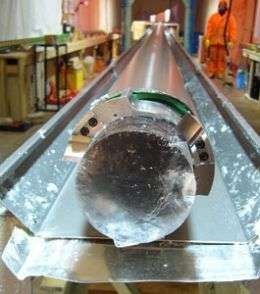
When do ice ages begin? In June, of course. Analysis of Antarctic ice cores led by Kenji Kawamura, a visiting scientist at Scripps Institution of Oceanography, UC San Diego, shows that the last four great ice age cycles began when Earth’s distance from the sun during its annual orbit became great enough to prevent summertime melts of glacial ice. The absence of those melts allowed buildups of the ice over periods of time that would become characterized as glacial periods.
Results of the study appear in the Aug. 23 edition of the journal Nature.
Jeff Severinghaus, a Scripps geoscientist and co-author of the paper, said the finding validates a theory formalized in the 1940s but first postulated in the 19th Century. The work also helps clarify the role of carbon dioxide in global warming and cooling episodes past and present, he said.
“This is a significant finding because people have been asking for 100 years the question of why are there ice ages,” Severinghaus said.
A premise advanced in the 1940s known as the Milankovitch theory, named after the Serbian geophysicist Milutin Milankovitch, proposed that ice ages start and end in connection with changes in summer insolation, or exposure to sunlight, in the high latitudes of the Northern Hemisphere. To test it, Kawamura used ice core samples taken thousands of miles to the south in Antarctica at a station known as Dome Fuji.
Scientists studying paleoclimate often use gases trapped in ice cores to reconstruct climatic conditions from hundreds of thousands of years in the past, digging thousands of meters deep into ice sheets. By measuring the ratio of oxygen and nitrogen in the cores, Kawamura’s team was able to show that the ice cores record how much sunlight fell on Antarctica in summers going back 360,000 years. The team’s method enabled the researchers to use precise astronomical calculations to compare the timing of climate change with sunshine intensity at any spot on the planet.
Kawamura, a former postdoctoral researcher at Scripps, used the oxygen-nitrogen ratio data to create a climate timeline that was used to validate the calculations Milankovitch had created decades earlier. The team found a correlation between ice age onsets and terminations, and variations in the season of Earth’s closest approach to the sun. Earth's closest pass, or perihelion, happens to fall in June about every 23,000 years. When the shape of Earth's orbit did not allow it to approach as closely to the sun in that month, the relatively cold summer on Earth encouraged the spread of ice sheets on the Northern Hemisphere's land surface. Periods in which Earth passed relatively close in Northern Hemisphere summer accelerated melt and brought an end to ice ages.
“When we start to come to the point of closest approach in June, that’s when the big ice melts off,” said Severinghaus.
Kawamura said the new timeline will serve as a guide that will allow researchers to test climate forecast models of the effects of carbon dioxide levels in the atmosphere. The team found that the changes in Earth’s orbit that terminate ice ages amplify their own effect on climate through a series of steps that leads to more carbon dioxide being released from the oceans into the air. This secondary effect, or feedback, has accounted for as much as 30 percent of the warming seen as ice ages of the past have come to an end.
“An important point is that climate models should be validated with the past climate so that we can better predict what will happen in the future with rising CO2 levels,” said Kawamura. “For that, my new timescale can distinguish the contribution to past climate change from insolation change and CO2.”
In addition to Kawamura and Severinghaus, authors of the report included Takakiyo Nakazawa, Shuji Aoki, Koji Matsumoto, and Hisakazu Nakata of Tohoku University, Sendai, Japan; Frederic Parrenin of Laboratoire de Glaciologie et Geophysique de l’Environment in Grenoble, France; Lorraine Lisiecki and Maureen Raymo of Boston University; Ryu Uemura, Hideaki Motoyama, Shuji Fujita, Kumiko Goto-Azuma, Yoshiyuki Fujii, and Okitsugu Watanabe of the National Institute of Polar Research in Tokyo, Japan; Manuel Hutterli of the British Antarctic Survey in Cambridge, England; and Francoise Vimeux and Jean Jouzel of Laboratoire des Sciences du Climat et de l’Environment in Gif-sur-Yvette, France.
Source: UCSD


