'Handy' Access to Restricted Areas
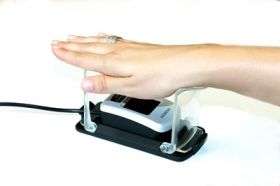
Siemens is expanding its range of biometric access authorization systems to include a hand-surface (palm) reader.
The solution is particularly useful for sterile hospital areas, as it does not require actual hand contact to identify an individual.
The latest version of Siemens’ ID Center biometric software also now supports the PalmSecure hand-surface reader produced by Fujitsu, as well as all major fingerprint scanners on the market and, of course, SmartCards, making it a uniquely versatile solution.
The market for access control systems is expected to grow to a volume of approximately $1 billion in Europe alone over the next four years from about 800 million, according to a study conducted by analysts at Frost & Sullivan. Biometric procedures will account for much of this growth. The palm reader, which was developed by biometric experts at Siemens IT Solutions and Services, supplements fingerprint-reading techniques that have been used for quite some time now.
The system is equipped with an infrared scanner that reads palms within seconds when a person’s hand is held at a distance of a few centimeters. The unit actually scans the pattern of veins under the skin, after which a computer compares the data with stored palm samples, granting access to restricted areas in the event of an exact match. The system is generally used in conjunction with a SmartCard, which can also be read without any contact by an RFID unit, for example.
Unlike fingerprint reading techniques, which require the finger to be pressed onto, or dragged across, a special surface, the reliability of the palm reader is not affected by dirt or skin injuries. The system can even "see through" gloves such as those worn in sterile hospital areas, which makes it easy for doctors to be granted quick access to operating rooms. The solution is also suitable for use at automated teller machines to improve hygiene.
Version 4.0 of the ID Center software is now being tested by selected customers and is expected to be launched on the market in September. The current version of the software is already being used by numerous private companies and public agencies.
Source: Siemens


