Nanoparticles hitchhike on red blood cells: a potential new method for drug delivery
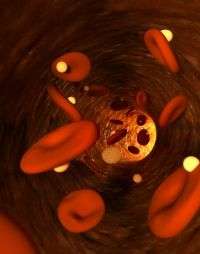
Researchers at the University of California, Santa Barbara have discovered that attaching polymeric nanoparticles to the surface of red blood cells dramatically increases the in vivo lifetime of the nanoparticles. The research, published in the July 07 issue of Experimental Biology and Medicine, could offer applications for the delivery of drugs and circulating bioreactors.
Polymeric nanoparticles are excellent carriers for delivering drugs. They protect drugs from degradation until they reach their target and provide sustained release of drugs. Polymeric nanoparticles, however, suffer from one major limitation: they are quickly removed from the blood, sometimes in minutes, rendering them ineffective in delivering drugs.
The research team, led by Samir Mitragotri, a professor of chemical engineering, and Elizabeth Chambers, a recent doctoral graduate, found that nanoparticles can be forced to remain in the circulation when attached to red blood cells. The particles eventually detach from the blood cells due to shear forces and cell-to-cell interactions, and are cleared from the system by the liver and spleen. Red blood cell circulation is not affected by attaching the nanoparticles.
“Attachment of polymeric nanoparticles to red blood cells combines the advantages of the long circulating lifetime of the red blood cell, and their abundance, with the robustness of polymeric nanoparticles,” said Mitragotri. “Using red blood cells to extend the circulation time of the particles avoids the need to modify the surface chemistry of the entire particle, which offers the potential to attach chemicals to the exposed surface for targeting applications.”
The researchers have learned that particles adhered to red blood cells can escape phagocytosis because red blood cells have a knack for evading macrophages. Nanoparticles aren’t the first to be piggybacking on red blood cells; the strategy has already been adopted by certain bacteria, such as hemobartonella, that adhere to RBCs and can remain in circulation for several weeks.
The researchers say that it may be possible to keep the nanoparticles in circulation for a relatively long time, theoretically up to the circulation lifetime of a red blood cell – which is 120 days – if the binding between particles and the red blood cells is strengthened. The methodology is applicable to drugs that are effective while still attached to a red blood cell, although the researchers say that slow release from the red blood cell surface is also feasible.
Mitragotri says “this mode of prolonging particle circulation has significant implications in drug delivery, potentially leading to new treatments for a broad variety of conditions such as cancer, blood clots and heart disease”. Dr. Steven R. Goodman, Editor-in-Chief of the journal, said “this study dealing with the attachment of nanoparticles to red blood cells may also have important implications for future treatment of hematologic disorders. This fusion of modern nanobioscience with cell biology and hematology is precisely the type of interdisciplinary study that the new Experimental Biology and Medicine is interested in publishing.” Experimental Biology and Medicine is a journal dedicated to the publication of multidisciplinary and interdisciplinary research in the biomedical sciences.
Source: Society for Experimental Biology and Medicine


