June 11, 2007 feature
Professor proposes theory of unparticle physics
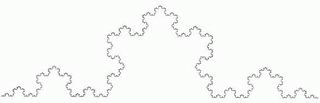
Howard Georgi, a physicist at Harvard University, has recently published a paper on so-called unparticle physics, which suggests the existence of “unparticle stuff” that cannot be accounted for by the standard model. Appearing in a recent edition of Physical Review Letters, the paper says that unparticle stuff would be very different than anything seen before.
Georgi, a highly regarded physicist well-known for his pioneering work in areas including supersymmetry, quantum chromodynamics, and grand unified theories, explains that the low-energy physics of nontrivial scale-invariance cannot be described in terms of particles. In this initial investigation of the idea, he gives a quantitative scenario of the production of unparticle stuff, and predicts how it could be experimentally detected in the upcoming Large Hadron Collider (LHC), the most powerful particle accelerator that will open in early 2008.
In scale-invariant theory—where objects don’t change when their dimensional qualities are multiplied by a rescaling parameter—the concept of particles doesn’t work because most particles have a definite nonzero mass. In quantum mechanics, this isn’t a problem because the standard model does not have scale-invariance. But Georgi suggests that there could be an undiscovered sector of the standard model that is exactly scale-invariant.
“I have been having a lot of fun with this,” Georgi told PhysOrg.com. “It is a phenomenon that has been understood mathematically for a long time, in the sense that we know of theories that have the peculiar property of scale-invariance. It is hard to describe this because it is so different from what we are used to. For us it makes a big difference whether we measure masses in grams or kilograms. But in a scale-invariant world, it makes no difference at all.”
Georgi explains that photons, which are particles of light, have the property of scale invariance because they have zero mass. Multiplying all the photon energies by a factor of 1000 would make them look exactly the same.
“Clever theorists (like Ken Wilson) showed long ago that there were crazier possibilities which do not involve particles with zero mass, but still have the property that energies can be multiplied by any factor to give a physically equivalent theory,” Georgi said. “[But] this is impossible if there are particles with any definite nonzero mass. That is why I called this ‘unparticle’ stuff.”
This scale-invariant sector would interact very weakly with the rest of the standard model, making it possible to observe evidence for unparticle stuff, if it exists. The unparticle theory is a high-energy theory that contains both standard model fields and “Banks-Zaks” fields (which has scale-invariance at an infrared point). The two fields can interact through the interactions of ordinary particles under high enough machine energy or a low enough mass scale.
“If all of the stuff that is scale-invariant couples to all the stuff that isn't in a way that gets weaker and weaker as the energy gets lower, then it could be that, at the energies we can probe today, we just don't see the unparticle stuff at all,” Georgi explained. “There could be a scale-invariant world separate from our own that is hidden from us at low energies because its interactions with us are so weak.”
These particle interactions would appear to have missing energy and momentum distributions. Georgi has calculated the peculiar distributions of missing energy for the decay of a top quark, which would signify the production of unparticle stuff.
“The very confusing question of ‘What does unparticle suff look like?’ gets replaced by a simpler question: ‘How does unparticle stuff begin to show up as the energy of our experiments is increased?’” he said.
He explained that a good way of understanding unparticle stuff is with neutrinos. Neutrinos have some properties in common with unparticle stuff. For example, neutrinos are nearly massless and therefore nearly scale invariant. They couple very weakly to ordinary matter at low energies, and the effect of the coupling increases as the energy increases.
“Very often, in a scattering experiment, we can infer the existence of neutrinos by adding up the energy and momentum of the colliding particles and subtracting the energy and momentum of all the particles we can see to get the energy and momentum of the ‘missing’ (which just means that we don’t see them because they escape our detectors without interacting) neutrinos,” he said. “By doing the scattering many times, we can measure a probability distribution for the missing energy and momentum. And by looking at the distribution, we can tell whether there is one or two or more neutrinos missing in the particular process we are studying.
“An interesting result of my analysis is that such a distribution for a process that produces unparticles looks like the distribution for a fractional number of massless particles,” he added. “This is weird, but it follows very simply from the scale invariance of the unparticles. It is the first glimmer of an answer to the question of how unparticles begin to show up.”
Because the signatures of unparticle stuff would be very distinct, LHC experiments have the potential to verify the existence of unparticle stuff immediately. Georgi says that, in his opinion, unparticle stuff would be a more striking discovery than supersymmetry or extra dimensions, both of which point to just more new particles. Unparticle stuff, on the other hand, would be a different concept altogether.
“I, and a number of other researchers, am now trying to push these ideas harder,” Georgi said. “Other weird properties of unparticles have already emerged. I expect more. It is great fun. Of course, it would be even greater fun if we actually saw stuff like this at the LHC. But even if we don’t, I believe that analyses like this are useful because they can shake us out of preconceptions that could cause us to miss important physics as the energy of our machines grows.”
Citation: Georgi, Howard. “Unparticle Physics.” Physical Review Letters 98, 221601 (2007).
Copyright 2007 PhysOrg.com.
All rights reserved. This material may not be published, broadcast, rewritten or redistributed in whole or part without the express written permission of PhysOrg.com.


