WISE feels the heat from Orion's sword
Feb 05, 2013
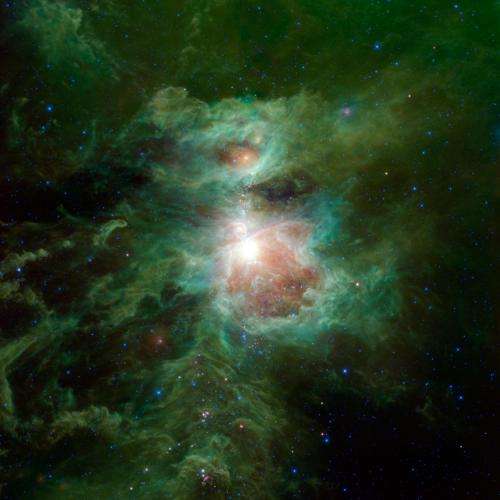
The Orion nebula is featured in this sweeping image from NASA's Wide-field Infrared Survey Explorer, or WISE. The constellation of Orion is prominent in the evening sky throughout the world from about December through April of each year. The nebula (also catalogued as Messier 42) is located in the sword of Orion, hanging from his famous belt of three stars. The star cluster embedded in the nebula is visible to the unaided human eye as a single star, with some fuzziness apparent to the most keen-eyed observers. Credit: NASA/JPL-Caltech/UCLA

(Phys.org)—The tangle of clouds and stars that lie in Orion's sword is showcased in a new, expansive view from NASA's Wide-field Infrared Survey Explorer, or WISE.

Orion, the famous hunter, is visible in evening skies throughout the world from about December through April. The constellation appears tranquil and still to the naked eye, but lying in its sword, at what appears to be a slightly fuzzy star, is a turbulent cauldron of stellar birth.

WISE scanned the whole sky in infrared light, capturing this vast view of the dynamic region, called the . The telescope picked up the from dust heated by newborn stars. The colors green and red highlight this warmed dust, while the white regions are the hottest. burned through the dust, carving out cavities, the largest of which is seen at the center of the picture.

Astronomers think that our sun was probably born in a similar cloud some five billion years ago. Over time, the cloud would have dispersed and the stars would have drifted apart, leaving us more isolated in space. The crowded in the Orion nebula are less than 10 million years old—billions of years from now, they will likely spread out.

NASA's Jet Propulsion Laboratory, Pasadena, Calif., manages, and operated, WISE for NASA's Science Mission Directorate. The spacecraft was put into hibernation mode in 2011, after it scanned the entire sky twice, completing its main objectives.

Explore further: The 'flame' burns bright in new WISE image

Related Stories

The 'flame' burns bright in new WISE image

Jul 03, 2012

(Phys.org) -- A new image from NASA's Wide-field Infrared Survey Explorer, or WISE, shows the candle-like Flame nebula lighting up a cavern of dust. The Flame nebula is part of the Orion complex, a turbulent ...

WISE presents a cosmic wreath

Dec 23, 2011

(PhysOrg.com) -- Just in time for the holidays, astronomers have come across a new image from NASA's Wide-field Infrared Survey Explorer, or WISE, that some say resembles a wreath. You might even think of ...

Image: Decorating the sky

Dec 27, 2010

This mosaic image taken by NASA's Wide-field Infrared Survey Explorer, or WISE, features three nebulae that are part of the giant Orion Molecular Cloud--the Flame nebula, the Horsehead nebula and NGC 2023.

Atacama Pathfinder Experiment: Setting the dark on fire

Jan 23, 2013

(Phys.org)—A new image from the Atacama Pathfinder Experiment (APEX) telescope in Chile shows a beautiful view of clouds of cosmic dust in the region of Orion. While these dense interstellar clouds seem ...

'Pacman' nebula gets some teeth

Oct 27, 2011

(PhysOrg.com) -- To visible-light telescopes, this star-forming cloud appears to be chomping through the cosmos, earning it the nickname the "Pacman" nebula, like the famous Pac-Man video game that debuted ...

Making a spectacle of star formation in Orion

Jun 30, 2011

(PhysOrg.com) -- Looking like a pair of eyeglasses only a rock star would wear, this nebula brings into focus a murky region of star formation. NASA's Spitzer Space Telescope exposes the depths of this dusty ...

Recommended for you

A hidden population of exotic neutron stars

2 hours ago

(Phys.org) —Magnetars – the dense remains of dead stars that erupt sporadically with bursts of high-energy radiation - are some of the most extreme objects known in the Universe. A major campaign using ...

Very Large Telescope celebrates 15 years of success

7 hours ago

(Phys.org) —With this new view of a spectacular stellar nursery ESO is celebrating 15 years of the Very Large Telescope—the world's most advanced optical instrument. This picture reveals thick clumps ...

Fragile mega-galaxy is missing link in history of cosmos

May 22, 2013

Two hungry young galaxies that collided 11 billion years ago are rapidly forming a massive galaxy about 10 times the size of the Milky Way, according to UC Irvine-led research published Wednesday in the journal ...

User comments : 0

More news stories

A hidden population of exotic neutron stars

(Phys.org) —Magnetars – the dense remains of dead stars that erupt sporadically with bursts of high-energy radiation - are some of the most extreme objects known in the Universe. A major campaign using ...

Russia evacuates drifting Arctic research station

Russia has ordered the urgent evacuation of the 16-strong crew of a drifting Arctic research station after ice floe that hosts the floating laboratory began to disintegrate, officials said Thursday.

Century-old science helps confirm global warming

(Phys.org) —Ocean measurements taken more than 135 years ago during the scientific expedition of HMS Challenger have provided further confirmation of human-produced global warming over the past century.

Bacterium from Canadian High Arctic and life on Mars

(Phys.org) —The temperature in the permafrost on Ellesmere Island in the Canadian high Arctic is nearly as cold as that of the surface of Mars. So the recent discovery by a McGill University led team of ...

Review: Google music plan solid, serendipitous

Google's new music service offers a lot of eye candy to go with the tunes. The song selection of around 18 million tracks is comparable to popular services such as Spotify and Rhapsody, and a myriad of playlists ...