Nearby ancient star is almost as old as the Universe
Feb 25, 2013 by Dan Majaess, Universe Today
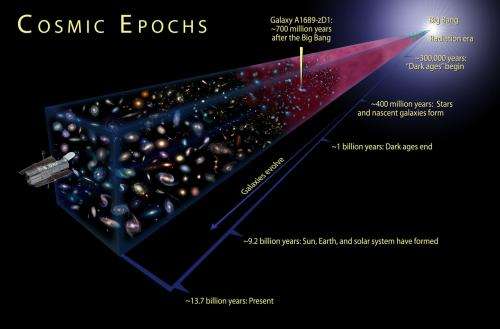
A new age estimate for the star HD 140283 is 14.46+-0.80 billion years, which implies that HD140283 was among the first few generations of stars created in the Universe. Credit: NASA, ESA, A. Felid (STScI)

A metal-poor star located merely 190 light-years from the Sun is 14.46+-0.80 billion years old, which implies that the star is nearly as old as the Universe! Those results emerged from a new study led by Howard Bond. Such metal-poor stars are (super) important to astronomers because they set an independent lower limit for the age of the Universe, which can be used to corroborate age estimates inferred by other means.

In the past, analyses of globular clusters and the Hubble constant ( of the ) yielded vastly different ages for the Universe, and were offset by billions of years! Hence the importance of the star (designated HD 140283) studied by Bond and his coauthors.

"Within the errors, the age of HD 140283 does not conflict with the , 13.77 ± 0.06 billion years, based on the microwave background and Hubble constant, but it must have formed soon after the ." the team noted.

Metal-poor stars can be used to constrain the age of the Universe because metal-content is typically a proxy for age. Heavier metals are generally formed in supernova explosions, which pollute the surrounding interstellar medium. Stars subsequently born from that medium are more enriched with metals than their predecessors, with each successive generation becoming increasingly enriched. Indeed, HD 140283 exhibits less than 1% the of the Sun, which provides an indication of its sizable age.
Nearby ancient star is almost as old as the universe
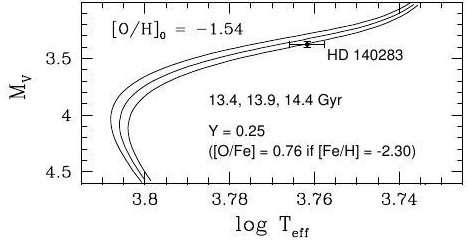
HD 140283 is estimated to be 14.46+-0.80 billion years old. On the y-axis is the star’s pseudo-luminosity, on the x-axis its temperature. Computed evolutionary tracks (solid lines ranging from 13.4 to 14.4 billion years) were applied to infer the age. Credit: adapted from Fig 1 in Bond et al. 2013 by D. Majaess, arXiv

HD 140283 had been used previously to constrain the age of the Universe, but uncertainties tied to its estimated distance (at that time) made the somewhat imprecise. The team therefore decided to obtain a new and improved distance for HD 140283 using the (HST), namely via the trigonometric parallax approach. The distance uncertainty for HD 140283 was significantly reduced by comparison to existing estimates, thus resulting in a more precise age estimate for the star.

The team applied the latest evolutionary tracks (basically, computer models that trace a star's luminosity and temperature evolution as a function of time) to HD 140283 and derived an age of 14.46+-0.80 billion years (see figure above). Yet the associated uncertainty could be further mitigated by increasing the sample size of (very) metal-poor stars with precise distances, in concert with the unending task of improving computer models employed to delineate a star's evolutionary track. An average computed from that sample would provide a firm lower-limit for the age of the Universe. The reliability of the age determined is likewise contingent on accurately determining the sample's . However, we may not have to wait long, as Don VandenBerg (UVic) kindly relayed to Universe Today to expect, "an expanded article on HD 140283, and the other [similar] targets for which we have improved parallaxes [distances]."
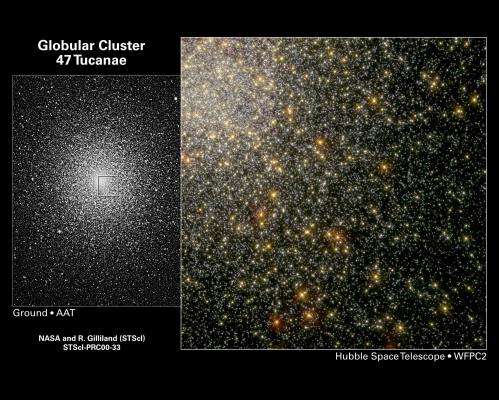
Age estimates for the Universe as inferred from globular clusters and the Hubble constant were previously in significant disagreement. Credit: NASA, R. Gilliland (STScI), D. Malin (AAO)

As noted at the outset, analyses of globular clusters and the Hubble constant yielded vastly different ages for the Universe. Hence the motivation for the Bond et al. 2013 study, which aimed to determine an age for the metal-poor star HD 140283 that could be compared with existing age estimates for the Universe. The discrepant ages stemmed partly from uncertainties in the cosmic distance scale, as the determination of the Hubble constant relied on establishing (accurate) distances to galaxies. Historical estimates for the Hubble constant ranged from 50-100 km/s/Mpc, which defines an age spread for the Universe of ~10 billion years.

The aforementioned spread in Hubble constant estimates was certainly unsatisfactory, and astronomers recognized that reliable results were needed. One of the key objectives envisioned for HST was to reduce uncertainties associated with the Hubble constant to <10%, thus providing an improved estimate for the age of the Universe. Present estimates for the Hubble constant, as tied to HST data, appear to span a smaller range (64-75 km/s/Mpc), with the mean implying an age near ~14 billion years.

Determining a reliable age for stars in globular clusters is likewise contingent on the availability of a reliable distance, and the team notes that "it is still unclear whether or not globular cluster ages are compatible with the age of the Universe [predicted from the Hubble constant and other means]." set a lower limit to the age of the Universe, and their age should be smaller than that inferred from the Hubble constant (& cosmological parameters).

In sum, the study reaffirms that there are old stars roaming the solar neighborhood which can be used to constrain the of the Universe (~14 billion years). The Sun, by comparison, is ~4.5 billion years old.

The team's findings will appear in the Astrophysical Journal Letters, and a preprint is available on arXiv.

Explore further: Hubble finds appearances can be deceptive

More information: iopscience.iop.org/2041-8205/

add to favorites email to friend print save as pdf

Related Stories

Ancient white dwarf stars

Nov 03, 2011

(PhysOrg.com) -- Pushing the limits of its powerful vision, NASA's Hubble Space Telescope uncovered the oldest burned-out stars in our Milky Way Galaxy in this image from 2002. These extremely old, dim "clockwork ...

Zeroing in on Hubble's constant

Jan 05, 2009

(PhysOrg.com) -- In the early part of the 20th Century, Carnegie astronomer Edwin Hubble discovered that the universe is expanding. The rate of expansion is known as the Hubble constant. Its precise value ...

Hubble finds appearances can be deceptive

Jan 28, 2013

(Phys.org)—Globular clusters are roughly spherical collections of extremely old stars, and around 150 of them are scattered around our galaxy. Hubble is one of the best telescopes for studying these, as ...

Infrared observatory measures expansion of universe

Oct 03, 2012

(Phys.org)—Astronomers using NASA's Spitzer Space Telescope have announced the most precise measurement yet of the Hubble constant, or the rate at which our universe is stretching apart.

A new way to measure the expansion of the universe

Jul 26, 2011

A PhD student from The International Centre for Radio Astronomy Research (ICRAR) in Perth has produced one of the most accurate measurements ever made of how fast the Universe is expanding.

Recommended for you

Hubble reveals the ring nebula's true shape

4 hours ago

(Phys.org) —The Ring Nebula's distinctive shape makes it a popular illustration for astronomy books. But new observations by NASA's Hubble Space Telescope of the glowing gas shroud around an old, dying, ...

A hidden population of exotic neutron stars

9 hours ago

(Phys.org) —Magnetars – the dense remains of dead stars that erupt sporadically with bursts of high-energy radiation - are some of the most extreme objects known in the Universe. A major campaign using ...

Very Large Telescope celebrates 15 years of success

14 hours ago

(Phys.org) —With this new view of a spectacular stellar nursery ESO is celebrating 15 years of the Very Large Telescope—the world's most advanced optical instrument. This picture reveals thick clumps ...

Fragile mega-galaxy is missing link in history of cosmos

May 22, 2013

Two hungry young galaxies that collided 11 billion years ago are rapidly forming a massive galaxy about 10 times the size of the Milky Way, according to UC Irvine-led research published Wednesday in the journal ...

User comments : 19

Adjust slider to filter visible comments by rank

Display comments: newest first

Pressure2
1.7 / 5 (6) Feb 25, 2013
A question I would like answered is what happens to neutron stars? An answer to this question could also explain the low iron content in stars thought to be the oldest stars. They may actually be among to youngest stars if neutron stars decay into hydrogen over millions of years.
natello
1.2 / 5 (20) Feb 25, 2013
HD 140283 is estimated to be 14.46 -0.80 billion years old.
So it already violates (within margin of error) the Big Bang model. It should therefore be considered as an evidence of against it, not for it. Everything else is just a data fishing.
In dense aether model the many dwarf galaxies around Milky Way are remnants of previous generation of galaxies and should be therefore older, than the observable Universe. The HD 140283 star could therefore come from one of such dwarf galaxies sucked into Milky Way. The HD 140283 is the high-velocity subgiant, which would support such an interpretation - it moves fast, because it's actually an intruder of Milky Way from outside.
Q-Star
4.6 / 5 (20) Feb 25, 2013
A question I would like answered is what happens to neutron stars? An answer to this question could also explain the low iron content in stars thought to be the oldest stars.


Not really, the oldest stars are low mass, they fuse their hydrogen very slowly, and do not contain enough mass to generate the high temperature required for fusion of the heavier elements, elements heavier than carbon.

,,,,,, if neutron stars decay into hydrogen over millions of years.


Though it is not "impossible physics", there is no mechanism understood that could allow that to happen. It has never been observed and no one has been able to posit a process by which it could happen that way.

The degenerate pressure of the neutron core doesn't permit enough movement for a great deal of "physics" to be occurring, but it is poorly understood area.
Q-Star
4.8 / 5 (22) Feb 25, 2013
So it already violates (within margin of error) the Big Bang model. It should therefore be considered as an evidence of against it, not for it.


Zephyr, no it doesn't. The "big bang" model(s) always include their own margin of error, all measurements do. There are no EXACT measurements. The so-called "big bang model" is usually reported with a plus or minus of 5% to 10%. Depending on which big model/parameter model being used. ALL models contain a margin. Except all the "PERFECT" models like "aether" which don't rely on any computations or numbers.

Ya have to read the fine print and actually KNOW the models before ya can comfortably argue against them.
Tuxford
1 / 5 (15) Feb 25, 2013
"Computed evolutionary tracks (solid lines ranging from 13.4 to 14.4 billion years) were applied to infer the age."

I too was confused until I read the above. Very likely, this is simply further evidence that evolutionary models are wrong, and thereby further support for LaViolette's continuous creation model. No wonder so many are so continuously confused.

If this star is growing from within through new matter nucleation at a rapid rate, forming new hydrogen, and has not experienced much explosive activity forming metals, it could result in low-metalicity. I would expect it likely to be a mid-size star in that case. If it lies in a dense star region, so much the better, as that would accelerate the process.
Modernmystic
1.3 / 5 (8) Feb 25, 2013
They basically spin down into a mass of neutrons.

Their ultimate fate may be tied to whether or not there is proton decay, but I'm unclear if this would effect such strong gravitationally bound neutrons.
barakn
1 / 5 (2) Feb 25, 2013
A question I would like answered is what happens to neutron stars? An answer to this question could also explain the low iron content in stars thought to be the oldest stars. They may actually be among to youngest stars if neutron stars decay into hydrogen over millions of years.
The protons would be popping up in a sea of neutrons. The neutron over-abundance and extreme pressure would make it more likely that the protons would assemble into neutron-rich heavy nuclei (like the neutron star's outer shell is already presumed to be). The result would not be a pure hydrogen star but an iron star.
Pressure2
1 / 5 (4) Feb 25, 2013
Well, if they would decay into an iron star where are they? There should be many of these iron stars in our galaxy. After all there is evidence of supernova, therefore neutron stars, almost from the beginning of the universe.
Q-Star
4.7 / 5 (12) Feb 25, 2013
Well, if they would decay into an iron star where are they? There should be many of these iron stars in our galaxy. After all there is evidence of supernova, therefore neutron stars, almost from the beginning of the universe.


They do not decay into an "iron star", except for a white dwarf.
When a iron core is formed, the star goes supernova and much of the iron is expelled to be recycled in other stars. After the supernova event, almost nothing is left but a large ball of neutrons,,,, unless the mass is sufficiently low to become a white dwarf.

Iron is created during the fusion of silicon, which takes an extraordinary temperature. On the order of billions of kelvins. There is not enough temperature on the surface of a neutron star to do much more than flash small amounts of hydrogen into helium which is immediately blown away.

No process will get iron from hydrogen.
Q-Star
4.7 / 5 (15) Feb 25, 2013
@ Pressure2

Maybe what I wrote was confusing, I'll try to be more clear,

A star ends it normal life in one of three ways.

Super-massive stars end in black holes. Super-massive stars are short lived, they burn their "fuel source" very quickly. They are rare not because they are long lived, they are rare because so few of them form in the first place.

Medium-massive stars end in neutron stars. They are much shorter lived than low mass stars. So most burned out stars observed are neutron stars.

Low mass stars (like the Sun) are very long lived, they end up as white dwarfs. (Call it an "iron star" if ya like, not a bad description. But it's an iron core, but no fusion is taking place.) There are few them to be observed because they are VERY long lived, meaning there hasn't been enough time since the "big bang" for them to form, live their long lives, and die. Ergo, they are rarer. Most stars are low mass stars, but they live long, so you don't see many dead ones.
dschlink
5 / 5 (12) Feb 25, 2013
Models for various estimates converge, but expecting perfect matches is ridiculous. Confusion arises in people who demand absolute certainly from science. Only religion works for them.

Pressure2
1.2 / 5 (6) Feb 25, 2013
Models for various estimates converge, but expecting perfect matches is ridiculous. Confusion arises in people who demand absolute certainly from science. Only religion works for them.


You got things almost backwards, classical science is close to a certainty, that's what has given us all are modern marvels. It is theoretical physics that is today's religion with wobbly facts to back up claims people like you seem to confuse with facts.
yash17
1 / 5 (1) Feb 25, 2013
In the evaluation to "The Big Bang theory", we might not only consider this HD 140283 case. Other case such as: LQG with longest dimension 4 billion light years (http://phys.org/n...e.html), accelerating expansion, dark matter, dark energy, cases in black holes growth & cases in galaxies growth, are also urged to consider. This all intrigue us to do little correction to "The Big Bang theory". Despite just little revision, the result of the correction could be prominence.
Grallen
3.3 / 5 (4) Feb 26, 2013
I don't have any evidence, math, or even faith in this. But I hope we find that the universe is much much older. Maybe even of indeterminable age. It would be much more interesting that way.
Fleetfoot
5 / 5 (6) Feb 26, 2013
Maybe what I wrote was confusing, I'll try to be more clear,

Low mass stars (like the Sun) are very long lived, they end up as white dwarfs. .. There are few them to be observed because they are VERY long lived, meaning there hasn't been enough time since the "big bang" for them to form, live their long lives, and die. Ergo, they are rarer. Most stars are low mass stars, but they live long, so you don't see many dead ones.


That's perhaps still a shade unclear. Low mass stars do live longer but the longest are red dwarfs. Those that become white dwarfs are more massive and have burnt out. They will stay visible as white dwarfs cooling radiatively for perhaps on the order of 100 billion years hence haven't had time to cool in the age of the universe.
natello
1.9 / 5 (9) Feb 26, 2013
Zephyr, no it doesn't. The "big bang" model(s) always include their own margin of error, all measurements do. There are no EXACT measurements.
You apparently don't realize, what the data fishing means. The star appears 14.46+-0.80 GYrs old, whereas the Universe is expected to be 13.77 ± 0.06 GYrs old. Therefore this finding should be considered as a violation of Big Bang model, not the evidence for it - or it would be a typical example of data fishing or data dredging. This is simply, how scientific methods just work. Everything else is manifestation of religion.
I of course do realize, that this evidence is not conclusive, but we have a number of such inconclusive evidences already. The mainstream is composed of religious lazy physicists, who are changing their way of thinking only when they're really forced to do it - but this is not my problem. I can work even with distributed evidence, I don't require 100% one.
natello
2.2 / 5 (10) Feb 26, 2013
Actually, under current state of mainstream science, physics of particular it's not so difficult to play smarter aleck, then the whole rest of physical community - it just requires to apply it's own rules and principle consequentially. Which I why I can be sure, cold fusion works, whereas my opponents are claiming the opposite.

The mainstream physicists evolved into strictly deterministically thinking creatures, which just means, they're waiting to 100% evidence of falsification of their theories, and this evidence must be even 100% quantitative in addition. The qualitative logical arguments, like the phases of Venus which decided the epicycle controversy are ignored with these people. The consequence is, new understanding or findings are adopted way slower than it could be, if all indicia would be considered.

Why the physicists are playing such an ignorants? It's easy to explain - it helps to keep the existing establishment their beloved jobs, salary and social prestige.
natello
1.7 / 5 (9) Feb 26, 2013
BTW I'm not supporter of Big Bang model or steady state one or cyclical one. In AWT the evolution of universe at large scales is mixture of all of them at the same moment. The red shift is interpreted as a result of scattering of light with density fluctuations of vacuum, i.e. like the evidence of steady state model of Universe. But for example the Doppler anisotropy of CMBR is considered as an evidence of high-level evolution of local area of our Universe. You may think about it like about giant density wave, which travels from place to place and when it hits the observable area of our Universe, it induces global changes in it.

That is to say, AWT usually models the space-time with water surface, but this surface isn't flat and still - it's subject of giant density fluctuations in similar way, like everything inside of it. Therefore from our limited perspective the observable part of universe could be a subject of very global changes quite easily.
VendicarE
not rated yet Feb 26, 2013

"A question I would like answered is what happens to neutron stars?" - Pressure2

God eats them. He tells me that they taste like Raisins.

More news stories

Hubble reveals the ring nebula's true shape

(Phys.org) —The Ring Nebula's distinctive shape makes it a popular illustration for astronomy books. But new observations by NASA's Hubble Space Telescope of the glowing gas shroud around an old, dying, ...

A hidden population of exotic neutron stars

(Phys.org) —Magnetars – the dense remains of dead stars that erupt sporadically with bursts of high-energy radiation - are some of the most extreme objects known in the Universe. A major campaign using ...

NASA head views progress on asteroid lasso mission

Surrounded by engineers, NASA chief Charles Bolden inspected a prototype spacecraft engine that could power an audacious mission to lasso an asteroid and tow it closer to Earth for astronauts to explore.

Controlling mood through the motions of mitochondria

(Medical Xpress)—Regulating the distribution of power in neurons is done by a system that makes the national electric grid look simple by comparison. Each neuron has several thousand mitochondria confined ...

A quantum simulator for magnetic materials

Physicists understand perfectly well why a fridge magnet sticks to certain metallic surfaces. But there are more exotic forms of magnetism whose properties remain unclear, despite decades of intense research. ...