First color image of Curiosity's tracks from orbit
Feb 01, 2013 by Jason Major, Universe Today
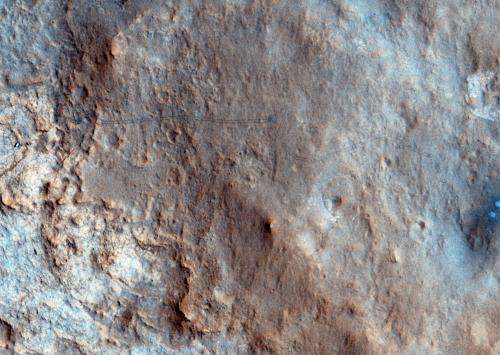
HiRISE image of Curiosity’s tracks, landing zone and the MSL rover at John Klein outcrop. Credit: NASA/JPL/University of Arizona

As Curiosity prepares for the historic first drilling operation on Mars, the HiRISE camera aboard the Mars Reconnaissance Orbiter captured an image of it from 271 km (169 miles) up, along with twin lines of tracks and the blast marks from the dramatic rocket-powered descent back on August 6 (UTC).

The image here was acquired on Jan. 13, 157 of the MSL mission, as part of a dual HiRISE/CRISM observation of the landing site. According to The University of Arizona's HiRISE site it's the first time the rover's tracks have been imaged in color.

Her original landing site can be seen at the right edge. (Wait… did I just say "her?")
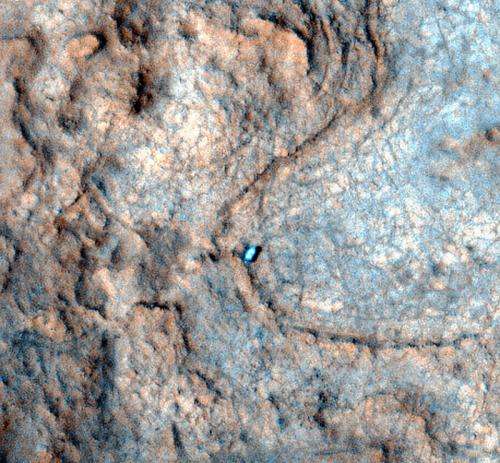
Orbital view (detail) of Curiosity at her drilling site in Yellowknife. Image was rotated so north is up. Credit: NASA/JPL/University of Arizona

The pair of bright white spots in the HiRISE image show the area immediately below where 's rockets were pointed. Those areas were "blasted clean" and therefore show brightest. The larger dark scour zone is dark because the fine dust has been blown away from the area leaving darker materials, according to Ross A. Beyer, UofA HiRISE team.

can be seen as she (yes, it was confirmed today during ScienceOnline2013 that the rover—like all exploration vehicles—is a girl) was preparing for drilling into a rock outcrop called John Klein within the "Yellowknife" region in Gale Crater. Drilling is expected to begin today, Jan. 31.

Explore further: Curiosity's rambling tracks visible from Mars orbit

More information: See more news from the MSL mission here.

add to favorites email to friend print save as pdf

Related Stories

Curiosity's rambling tracks visible from Mars orbit

Jan 17, 2013

Look closely and see where the Curiosity rover has been roving about inside Gale Crater on Mars, from "Bradbury Landing" to its current location in "Yellowknife Bay." This shot was taken by the HiRISE camera ...

Image: A whole new world for Curiosity

Aug 14, 2012

(Phys.org) -- This color-enhanced view -- taken by the High Resolution Imaging Science Experiment (HiRISE) on NASA's Mars Reconnaissance Orbiter as the satellite flew overhead -- shows the terrain around ...

Recommended for you

Building a better team—on Mars

12 hours ago

Sometime in the next quarter-century, NASA plans to send the first humans to Mars, a mission that will push the boundaries of teamwork for a handful of astronauts who will spend as long as three years together ...

User comments : 4

Adjust slider to filter visible comments by rank

Display comments: newest first

deatopmg
1.5 / 5 (8) Feb 01, 2013
Amazing how NASA releases full resolution photos when it benefits their PR campaign but only releases highly compressed JPEG's (or other formats made from those JPEG's) to the paying public.

??Hiding anything??
FrankHerbert2
2.8 / 5 (13) Feb 01, 2013
You don't believe in Obama_socks (pirouette) giant semi-transparent martians, do you?

What exactly do you think NASA is hiding?
Bob_Kob
3.3 / 5 (4) Feb 01, 2013
I assume they're busy making money selling the other high-res photos..
VendicarE
4 / 5 (4) Feb 01, 2013
God Damn spectacular images. No wonder the Republicans want to destroy NASA.

"Hiding anything" - DeaTard

As a congenital liar DeaTard can't conceive of anyone else being open and honest.

It is completely unfathomable to him.

More news stories

NASA's BARREL mission launches 20 balloons

(Phys.org) —In Antarctica in January, 2013 – the summer at the South Pole – scientists released 20 balloons, each eight stories tall, into the air to help answer an enduring space weather question: ...

Power of US tornado dwarfs Hiroshima bomb

Wind, humidity and rainfall combined precisely to create Monday's massive killer tornado in Oklahoma. The awesome amount of energy released dwarfed the power of the atomic bomb that leveled Hiroshima.

Encouraging signs for bee biodiversity

Declines in the biodiversity of pollinating insects and wild plants have slowed in recent years, according to a new study. Researchers led by the University of Leeds and the Naturalis Biodiversity Centre in the Netherlands ...

If you can remember it, you can remember it wrong

(Medical Xpress)—Native peoples in regions where cameras are uncommon sometimes react with caution when their picture is taken. The fear that something must have been stolen from them to create the photo ...

B vitamins could delay dementia

(Medical Xpress)—Despite spending billions of dollars on research and development, drug companies have been unable to come up with effective treatments for dementia and Alzheimer's Disease (AD). Now, A. ...