Fish become bolder and more gluttonous from drug residue
Feb 14, 2013
Fish become bolder and more gluttonous from drug residue
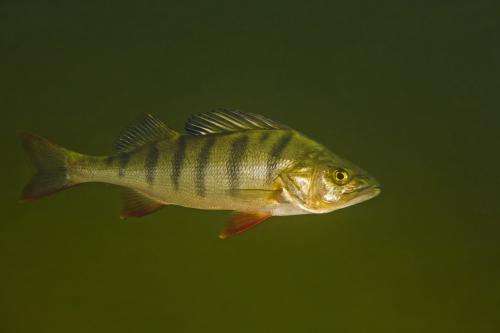
This shows a Perch (Perca fluviatilis). Credit: Bent Christensen

Anxiety-moderating drugs that reach waterways via wastewater create fearless and asocial fish that eat more quickly than normal. These behavioral changes can have serious ecological consequences. This is shown by Umeå University researchers in the prestigious journal Science.

Many drugs leave our bodies unaffected, and residues from them are therefore found in . Low concentrations of drugs are often found downstream from . Today we test how dangerous drugs are to humans, but our knowledge of the environmental impacts of drugs is limited. For the first time, scientists have now been able to show how the behavior of fish is affected by involuntary medication.

Researchers have examined how perch behave when they are exposed to the -moderating drug Oxazepam. The changes were obvious in corresponding to those found in waters in densely populated areas in Sweden.

"Normally, perch are shy and hunt in schools. This is a known strategy for survival and growth. But those who swim in Oxazepam became considerably bolder," explains ecologist Tomas Brodin, lead author of the article.

The drug made the fish braver and less social. This means that they left their schools to look for food on their own, a behavior that can be risky, as school formation is a key defense against being eaten by predatory fish.

The fish also ate more quickly. Since fish fulfill an important function in many , changes in eating behavior can seriously disturb the .

"We're now going to examine what consequences this might have. In waters where fish begin to eat more efficiently, this can affect the composition of species, for example, and ultimately lead to unexpected effects, such as increased risk of algal blooming," says Tomas Brodin.

Considerably more drugs with the same function are found in surface water downstream from sewage treatment plants, not only in Sweden but also elsewhere in the world. Moreover, drug use is predicted to increase. This means that previously unknown changes in behavior among fish, with ecological consequences as a result, may be a global phenomenon.

"The solution to the problem is not to stop medicating ill people but to try to develop sewage treatment plants that can capture environmentally hazardous drugs," says environmental chemist Jerker Fick.

The study, published in Friday's edition of Science, should be seen as a pointer about what might already be underway in many waters around the world. More comprehensive studies are required before any far-reaching conclusions can be drawn.

The scientists are presenting their findings at a press conference arranged by Science at the scientific conference AAAS Annual Meeting in Boston on February 14.

Explore further: Fish eaters run lower risk of heart attack – despite some mercury content

More information: www.sciencemag.org/content/339/6121/814.abstract?sid=d2996dc9-dfd8-43a1-99d7-b51cfa0a4ae6

Related Stories

Drugs seeping into Lake Michigan

Apr 15, 2007

Drugs are seeping into the Grand River and Lake Michigan from the Grand Rapids, Mich., sewage treatment plant, a study found.

An enzyme in fish can demonstrate environmental toxins

Nov 08, 2011

The level of the enzyme carbonyl reductase (CBR) is elevated in the livers of fish that have been exposed to cleaned wastewater. Scientists at the University of Gothenburg can show that CBR has properties that may make it ...

Medicine residues may threaten fish reproduction

Apr 05, 2010

Researchers at Umea University and the Sahlgrenska Academy at the University of Gothenburg, Sweden, have discovered that traces of many medicines can be found in fish that have been swimming in treated waste water. One such ...

Recommended for you

Climate change may have little impact on tropical lizards

18 hours ago

A new Dartmouth College study finds human-caused climate change may have little impact on many species of tropical lizards, contradicting a host of recent studies that predict their widespread extinction in a rapidly warming ...

Wetlands: value to locals matters most

19 hours ago

A new way of valuing ecosystem services, incorporating the local perspective, is the driving force behind a project assessing aquatic ecosystems in highland areas of Asia

Symbolic saviour of an endangered species

May 16, 2013

In 2006 Berlin Zoo saw the birth of their first polar bear cub in 33 years. A retired circus polar bear gave birth to two cubs at the zoo. One of them died soon after, but Knut survived. At only a month old he became the ...

User comments : 1

Adjust slider to filter visible comments by rank

Display comments: newest first

dschlink
not rated yet Feb 15, 2013
This brings to mind the caffeine studies of Elliot Bay and the Washington/Oregon coasts.

More news stories

Front-row seats to climate change

By day, insects provide the white noise of the South, but the night belongs to the amphibians. In a typical year, the Southern air hangs heavy from the humidity and the sounds of wildlife.

Climate change may have little impact on tropical lizards

A new Dartmouth College study finds human-caused climate change may have little impact on many species of tropical lizards, contradicting a host of recent studies that predict their widespread extinction in a rapidly warming ...

US seizes Bitcoin operator accounts

US authorities seized the accounts of a Bitcoin digital currency exchange operator, claiming it was functioning as an "unlicensed money service business," court documents showed Friday.

Chinese, Indian airlines face EU pollution fines

Eight Chinese and two Indian airlines face fines of up to several million euros for not paying for their greenhouse gas emissions during flights within the bloc, the European Commission said on Friday.

Alaska volcano shoots ash 15,000 feet into the air

(AP)—One of Alaska's most restless volcanoes has shot an ash cloud 15,000 feet into the air in an ongoing eruption that has drawn attention from a nearby community but isn't expected to threaten air traffic.