Observing how EGFR clusters malfunction in cancer cells
Feb 26, 2013
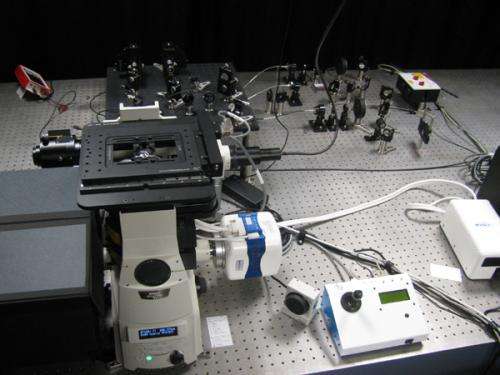
Researcher Adam Smith uses a new photon-counting technique to observe clusters of EGFR, a protein common in lung and colon cancers and glioblastoma, through this microscope.

For scientists to improve cancer treatments with targeted therapeutic drugs, they need to be able to see proteins prevalent in the cancer cells. This has been an impossible, until now. Thanks to a new microscopy technique, University of Akron researcher Dr. Adam Smith, assistant professor of chemistry, has observed how clusters of epidermal growth factor receptor (EGFR)—a protein abundant in lung and colon cancers, glioblastoma and others—malfunctions in cancer cells.

"We can directly observe protein clusters, in a living cell membrane, that are invisible to traditional methods. This opens up the possibility to directly measure the effect of drugs on the ," Smith says.

Smith's work lies at the heart of current-day cancer research, which focuses on developing targeted drugs that kill cancer cells without the collateral damage associated with traditional treatments like chemotherapy.

Specifically, Smith used a cutting-edge photon-counting technique, which enables scientists to measure the cluster size of EGFR proteins. The technique represents a significant advancement from studying the cultures with a traditional microscope, which cannot visually capture objects as small as the EGFR clusters, according to Smith, a lead author of "Conformational Coupling across the Plasma Membrane in Activation of the EGF Receptor," published in the Jan. 31 issue of the journal Cell, which highlights the technique.
Target: Cancer
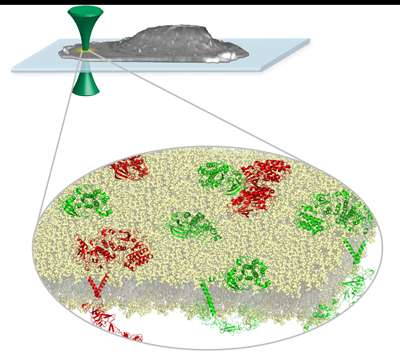
The top portion of this illustration shows a 3-D image of the cells Dr. Adam Smith, and his team observe. By focusing a laser onto the cell membrane, and using the new photon-counting technique, they can measure the cluster size of EGFR proteins, which are prevalent in some common cancers. The new technique, developed by Smith, allows scientists to measure clustering at the level of individual proteins, as shown in the bottom portion of the image. Due to their small size, EGFR clusters cannot be measured using a traditional microscope.

"Another difficulty with studying EGFR is that it's located in the cell membrane, which can be thought of as a fence line that defines the cell boundary, but in reality it is more like an untamed hedge row," says Smith, explaining how the new laser-based overcomes that obstacle and allows scientists to study, in real time, how EGFR works in healthy cells and also how it malfunctions in .

Smith's subsequent work studying the interaction of drugs with the targeted EGFR "will significantly improve drug discovery, which too often relies on indirect measure of efficacy," he says.

Explore further: The right combination: Overcoming drug resistance in cancer

More information: www.cell.com/abstract/S0092-8674(12)01554-1

add to favorites email to friend print save as pdf

Related Stories

Protein inhibits cancer cell growth

Dec 21, 2009

(PhysOrg.com) -- Researchers at the University of Toronto and Goethe University in Germany have discovered a protein that can inhibit the growth of cancer cells, providing crucial clues for the future development of new drugs ...

The right combination: Overcoming drug resistance in cancer

Jun 01, 2012

Overactive epidermal growth factor receptor (EGFR) signaling has been linked to the development of cancer. Several drug therapies have been developed to treat these EGFR-associated cancers; however, many patients have developed ...

Recommended for you

Explainer: What are chemical weapons?

May 24, 2013

There was chaos on the streets of Halajba in March 1988. In this corner of Iraq, at the time Iraqi Kurdistan, people had suddenly started experiencing cold-like symptoms – tight chest and nasal congestion. ...

Scientists develop advanced biological computer

May 24, 2013

(Phys.org) —Using only biomolecules (such as DNA and enzymes), scientists at the Technion-Israel Institute of Technology have developed and constructed an advanced biological transducer, a computing machine capable of manipulating ...

Research aims to fix long-held, inaccurate insect model

May 24, 2013

(Phys.org) —In humans, a polymer called melanin determines skin, eye and hair color—the darker the skin, the more melanin in a person's body. For insects, melanin is a major aspect of their immune defense ...

Molecular modelling to help create better, safer drugs

May 24, 2013

(Phys.org) —How our bodies break down the common drugs ibuprofen, diclofenac and warfarin is the subject of a new study from the University of Bristol, published in the Journal of the American Chemical So ...

User comments : 0

More news stories

New method for producing clean hydrogen

Duke University engineers have developed a novel method for producing clean hydrogen, which could prove essential to weaning society off of fossil fuels and their environmental implications.

Explainer: What are chemical weapons?

There was chaos on the streets of Halajba in March 1988. In this corner of Iraq, at the time Iraqi Kurdistan, people had suddenly started experiencing cold-like symptoms – tight chest and nasal congestion. ...

Scientists develop advanced biological computer

(Phys.org) —Using only biomolecules (such as DNA and enzymes), scientists at the Technion-Israel Institute of Technology have developed and constructed an advanced biological transducer, a computing machine capable of manipulating ...

Yahoo, pay-TV operators among Hulu bidders

Online video site Hulu is again up for sale, with Yahoo and pay TV operators DirecTV and Time Warner Cable among the seven bidders, according to a person with direct knowledge of the matter.