Scientist: I'm NOT seeking a mom for a Neanderthal
Jan 22, 2013 by Malcolm Ritter
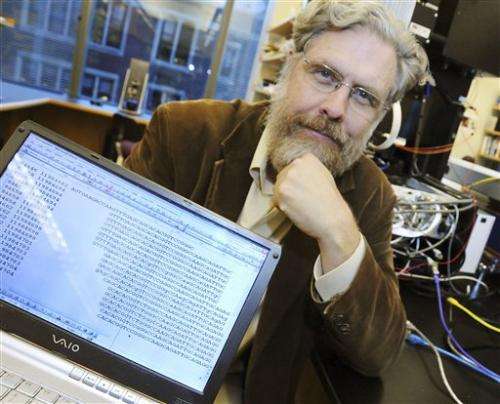
In this Oct. 20, 2008 file photo, Harvard Medical School genetics professor George Church poses for a photo with DNA sequence data for Dr. John Halamka, chief information officer, following a news conference in Boston. Church says reports that made him sound like he was searching for a woman to bear a Neanderthal baby are based on misunderstandings of an interview he gave the German magazine Der Spiegel. Church said the idea of bringing back Neanderthals gets brief mention as a theoretical possibility in his recent book, "Regenesis: How Synthetic Biology Will Reinvent Nature and Ourselves.'' (AP Photo/Lisa Poole, File)

A prominent genetics expert from Harvard Medical School wants to make one thing perfectly clear: He is NOT looking for a woman to bear a Neanderthal baby. Not even an adventurous one.

"Definitely not," said George Church.

Is he advocating for creating a Neanderthal? No. Does he plan to pursue such a project? "We have no projects, no plans, we have no papers, no grants," to do that, he said in a telephone interview Tuesday.

You wouldn't know that from some press reports that shot around the Internet the past few days, which made Church sound like he was supporting the idea and even looking for an "adventurous" woman to bear the Neanderthal child.

Church says those reports are based on misunderstandings of an interview he gave the German magazine Der Spiegel. The publication had approached him to talk about his recent book, "Regenesis: How Synthetic Biology Will Reinvent Nature and Ourselves."

Church said the idea of bringing back Neanderthals gets brief mention as a theoretical possibility, and the book refers to an "adventurous" woman merely to point out that the process would require a woman who no doubt would be adventurous.

"It said you're going to need someone like that if you're going to do it," he said. "It's certainly very different from taking out a want ad."

Neanderthals were stocky, muscular hunters who lived in Europe and western Asia. They died out sometime after modern humans arrived in Europe, which occurred some 40,000 to 45,000 years ago.

Scientists have recovered DNA from Neanderthal fossils. Making a Neanderthal would start with putting such DNA into human cells. They would be used to make an embryo, which would be carried to term by a surrogate mother, Church said.

Such a process would face ethical questions involving respect for the mother and child, as well as safety issues, and it would also require societal approval, Church said.

Scientists have long talked about bringing back long-extinct animals, such as by recovering genes from the remains of mammoths and using elephants as surrogate mothers. That has its own ethical issues, although not as troubling as a Neanderthal project, Church said.

Although he's not saying that a Neanderthal project is necessarily a good idea, "I think it is up for discussion, and hopefully for several years we can have a calm discussion about it," Church said. "It's way better to think of these things in advance."

Explore further: Largest group of fossil humans are Neanderthals after all

4.1 /5 (16 votes)
add to favorites email to friend print save as pdf

Related Stories

Could Neanderthals live again?

Feb 11, 2010

(PhysOrg.com) -- Researchers are closer than ever to having a first draft of a complete sequence of the genome of a Neanderthal woman who lived some 30,000 years ago, and this means it may one day be possible ...

Handsome by Chance

Aug 02, 2007

Chance, not natural selection, best explains why the modern human skull looks so different from that of its Neanderthal relative, according to a new study led by Tim Weaver, assistant professor of anthropology at UC Davis.

Recommended for you

The eloquence of the otoliths

May 16, 2013

Fish fossils that are about 23 million years old give unprecedented insight into the evolutionary history of the gobioid order, one of the most species-rich groups among the modern bony fishes.

Light cast on lifestyle and diet of first New Zealanders

May 16, 2013

(Phys.org) —A University of Otago-led multidisciplinary team of scientists have shed new light on the diet, lifestyles and movements of the first New Zealanders by analysing isotopes from their bones and teeth.

mtDNA study shows Minoans came from Europe not Africa

May 15, 2013

(Phys.org) —A new study conducted by a team of American and Greek researchers has found that the people of the ancient Minoan civilization living on the island of Crete most likely came from Europe. In ...

User comments : 3

Adjust slider to filter visible comments by rank

Display comments: newest first

nuge
5 / 5 (3) Jan 22, 2013
In other words, science marches on as per usual; it is once again the science JOURNALISTS who have let everybody down with sensationalist bullshit.
Tristan
5 / 5 (2) Jan 23, 2013
I would totally bear a neanderthal baby. Unfortunately, I'm male, and perhaps I would feel differently if I were female ^^
PaddyL
4 / 5 (1) Jan 23, 2013
Brave New World has arrived. To bad Michael Crichton is not alive to comment upon Dr Church's work.

More news stories

Evolution of lying

(Phys.org) —Ultimately, our ability to convincingly lie to each other may have evolved as a direct result of our cooperative nature.

Honeybees trained in Croatia to find land mines

(AP)—Mirjana Filipovic is still haunted by the land mine blast that killed her boyfriend and blew off her left leg while on a fishing trip nearly a decade ago. It happened in a field that was supposedly ...

Mice, gerbils perish in Russia space flight

A number of mice and eight gerbils sent into space in a Russian capsule destined to find out how well organisms can withstand extended flights perished during their journey, scientists said Sunday as the ...