Russians announce retrieval of first clean ice sample from Lake Vostok
Jan 14, 2013 by Bob Yirka report
Credit: NSF

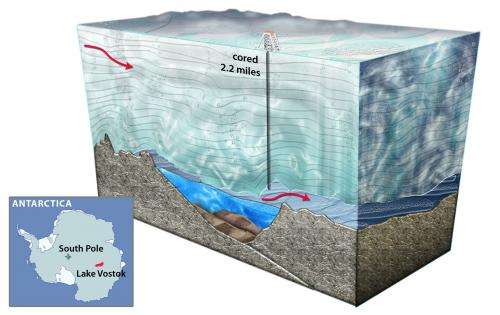
(Phys.org)—Researchers with Russia's Arctic and Antarctic Research Institute have announced that they have successfully retrieved a clean ice core sample from Lake Vostok in Antarctica. The sample, taken from a bore hole drilled over two miles through the ice to the lake underneath, is the result of years of effort. Researchers hope to find evidence in the ice of life on Earth as it existed as far back as 20 million years ago.

Lake Vosok, situated near the center of Antarctica, is water lying beneath a sheet of ice over two miles deep – it remains liquid due to geothermal heat underneath. Its existence was discovered in late 1996 and since that time, researchers have been eager to drill down to retrieve . Caution was advised, however, as scientists worried that drilling attempts might cause material from the surface to contaminate the water or samples received. One prior attempt to drill down to the lake by a British team failed leaving the Russians to give it a try. They made it to within 130 meters of the surface of the lake back in 1998, but halted work when scientists around the world expressed concerns about the lack of planning to prevent contamination. Over the years, the Russians worked out various plans to extract a sample without dirtying the lake but it was only recently that they settled on the simplest: Bore down to within just a few meters of the surface, then let the from the lake break through the remaining ice and push up into the where it would freeze almost instantly. To collect a water sample from the lake would then require simply pulling up the core. Unfortunately, when that approach was tried last year, the core sample retrieved showed of contamination by drilling equipment, e.g. oil used as a lubricant.
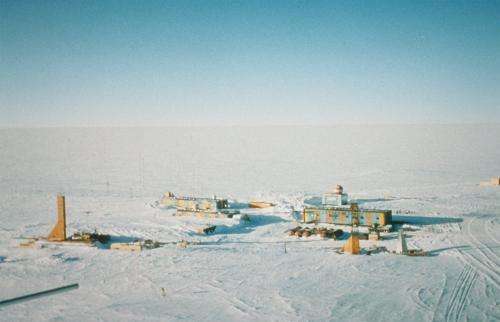
Wostok-Station (NOAA)

Scientists the world over are hoping this new sample will contain evidence of a previously unknown form of life – a possible relative of some life forms still around today. If that turns out to be the case, a lot of research will go into its examination and study. Also, it might lead to new ideas for exploring other planets that are covered in ice sheets, but might be harboring life underneath.

With this latest extraction, the Russians insist they've retrieved a pure sample, but they won't know for sure until they get it back to their lab and study it – that won't happen though till it grows warm enough in Antarctica for a ship to arrive to carry the sample home in the spring.

Explore further: NASA sees Cyclone Mahasen hit Bangladesh

Related Stories

Scientists drill two miles down to ancient Lake Vostok

Feb 13, 2012

(PhysOrg.com) -- Russian scientists last week finished penetrating more than two miles through the Antarctic ice sheet to Lake Vostok, a huge freshwater lake that has been buried under the ice for millions ...

Russia 'drills into' Antarctic subglacial lake

Feb 06, 2012

A Russian team has succeeded in drilling through four kilometres (2.5 miles) of ice to the surface of a mythical subglacial Antarctic lake which could hold as yet unknown life forms, reports said Monday.

Recommended for you

Alaska volcano shoots ash 15,000 feet into the air

18 hours ago

(AP)—One of Alaska's most restless volcanoes has shot an ash cloud 15,000 feet into the air in an ongoing eruption that has drawn attention from a nearby community but isn't expected to threaten air traffic.

NASA sees Cyclone Mahasen hit Bangladesh

May 17, 2013

NASA's Tropical Rainfall Measuring Mission satellite known as TRMM measured Cyclone Mahasen's rainfall rates from space as it made landfall on May 16. Mahasen has since dissipated over eastern India.

Rapid climate change ruled out ice age trees

May 17, 2013

Short, sharp fluctuations in the Earth's climate throughout the last ice age may have stopped trees from getting a foothold in Europe and northern Asia, scientists say.

Earth's iron core is surprisingly weak, researchers say

May 17, 2013

The massive ball of iron sitting at the center of Earth is not quite as "rock-solid" as has been thought, say two Stanford mineral physicists. By conducting experiments that simulate the immense pressures deep in the planet's ...

User comments : 3

Adjust slider to filter visible comments by rank

Display comments: newest first

deisik
5 / 5 (4) Jan 14, 2013
Scientists the world over are hoping this new sample will contain evidence of a previously unknown form of life


That would make a good scenario for another horror movie
frajo
5 / 5 (1) Jan 14, 2013
A few weeks ago, another Phys.Org article informed us that a British expedition had to go back home because they were stuck after drilling 300 m.
Wonder how the Russians managed to overcome the difficulties the British had.

See http://phys.org/n...ake.html
and http://www.telegr...off.html .
fmfbrestel
5 / 5 (1) Jan 14, 2013
Wonder how the Russians managed to overcome the difficulties the British had.


The British simply ran out of fuel, iirc. They miscalculated how much fuel it would take to breach the lake, and ran out. Couldn't resupply and were forced to retreat as winter set in.

In Mother Russia, gas runs out of barrel!!

More news stories

Galaxy's Ring of Fire

Johnny Cash may have preferred this galaxy's burning ring of fire to the one he sang about falling into in his popular song. The "starburst ring" seen at center in red and yellow hues is not the product of ...

Alaska volcano shoots ash 15,000 feet into the air

(AP)—One of Alaska's most restless volcanoes has shot an ash cloud 15,000 feet into the air in an ongoing eruption that has drawn attention from a nearby community but isn't expected to threaten air traffic.

Chinese, Indian airlines face EU pollution fines

Eight Chinese and two Indian airlines face fines of up to several million euros for not paying for their greenhouse gas emissions during flights within the bloc, the European Commission said on Friday.

Morocco to harness the wind in energy hunt

Morocco is ploughing ahead with a programme to boost wind energy production, particularly in the southern Tarfaya region, where Africa's largest wind farm is set to open in 2014.

US seizes Bitcoin operator accounts

US authorities seized the accounts of a Bitcoin digital currency exchange operator, claiming it was functioning as an "unlicensed money service business," court documents showed Friday.