Testing time for Proba-V, ESA's global vegetation tracker
Jan 15, 2013
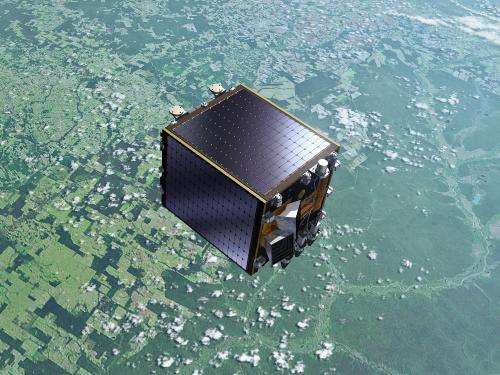
Proba-V satellite.

(Phys.org)—ESA's Proba-V microsatellite is now assembled and midway through testing to ensure it is fully spaceworthy. The miniature Earth-observer, designed to chart global vegetation every two days, will be launched in April.

The testing at the specialised Intespace facility in Toulouse, France, includes rigorous simulations of Proba-V's take-off conditions and the hard vacuum and it must endure in orbit.

It comes after Proba-V's assembly was completed by prime contractor QinetiQ Space at its facility in Kruibeke, Belgium last month.
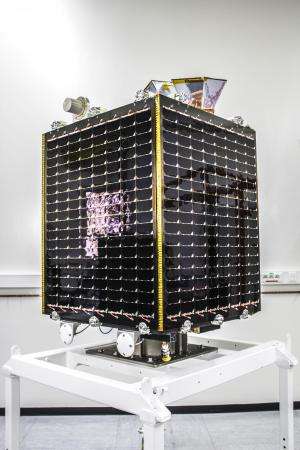
Completed Proba-V satellite.

Building it was a complex operation. Although smaller than a cubic metre, the satellites carries a wide-angle telescope for its main Earth-monitoring instrument, a pair of , a fibre optic connector experiment, a prototype based on the semiconductor , and a test receiver to track aircraft in flight all around the globe.

Such a crowded payload is standard for ESA's Proba series of satellites, set up to give early space experience to promising new European technologies, especially from smaller companies often lacking easy access to space.

But Proba-V also marks a departure from previous technology demonstrators Proba-1 in 2001 and Proba-2 in 2009. Both later became operational missions once the outstanding performance of their main instruments became clear.
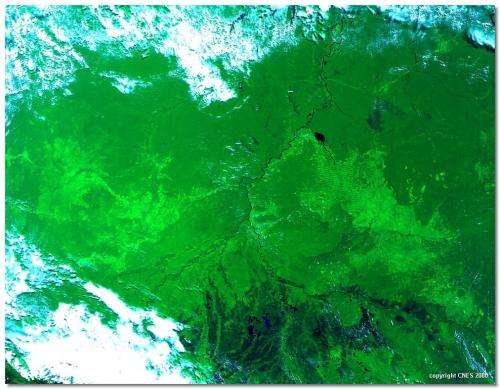
Deforestation in Brazil.

This time around, Proba-V has been conceived as a quasi-operational mission from the start, serving a waiting community of users. 

The V stands for Vegetation: the is flying a miniaturised version of the Vegetation sensor on France's full-sized Spot-5 satellite, intended to extend its nearly 15-year continuous record of observations – dating back to the previous Spot-4 mission, launched in 1998.

There are more than 10 000 registered users of Vegetation products worldwide, and the data have contributed to hundreds of scientific papers. 

Despite being much smaller than the original Vegetation instrument, Proba-V's version observes compatible spectral bands while delivering a spatial resolution three times sharper.

Among other firsts for the mission, Proba-V will fly a radio amplifier based on gallium nitride. Often described as the most promising semiconductor since silicon, gallium nitride offers higher power levels and radiation resistance.

Proba-V will also be the world's first space mission to detect Automatic Dependent Surveillance Broadcast signals from aircraft, building up a global overview of air traffic. 

Explore further: Proba-2's espresso-cup microcamera snaps Hurricane Isaac

add to favorites email to friend print save as pdf

Related Stories

Wide-eyed Proba-V will track global vegetation daily

May 04, 2010

(PhysOrg.com) -- The small but powerful camera of ESA's Proba-V mission can fit on a single laboratory table for testing. But when it reaches orbit, this compact sensor will deliver a daily overview of virtually ...

Small but agile Proba-1 reaches 10 years in orbit

Oct 25, 2011

A good photographer needs agility. So it is with ESA microsatellite Proba-1, which turns in space to capture terrestrial targets. Celebrating its tenth birthday this week, Proba-1’s unique images are ...

Proba-2 satellite flies into its Russian launch site

Sep 07, 2009

(PhysOrg.com) -- Proba-2 has reached Plesetsk Cosmodrome in northern Russia, where it is being prepared for launch this November. Among the smallest satellites ever built by ESA, it was transported there aboard ...

Recommended for you

Dark, massive asteroid to fly by Earth on May 31

11 hours ago

It's 1.7 miles long. Its surface is covered in a sticky black substance similar to the gunk at the bottom of a barbecue. If it impacted Earth it would probably result in global extinction. Good thing it is ...

Research team explains 'Lazarus' comets

14 hours ago

Astronomers from the University of Antioquia have discovered a graveyard of comets. These once-dormant comets, dubbed by astronomers as "The Lazarus comets," are now rejuvenated.

NASA ships sensors for seafaring satellite to France

15 hours ago

(Phys.org) —Three NASA-built instruments that are integral components of the next in a series of U.S./European ocean altimetry satellites have arrived in France for integration with their spacecraft in ...

Trip into space with DiCaprio costs $1.55m

15 hours ago

Leonardo DiCaprio is going to get closer to stars of a different kind as he heads into space aboard the Virgin Galactic, and a well-heeled bidder at the Cannes Film Festival has paid 1.2 million euros (1.5 million) to be ...

User comments : 0

More news stories

Galaxies fed by funnels of fuel

(Phys.org) —Computer simulations of galaxies growing over billions of years have revealed a likely scenario for how they feed: a cosmic version of swirly straws.

Dark, massive asteroid to fly by Earth on May 31

It's 1.7 miles long. Its surface is covered in a sticky black substance similar to the gunk at the bottom of a barbecue. If it impacted Earth it would probably result in global extinction. Good thing it is ...

Source of life running out: water scientists

The majority of people on Earth people will face severe water shortages within a generation or two if pollution and waste continues unabated, scientists warned at a conference in Bonn Friday.

Google eyes emerging markets networks

Google has become deeply involved in a series of projects to build and operate wireless networks in emerging markets including sub-Saharan Africa and Southeast Asia, a report said Friday.