NSF cooperating with Italy, New Zealand in search for downed plane in Antarctica
Jan 25, 2013
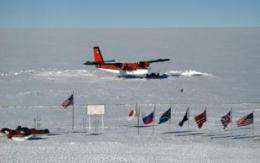
This shows a Twin Otter aircraft at NSF's Amundsen-Scott South Pole Station in a 2006 photograph. Credit: Photograph by: Spencer Klein, NSF

Officials with the U.S. Antarctic Program are cooperating with their Italian and New Zealand counterparts, as well as the Rescue Coordination Centre in Wellington, NZ, in a search-and-rescue effort to locate a propeller-driven aircraft that is believed to have crashed in a remote and mountainous part of Antarctica.

A three-person crew is believed to have been aboard the de Havilland Twin Otter when contact was lost with the plane in the early morning hours of Jan. 23, Eastern Standard Time (U.S. stations in Antarctica keep New Zealand time). The nationalities of the crew are unconfirmed at this point.

The missing was flying in support of the Italian Antarctic Program under the logistical responsibility of the Italian National Agency for New Technologies, Energy and Sustainable Economic Development (ENEA), and was en route from NSF's Amundsen-Scott South Pole Station to the Italian research station at Terra Nova Bay when contact was lost with the in a remote region of the Transantarctic Mountains.

The aircraft is owned and operated by Kenn Borek Air Ltd., a Canadian firm headquartered in Calgary that charters aircraft to the U.S. program.

Communications between U.S. officials at McMurdo Station in and the New Zealand Rescue Coordination Centre confirmed that an emergency locator beacon had been activated.

Officials are monitoring conditions at the site, where the weather is currently very poor, to decide when to launch a search of the area and what kind of aircraft to use.

Explore further: Plane carrying 3 Canadians missing in Antarctica

add to favorites email to friend print save as pdf

Related Stories

Plane carrying 3 Canadians missing in Antarctica

Jan 24, 2013

Bad weather has forced rescuers to wait until Friday to try to reach a small plane believed to have crashed in an Antarctic mountain range while carrying three Canadians between scientific research stations on the continent.

Australian jet in Antarctica rescue mission

Aug 09, 2012

An Australian medical team and government jet have been dispatched to Antarctica to attempt a landing on an ice runway to rescue a sick scientist from the United States' McMurdo Station base.

Patient Sucessfully Evacuated From Antarctica

Aug 10, 2012

A medical evacuation flight bringing a patient from the National Science Foundation's McMurdo Station in Antarctica arrived safely in Christchurch, New Zealand at approximately 3 a.m. Eastern Time on Thurs ...

South Pole website celebrates a century of science

Dec 15, 2011

A century ago, two groups of explorers crossed the Antarctic continent, competing for the distinction of being the first to stand at the geographic South Pole. Norwegian native Roald Amundsen and his men won ...

Recommended for you

Siberian caves warn of permafrost meltdown

7 hours ago

Climate records captured in Siberian caves suggest 1.5 degrees of warming is enough to trigger thawing of permafrost, according to a paper to be given at the Geological Society of London on 27 June.

User comments : 0

More news stories

Metamorphosis of moon's water ice explained

Using data gathered by NASA's Lunar Reconnaissance Orbiter (LRO) mission, scientists believe they have solved a mystery from one of the solar system's coldest regions—a permanently shadowed crater on the ...

US doctors' group labels obesity a disease

(HealthDay)—In an effort to focus greater attention on the weight-gain epidemic plaguing the United States, the American Medical Association has now classified obesity as a disease.