Multiple steps toward the 'quantum singularity'
Jan 18, 2013 by Larry Hardesty
Credit: Christine Daniloff/MIT

In early 2011, a pair of theoretical computer scientists at MIT proposed an optical experiment that would harness the weird laws of quantum mechanics to perform a computation impossible on conventional computers. Commenting at the time, a quantum-computing researcher at Imperial College London said that the experiment "has the potential to take us past what I would like to call the 'quantum singularity,' where we do the first thing quantumly that we can't do on a classical computer."

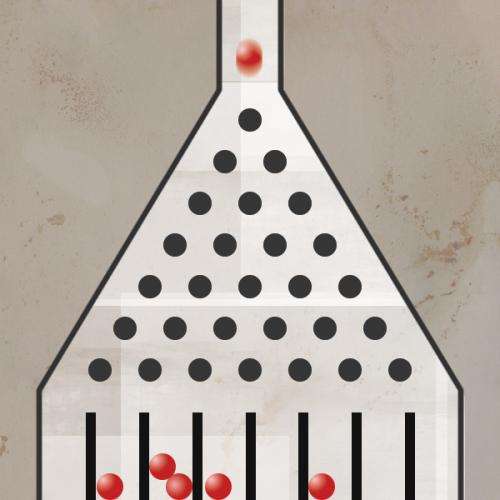
The experiment involves generating individual photons—particles of light—and synchronizing their passage through a maze of optical components so that they reach a battery of at the same time. The MIT researchers—Scott Aaronson, an associate professor of electrical engineering and computer science, and his student, Alex Arkhipov—believed that, difficult as their experiment may be to perform, it could prove easier than building a fully functional quantum computer.

In December, four different groups of , centered at the University of Queensland, the University of Vienna, the University of Oxford and Polytechnic University of Milan, reported the completion of rudimentary versions of Aaronson and Arkhipov's experiment. Papers by two of the groups appeared back to back in the journal Science; the other two papers are as-yet unpublished.

All four papers, however, appeared on arXiv, an online compendium of research papers, within a span of three days. Aaronson is a co-author on the paper from Queensland, as is Justin Dove, a graduate student in the Department of Electrical Engineering and Computer Science and a member of MIT's Optical and Quantum Communications Group.

Changing channels

The original formulation of Aaronson and Arkhipov's experiment proposed a network of beam splitters, optical devices that are ordinarily used to split an optical signal in half and route it down separate fibers. In practice, most of the groups to post papers on arXiv—those other than the Queensland group—built their networks on individual chips, using channels known as waveguides to route the photons. Where two waveguides come close enough together, a photon can spontaneously leap from one to the other, mimicking the behavior caused by a beam splitter.

Performing a calculation impossible on a conventional computer would require a network of hundreds of beam splitters, with dozens of channels leading both in and out. A few dozen photons would be fired into the network over a random subset of the channels; photodetectors would record where they come out. That process would have to be repeated thousands of times.

The groups posting papers on arXiv used networks of 10 or so beam splitters, with four or five channels leading in, and three or four photons. So their work constitutes a proof of principle—not yet the "quantum singularity."

The computation that Aaronson and Arkhipov's experiment performs is obscure and not very useful: Technically, it samples from a probability distribution defined by permanents of large matrices. There are, however, proposals to use optical signals to do general-purpose , most prominently a scheme known as KLM, after its creators, Emanuel Knill, Raymond Laflamme and Gerard Milburn.

According to Dove, some in the quantum-computing community have suggested that Aaronson and Arkhipov's experiment may be difficult enough to perform with the requisite number of photons that researchers would be better off trying to build full-fledged KLM systems.

But, Dove says, "One of the ways that Scott and I like to pitch this idea is as an intermediate step that we need to do KLM." Building a KLM optical quantum computer would entail building everything necessary to perform the Aaronson-Arkhipov experiment—plus a bunch of other, perhaps even more challenging, technologies.

"You can think of Scott and Alex's result as saying, 'Look, one of the steps to performing KLM is interesting in its own right,'" Dove says. "So I think it's inevitable that we're going to do these experiments, whether people label them that way or not."

Explore further: At the solstice: Shining light on quantum computers

Related Stories

Quantum computing with recycled particles

Oct 23, 2012

A research team from the University of Bristol's Centre for Quantum Photonics (CQP) have brought the reality of a quantum computer one step closer by experimentally demonstrating a technique for significantly reducing the ...

Recommended for you

How do cold ions slide

12 minutes ago

Things not always run smoothly. It may happen, actually, that when an object slides on another, the advancement may occur through a 'stop and go' series in the characteristic manner which scientists call ...

Hydrogen atoms under the magnifying glass

23 hours ago

To describe the microscopic properties of matter and its interaction with the external world, quantum mechanics uses wave functions, whose structure and time dependence is governed by the Schrödinger equation. ...

Physicists help design, build cargo X-ray scanners

23 hours ago

(Phys.org) —Two SLAC physicists with decades of particle accelerator experience helped a Silicon Valley company design and build X-ray devices that scan cargo containers for nuclear materials and other ...

User comments : 16

Adjust slider to filter visible comments by rank

Display comments: newest first

Antoweif
3.2 / 5 (13) Jan 18, 2013
"...that would harness the weird laws of quantum mechanics ..."
The only weird thing here is how everyone claims quantum mechanics is weird. It's weird because you make it weird.
natello
1.7 / 5 (12) Jan 18, 2013
The quantum computing cannot compete the classical computers at the moment, when the computational power of classical computers is already limited with Heisenberg uncertainty principle. The quantum computers are very fuzzy and when they would be forced to achieve the same precision like the classical ones, their speed will be comparable. They just serve as a salary generators for researchers involved.
natello
2 / 5 (8) Jan 18, 2013
A survey of leading thinkers shows that they are as far as ever from agreeing on the nature of reality: quantum computer expectations
robeph
3 / 5 (9) Jan 18, 2013
@natallo are you really this stupid?

"The quantum computers are very fuzzy and when they would be forced to achieve the same precision like the classical ones, their speed will be comparable. They just serve as a salary generators for researchers involved."

What kind of damaged neurology did you suffer as a child that makes you make such ignorant and laughable statements? I have trouble shaking my head at the stupid pseudo-science that cantdrive spouts after the c spinal damage I've likely incurred while reading yours.

Research, regardless of why (were your comments even remotely realistic) is still research and it assuredly advances science, so whatever it may be, I say onward.
natello
1.7 / 5 (11) Jan 18, 2013
My point was, the Heisenberg uncertainty principle limits the processing speed of classical computers in the same way, like the (speed of) quantum ones. The quantum computers are just approaching to the same product of processing speed and computational precision from the opposite side, than the classical computers. My comment indeed reveals a trivial fact - but this fact is kept in secret with proponents of quantum computing from apparent employment reasons.
natello
1.7 / 5 (12) Jan 18, 2013
I'm not so stupid and I know about trustful hope, which every layman - who is interested about science - puts into expectations of new technology. But the naive equation "more research = more progress" isn't always valid. Sometimes the people are getting fooled with their own beliefs. Such a naivety has its dual side too: sometimes the technology, which has been ignored with official researchers (like the cold fusion) will become the most promising one. The key point here is, the research in contemporary science is strictly employment driven: the important findings aren't those, which could help the human civilization as a whole, but just the findings, which would promote another jobs and occupation of researchers itself. It's parasitic trait of every isolated group of people or society, which lacks the public feedback over its own incentives: it will start to grow into account of the rest of human society, which actually whole its business.
natello
1.7 / 5 (11) Jan 18, 2013
"which actually whole its business" should be "which actually pays whole its business."
Tektrix
4.1 / 5 (9) Jan 18, 2013
Quantum computers are probabilistic, not deterministic. This "fuzziness" being spoken of is a feature, not a bug and is what will allow quantum computers to eventually do things classical computers cannot. Deterministic machines, for instance, cannot model complex biological systems beyond basic schema that can only execute very limited functions (and no real executive functions.) A probabilistic computer on the other hand, is especially good at solving problems unique to fuzzy, non-deterministic environments- such as real (non-binary) life. Quantum computing will also let us move beyond the somewhat limited categorical manipulations of Turing machines, to computing in multiple dimensions simultaneously. Hardly a waste of time or mere grant fodder.
icuvd
4 / 5 (2) Jan 18, 2013
I'm just impressed that someone wrote an article on quantum computing without using the phrase "holy grail".
robeph
4.2 / 5 (6) Jan 19, 2013
But the naive equation "more research = more progress" isn't always valid.


More research does mean more progress, without fail. This is an absolute. The caveat, however, is the research must at least be valid and not redundant. Whether research validates, furthers, or falsifies prior theory it is still progress.

You speak of "laymen" yet continuously go on about cold fusion and this false idea that it is somehow suppressed. The issue isn't suppression, the problem is the reproducibility of the effects consistently (aka scientific method). None of the research is suppressed, it's all there for the taking, it just isn't viable. Will it ever be? No clue. What it absolutely isn't is the savior of the world's energy needs that with the all the naivety you claim to not suffer, you show a great deal of in your adherence to this.

I'd really love to meet some of these pseudo-scientific nuts on this site. I bet they're more comedic in person than a room full of Dane Cook clones.
lbuz
3 / 5 (2) Jan 19, 2013
Get'em Rob!!! I've been spending more time at Science Daily for exactly that reason. In a slightly less imperfect world it would be possible to carry on a well reasoned discussion here without "I know the real truth that THEY are keeping from us" folks fouling the conversation space. Grandiosity and self-deception tied with conspiratorial irrelevance is like a dead moose in the middle of the road; you can drive around it but you can't avoid the smell. You would think that ending up over and over again as intellectual road kill would encourage new pursuits.......
vacuum-mechanics
2.6 / 5 (5) Jan 19, 2013
In early 2011, a pair of theoretical computer scientists at MIT proposed an optical experiment that would harness the weird laws of quantum mechanics to perform a computation impossible on conventional computers….

Actually what that seems to be 'the weird laws of quantum mechanics' is because we do not know the basic foundation of quantum mechanics! Understanding the working mechanism behind quantum mechanics (below), then it is not weird anymore.
http://www.vacuum...17〈=en
ValeriaT
3 / 5 (2) Jan 19, 2013
How the quantum computers with high number of qbits actually work (please ignore the resemblance of demonstrator with Sheldon Cooper from T.B.B.T.)...
frajo
2.3 / 5 (3) Jan 20, 2013
What kind of damaged neurology did you suffer as a child that makes you make such ignorant and laughable statements?
Natello (clone of Zephir) didn't suffer his damage until he grew up to believe that he's the greatest living physicist on this planet. But nowhere did he find a job.
Now, due to this insult, he is in a state of permanent excitation and attacks everything and everybody whom he sees as a proponent of established science.
His arrogated sense of superiority makes him disregard the common rules of decency.

I'd really love to meet some of these pseudo-scientific nuts on this site. I bet they're more comedic in person than a room full of Dane Cook clones.
You'll be disappointed. Internet psychotics are inconspicuous and rather boring in real life.

Btw, ValeriaT is another clone of that same Zephir.
ValeriaT
5 / 5 (2) Jan 20, 2013
and attacks everything and everybody whom he sees as a proponent of established science
I'm just saying, the computational power of quantum computers is limited with the same physical laws, like the computational power of classical ones - just from the opposite side of product of computational speed and precision. Is that manifestation of psychosis?
omerbashich
2 / 5 (4) Jan 21, 2013
What a hilarious site, look at the "rating system" for comments. You can give little stars to posters. (S)he loves me, (s)he loves me not... Then if someone grades my post highly, should I return the favor? As in the "peer review" system. But what a sicko you have to be to make a grading system for even them comments...

It's lab Nazi control-freaks thinking science is about democracy, when it isn't.

In the meantime, on planet Earth: "How Wineland & Haroche Stole My Discovery (and got 2012 PHYSICS NOBEL PRIZE for it...)"
https://sites.goo...ci#Nobel

More news stories

Theorists weigh in on where to hunt dark matter

(Phys.org) —Now that it looks like the hunt for the Higgs boson is over, particles of dark matter are at the top of the physics "Most Wanted" list. Dozens of experiments have been searching for them, but ...

Hydrogen atoms under the magnifying glass

To describe the microscopic properties of matter and its interaction with the external world, quantum mechanics uses wave functions, whose structure and time dependence is governed by the Schrödinger equation. ...

Physicists help design, build cargo X-ray scanners

(Phys.org) —Two SLAC physicists with decades of particle accelerator experience helped a Silicon Valley company design and build X-ray devices that scan cargo containers for nuclear materials and other ...

Unlocking secrets of cell reproduction

Research published in Open Biology today identifies, for the first time, nearly all the genes required for reproduction of a cell in a living organism.

Fast-acting mothers' milk for healthier babies

Human breastmilk responds quickly to protect the child when there is an infection in mothers or babies, according to new international research led by The University of Western Australia.