Joint Polar Satellite System spacecraft completes delta critical design review
Jan 16, 2013
Joint Polar Satellite System spacecraft completes delta critical design review
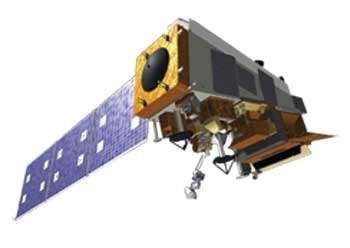
This is an artist's concept of the JPSS-1 spacecraft. Credit: NOAA/Ball Aerospace

The Joint Polar Satellite System (JPSS-1) spacecraft recently cleared its final major design review, demonstrating that spacecraft development is on track to provide critical environmental data when launched no later than the first quarter of calendar year 2017.

A four-day Critical Design Review (dCDR) of work conducted by Ball Aerospace & Technologies Corp., of Boulder, Colo., was held in December 2012 with representatives from NASA's Goddard Space Flight Center, Greenbelt, Md.; NASA Headquarters, Washington; the National Oceanic and Atmospheric Administration (NOAA), Washington; and JPSS instrument providers.

"The JPSS-1 Spacecraft team presented a very successful delta Critical Design Review in December at the Ball Aerospace facility in Boulder, Colo.," said Bill Anselm JPSS-1 Observatory Manager. "The JPSS-1 Spacecraft delta review presented the integrity of improvements and upgrades made since then, as well as the status of the overall development. With the success of this review, the spacecraft has now been approved to proceed into implementation."

The JPSS-1 Spacecraft baseline design was established at a formal review in January 2011, and is based largely on the Suomi National Polar-orbiting Partnership (Suomi NPP) spacecraft, also built by Ball Aerospace. Suomi NPP was launched in October 2011, and is now being operated by NOAA under a NASA/NOAA partnership to support NOAA's operational weather forecasting as well as NASA's Earth science research.. JPSS-1 will follow the Suomi NPP satellite to maintain continuity of weather and environmental observations.

Explore further: Storms, ozone, vegetation and more: NASA-NOAA Suomi NPP satellite returns first year of data

add to favorites email to friend print save as pdf

Related Stories

Infrared sounder on NASA's suomi NPP starts its mission

Feb 09, 2012

(PhysOrg.com) -- A powerful new infrared instrument, flying on NASA's newest polar-orbiting satellite, designed to give scientists more refined information about Earth's atmosphere and improve weather forecasts ...

NASA selects launch contractor for three missions

Jul 17, 2012

(Phys.org) -- NASA has selected United Launch Services LLC of Englewood, Colo., to launch the Soil Moisture Active Passive (SMAP), Orbiting Carbon Observatory-2 (OCO-2) and Joint Polar Satellite System-1 (JPSS-1) ...

NASA's NPP satellite undergoing flight environmental testing

Feb 12, 2011

The NASA National Polar-orbiting Operational Environmental Satellite System (NPOESS) Preparatory Project (NPP) climate/weather satellite is undergoing flight environmental testing at Ball Aerospace & Technologies Corp's production ...

Recommended for you

NASA head views progress on asteroid lasso mission

7 hours ago

Surrounded by engineers, NASA chief Charles Bolden inspected a prototype spacecraft engine that could power an audacious mission to lasso an asteroid and tow it closer to Earth for astronauts to explore.

Ecuador satellite collides with Russian space junk

7 hours ago

A small Ecuadoran satellite collided in orbit with the remains of a Russian rocket, but it is too soon to know how much damage it might have sustained, Quito's space agency said Thursday.

Forecast for Titan: Wild weather could be ahead

May 22, 2013

(Phys.org) —Saturn's moon Titan might be in for some wild weather as it heads into its spring and summer, if two new models are correct. Scientists think that as the seasons change in Titan's northern hemisphere, ...

SDO observes mid-level solar flare

May 22, 2013

UPDATE 16:30 p.m. EDT: The M7-class flare was also associated with a coronal mass ejection or CME, another solar phenomenon that can send billions of tons of particles into space. While this CME was not Ea ...

User comments : 0

More news stories

A hidden population of exotic neutron stars

(Phys.org) —Magnetars – the dense remains of dead stars that erupt sporadically with bursts of high-energy radiation - are some of the most extreme objects known in the Universe. A major campaign using ...

Hubble reveals the ring nebula's true shape

(Phys.org) —The Ring Nebula's distinctive shape makes it a popular illustration for astronomy books. But new observations by NASA's Hubble Space Telescope of the glowing gas shroud around an old, dying, ...

NASA head views progress on asteroid lasso mission

Surrounded by engineers, NASA chief Charles Bolden inspected a prototype spacecraft engine that could power an audacious mission to lasso an asteroid and tow it closer to Earth for astronauts to explore.

Controlling mood through the motions of mitochondria

(Medical Xpress)—Regulating the distribution of power in neurons is done by a system that makes the national electric grid look simple by comparison. Each neuron has several thousand mitochondria confined ...

A quantum simulator for magnetic materials

Physicists understand perfectly well why a fridge magnet sticks to certain metallic surfaces. But there are more exotic forms of magnetism whose properties remain unclear, despite decades of intense research. ...