New book connects the human community to its cosmic roots
The 1969 "Woodstock" song by Joni Mitchell, it turns out, was onto something: "We are stardust / billion-year-old carbon."
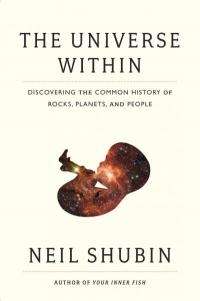
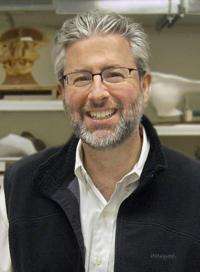
University of Chicago evolutionary biologist, Neil Shubin, PhD, makes that connection between astronomical events and the human species in his new book, "The Universe Within: Discovering the Common History of Rocks, Planets, and People," a follow up to his 2008 best-seller, "Your Inner Fish."
Where "Your Inner Fish" goes back millions of years to look at the evolutionary links between human anatomy and other animals around the world, "The Universe Within" goes back billions of years and extends out to the universe to trace the impact of cosmic events on the human body.
Shubin explains in the prologue for "The Universe Within" that it became clear while writing his first book that the creatures he initially focused on, such as fish, worms and algae, "are but gateways to ever deeper connections—ones that extend back billions of years before the presence of life and of Earth itself."
He goes on to explain how the molecules that compose our bodies "arose in stellar events in the distant origins of the solar system." Written inside humans, Shubin argues, "is the birth of the stars, the movement of heavenly bodies across the sky, even the origin of days themselves."
"Every organ, cell, and gene of our bodies contains artifacts of the history of the universe, solar system and planet," said Shubin, professor and associate dean for the Department of Organismal and Evolutionary Biology at the University of Chicago. "This is the story of our deep connection to the physical world as seen in stars, rocks, and the workings of DNA."
The book, to be released Jan. 8, received advanced praise.
The Universe Within is a "fascinating, accessible tour of how life on Earth, including our own, has been shaped by many upheavals in our planet's long history," Sean Carroll, PhD, vice president for science education of the Howard Hughes Medical Institute and professor of molecular biology and genetics at the University of Wisconsin, said in a review blurb.
Shubin's new book, said Lawrence M. Krauss, Director of the Origins Project and Foundation Professor in the School of Earth and Space Exploration at Arizona State University, tells the tale, "with great authority, accuracy and a wonderfully light touch, a grand synthesis that manages to incorporate forefront research in astronomy, geology, paleontology, and genetics."
Themes in "The Universe Within" are presented chronologically, beginning with the big bang 13.7 billion years ago, followed by the birth of stars about a million years later. Shubin then follows the story through the formation of the solar system 4.6 billion years ago, the appearance of water on Earth 4.1 billion years ago, the emergence of life 3.5 billion years ago and the rapid and ongoing evolution since then of extraordinary diversity.
Shubin presents key aspects of this vast, multifaceted and potentially overwhelming cosmic history through personal tales of scientific exploration and discovery, including his own arctic adventures. He provides brief, anecdotal portraits of the brilliant but often quirky scientists who made the connections that have shaped our understanding of the world around us, as well as their struggles to convince colleagues.
Shubin pulls together data from geology, biochemistry and anatomy to help readers gain an appreciation for the wonders of how life works.
"The first 2.7 billions years of our history was entirely in water," he writes, "and its imprint is in every organ system in our bodies."
But the last 300 million years have been defined by how land animals, including humans, deal with separation from water. He describes how humans form three different kinds of kidneys while in the womb. The first and most primitive is like those seen in jawless fishes, the second develops from bony fishes, and the third, the system used by mammals, appears at the end of the first trimester.
After we are born, "our body dries out with every passing year," he notes. Newborns are "about 75 percent water, not much different from an average potato," but adults are only 57 percent water by weight.
The magic of Shubin's appeal "is that you can open to any page and in a paragraph or two witness an entire revelation," says science writer Craig Childs, author of "Apocalyptic Planet." "Shubin weaves very human stories into an earthly and universal narrative that without this book might seem too vast or too miniscule to matter."
The hardcover (190 pages, Pantheon) will be available online and at major bookstores beginning Tuesday, Jan.8. Shubin will appear on Comedy Central's "The Colbert Report" on Jan. 9. He will lecture in Chicago on Jan. 10 at the University of Chicago Seminary Bookstore, 5751 S. Woodlawn Ave., and at the Chicago Public Library on Feb. 10.
Provided by University of Chicago Medical Center


