Glasses begin to reveal their high pressure secrets
Jan 08, 2013
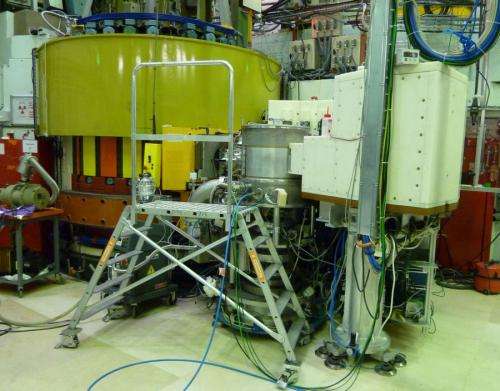
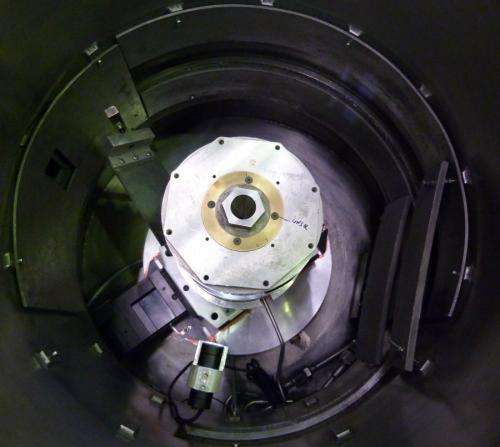
The Paris-Edinburgh press mounted on the D4c neutron diffractometer.

The structural changes in glasses and liquids induced by high-pressure conditions can substantially alter their dynamical and transport properties. Unravelling the mechanisms behind these transformations is, however, a formidable task owing to the intrinsic disorder of the atomic arrangements and the need for small samples to attain high pressure conditions. In J. Phys.: Condens. Matter 24 502101, we show that neutron diffraction with isotope substitution can be used to disentangle the structural complexity of glass at pressures up to 8 GPa (80,000 atmospheres). The work reveals the nature of density-driven structural collapse. A new probe for the structure of materials under extreme conditions is introduced.

Neutron diffraction with isotope substitution has played a key role in revealing the structure of multi-component glasses and liquids. However, there are a number of challenges at high-pressure: the sample sizes are necessarily small; the high-pressure apparatus leads to detrimental background scattering; and neutron diffraction is a flux-limited probe by comparison with x-ray diffraction. Recently, much effort has been devoted to the instrumentation and methodology required to make of the neutron for glasses and liquids at pressures within the 1–20 GPa regime. The progress made has facilitated a first exploitation of high-pressure neutron diffraction with isotope substitution. The method was applied to amorphous GeO2 on account of its role as a prototypical network-glass former and the availability of suitable isotopes.

The D4c diffractometer at the Institut Laue-Langevin.

The experimental results, obtained at the Institut Laue-Langevin, enabled the coordination environments of Ge and O to be individually resolved over an extended range of distances in real space. In particular, they provided a rigorous test of various models proposed for the mechanisms of density-driven network collapse as the structural motifs transform from GeO4 tetrahedra to GeO6 octahedra. The experimental results are in quantitative agreement only with molecular dynamics simulations made using transferrable interaction potentials that include dipole-polarization effects. Unlike its crystalline counterpart, fivefold coordinated germanium atoms in GeO2 glass play an essential role in the pressure-driven transformations.

The work in J. Phys.: Condens. Matter 24 502101 shows that with isotope substitution can be successfully applied to a prototypical glass at pressures above 1 GPa. The method enables the detailed structure around targeted chemical species to be measured over a large range of distances in real space. This provides essential and currently unavailable information for testing competing models for the density-driven collapse of materials. The work opens up a new vista of opportunity for unravelling the structural complexity of a wide range of glasses and liquids under high-pressure conditions.

Explore further: A new way of making glass

More information: iopscience.iop.org/0953-8984/24/50/502101/

add to favorites email to friend print save as pdf

Related Stories

A new technique for understanding quantum effects in water

Oct 03, 2011

It covers over two thirds of our planet, is essential for life on Earth and its chemical formula is one of the few most people can name, but we still have much to learn about the structure of H2O. Now, scientists ...

Metallic Glass Yields Secrets Under Pressure

Mar 16, 2010

(PhysOrg.com) -- Metallic glasses are emerging as potentially useful materials at the frontier of materials science research. They combine the advantages and avoid many of the problems of normal metals and ...

Cellulose breakdown

Jun 24, 2011

Ionic liquids have emerged as promising new solvents capable of disrupting the cellulose crystalline structure in a wide range of biomass feedstocks.

Under pressure: Germanium

Apr 06, 2011

(PhysOrg.com) -- Although its name may make many people think of flowers, the element germanium is part of a frequently studied group of elements, called IVa, which could have applications for next-generation ...

A new way of making glass

Nov 09, 2012

(Phys.org)—A new way to make glass has been discovered by a collaboration of researchers at the Universities of Düsseldorf and Bristol using a method that controls how the atoms within a substance are ...

Recommended for you

Promising doped zirconia

May 17, 2013

Materials belonging to the family of dilute magnetic oxides (DMOs)—an oxide-based variant of the dilute magnetic semiconductors—are good candidates for spintronics applications. This is the object of ...

Nanocrystals grow from liquid interface

May 17, 2013

An international collaboration of scientists has discovered a unique crystalizing behavior at the interface between two immiscible liquids that could aid in sustainable energy development.

User comments : 0

More news stories

A quantum simulator for magnetic materials

Physicists understand perfectly well why a fridge magnet sticks to certain metallic surfaces. But there are more exotic forms of magnetism whose properties remain unclear, despite decades of intense research. ...

Engineers pioneer flat spray-on optical lens

A University of British Columbia engineer and a team of U.S. researchers have made a breakthrough utilizing spray-on technology that could revolutionize the way optical lenses are made and used.

Researchers forward quest for quantum computing

Research teams from UW-Milwaukee and the University of York investigating the properties of ultra-thin films of new materials are helping bring quantum computing one step closer to reality.

How do cold ions slide

Things not always run smoothly. It may happen, actually, that when an object slides on another, the advancement may occur through a 'stop and go' series in the characteristic manner which scientists call ...

Controlling mood through the motions of mitochondria

(Medical Xpress)—Regulating the distribution of power in neurons is done by a system that makes the national electric grid look simple by comparison. Each neuron has several thousand mitochondria confined ...