Lord of the Wings: Elevated particles a rising star
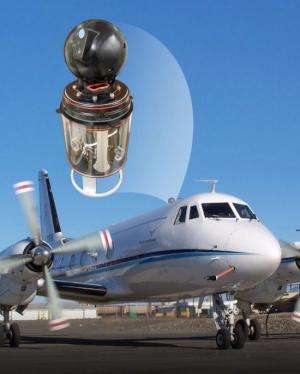
(Phys.org)—Researchers at Pacific Northwest National Laboratory, in collaboration with colleagues at NASA Ames Research Center, developed a next-generation assessment of tiny airborne particle-understanding capability, the Spectrometer for Sky-Scanning, Sun-Tracking Atmospheric Research, or 4STAR. Their new model demonstrates the potential for the new airborne instrument to obtain the most important climate-related properties of tiny particles suspended in the atmosphere.
Aerosols, tiny airborne particles of dust and pollution, affect the atmosphere and the surface of the earth by scattering and absorbing light. Scattering of the sun's light happens when direct light is reflected off the particles and redistributed, or scattered. The absorption of sunlight heats up the atmosphere while at the same time reducing the amount of sunlight reaching the earth. The combined effects of scattering and absorption can either cool or warm the earth's surface and the atmosphere itself. Improved estimation of these properties from the ground, space, and air allows scientists the flexibility to measure these particles over oceans and in areas previously unstudied.
Researchers developed 4STAR, adding next-generation tools that will exceed the observation tool currently used by NASA's AERONET program. The AERONET program relies on stationary ground-based instruments, thus limiting the measurement of these atmospheric aerosols to specific points on the globe. In contrast, with 4STAR, researchers created an airborne instrument to have the flexibility to go over previously unstudied water and land. Significantly, the new instrument also takes thousands of measurements at different wavelengths as rapidly as the existing measurement collects a measurement at a single wavelength. The team applied state-of-the-art models and simulations to test the accuracy of 4STAR.
"After eight years of research to build 4STAR, this is really good news," said PNNL atmospheric scientist and lead researcher Dr. Evgueni Kassianov. "One piece of the puzzle is complete-getting better predictions of our climate."
The 4STAR was deployed on board the PNNL-operated G-1 aircraft, part of the U.S. Department of Energy (DOE) Research Aircraft Facility, with a suite of instruments taking in situ measurements of atmospheric gases, aerosols, and clouds. The unique capabilities of the 4STAR provide a real-time airborne spectra of direct and scattered sunlight, making the 4STAR one of the "jewels in the crown" of DOE's aircraft instruments. The instrument looks like a bowling ball sitting atop the PNNL G-1 aircraft. With the optical collector trained on the sun and sky light, the rest of the instrument is below in the aircraft cabin, collecting and sending data through fiber optic cable to on board light-measuring instruments.
Future steps will involve model studies focused on identifying potential limitations and capitalizing on the advantages of the 4STAR-based aerosol measurements. Similar model studies are being performed for different observational conditions, types of aerosols, and sampling strategies.
More information: Kassianov E, C Flynn, J Redemann, B Schmid, PB Russell, and A Sinyuk. 2012. "Initial Assessment of the Spectrometer for Sky-Scanning, Sun-Tracking Atmospheric Research (4STAR)-Based Aerosol Retrieval: Sensitivity Study." Atmosphere 3(4):495-521. DOI:10.3390/atmos3040495
Provided by Pacific Northwest National Laboratory


