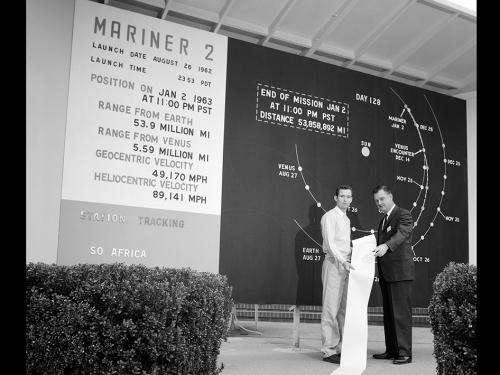
Image: Data from Venus
Dec 17, 2012
Credit: NASA/JPL

On Dec. 14, 1962, NASA's Mariner 2 spacecraft sailed close to the shrouded planet Venus, marking the first time any spacecraft had ever successfully made a close-up study of another planet. It flew by Venus as planned at a range of 34,762 km (21,600 miles), scanning the planet's atmosphere and surface for 42 minutes.

The spacecraft showed that surface temperature on Venus was at least 425°C (797°F) on both the day and night sides, hot enough to melt lead.

It also showed that Venus rotates in the opposite direction from most planets in our solar system, has an atmosphere mostly of carbon dioxide with very high pressure at the planet's surface, continuous and no detectable magnetic field. It also found the solar wind streams continuously and that the density of between planets is much lower than it is near Earth.

Explore further: NASA celebrates 50 years of planetary exploration

add to favorites email to friend print save as pdf

Related Stories

Spacecraft Tandem Provide New Views of Venus

Jul 19, 2007

NASA's Mercury Surface, Space Environment, Geochemistry, and Ranging spacecraft, known as Messenger, and the European Space Agency's Venus Express recently provided the most detailed multi-point images of ...

NASA celebrates 50 years of planetary exploration

Dec 13, 2012

(Phys.org)—Fifty years ago on a mid-December day, NASA's Mariner 2 spacecraft sailed close to the shrouded planet Venus, marking the first time any spacecraft had ever successfully made a close-up study ...

Chasing clouds on Venus

Oct 08, 2012

(Phys.org)—Clouds regularly punctuate Earth's blue sky, but on Venus the clouds never part, for the planet is wrapped entirely in a 20 km-thick veil of carbon dioxide and sulphuric dioxide haze.

Venus Express spacecraft fires main engine

Feb 20, 2006

One hundred days after its launch to Venus, the European Space Agency's Venus Express has successfully tested its main engine for the first time in space.

Recommended for you

Forecast for Titan: Wild weather could be ahead

12 hours ago

(Phys.org) —Saturn's moon Titan might be in for some wild weather as it heads into its spring and summer, if two new models are correct. Scientists think that as the seasons change in Titan's northern hemisphere, ...

SDO observes mid-level solar flare

12 hours ago

UPDATE 16:30 p.m. EDT: The M7-class flare was also associated with a coronal mass ejection or CME, another solar phenomenon that can send billions of tons of particles into space. While this CME was not Ea ...

NASA's IRIS mission readies for a new challenge

21 hours ago

(Phys.org) —The time draws near. NASA is getting ready to launch a new mission, a mission to observe a largely unexplored region of the solar atmosphere that powers its dynamic million-degree outer atmosphere and drives ...

User comments : 0

More news stories

Forecast for Titan: Wild weather could be ahead

(Phys.org) —Saturn's moon Titan might be in for some wild weather as it heads into its spring and summer, if two new models are correct. Scientists think that as the seasons change in Titan's northern hemisphere, ...

Scientists announce Top 10 New Species from 2012

An amazing glow-in-the-dark cockroach, a harp-shaped carnivorous sponge and the smallest vertebrate on Earth are just three of the newly discovered top 10 species selected by the International Institute for ...

Theorists weigh in on where to hunt dark matter

(Phys.org) —Now that it looks like the hunt for the Higgs boson is over, particles of dark matter are at the top of the physics "Most Wanted" list. Dozens of experiments have been searching for them, but ...