Astronomers go infrared to map brightest galaxies in Universe
Dec 04, 2012
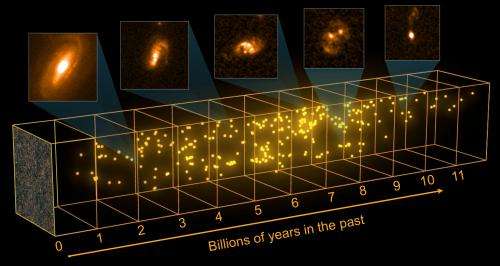
A 3D projection of almost 300 galaxies in the census in the same part of the sky. The third dimension shows how many billions of years back in time we are seeing each galaxy, determined by observations from the Keck Observatory. At top are images from the Hubble Space Telescope of five galaxies in the census. Credit: ESA-C. Carreau

(Phys.org)—A group of astronomers from the University of Hawaii at Manoa, the U.S. Mainland, Canada, and Europe recently used the twin telescopes of the W. M. Keck Observatory on Mauna Kea, Hawaii, to conduct a census of the brightest, but until now unseen, galaxies in the distant Universe, bringing astronomers one step closer to understanding how galaxies form and evolve.

These glow so brightly at that they would outshine our own Milky Way by hundreds, maybe thousands, of times. They are forming stars so quickly that between 100 and 500 new stars are born in each galaxy every year, and have been coined "starbursts" by astronomers.

While it's not clear what gives these galaxies their intense luminosity, it could be the result of a collision between two spiral-type galaxies, similar to the Milky Way and Andromeda Galaxies. Or they could be in a particularly gas-rich region of space, where galaxies form stars quickly due to constant bombardment from gas and dust.

Despite their brightness, these galaxies are nearly invisible at the wavelengths our eyes and most telescopes on Earth can see because they contain huge amounts of dust, which absorbs visible starlight. But they were detectable directly in the infrared from observations at the Herschel Space Observatory, said Dr. Caitlin Casey, a Hubble fellow at the UH Manoa Institute for Astronomy and the lead scientist behind the new results. "Herschel is an sensitive to wavelengths not observable from within Earth's atmosphere," she said.
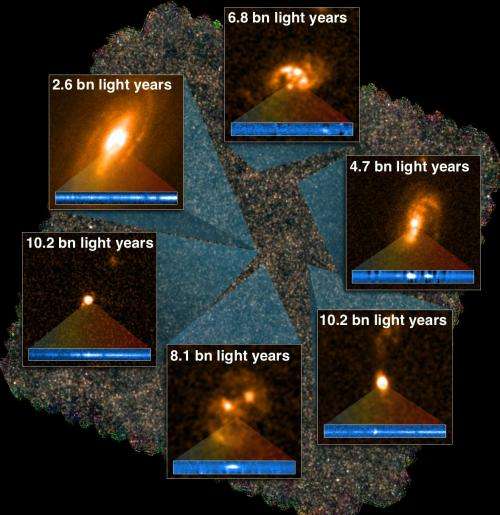
Images of six of the dusty galaxies as seen by Hubble Space Telescope with distances (in billions of light years) measured by the W. M. Keck Observatory. The background is an image of the sky in far-infrared from Herschel, where dusty galaxies like this are most easily detected. The Keck data (shown in blue below galaxy images), which spreads the light of each galaxy into a spectrum, allowed the astronomers to measure distances to each galaxy using “fingerprints” of atoms and molecules in each galaxy. These galaxies were previously unidentified due to the large amounts of dust absorbing the visible light. Credit: ESA-C. Carreau

"Detecting these bright used to be difficult, and a handful was plenty; now with Herschel we are finding them by the thousands, enabling a census like this," said Göran Pilbratt, Herschel Project Scientist.

Once found, taking measurements of these galaxies at required using the 10-meter Keck telescopes, the two largest in the world. Over the course of several nights the group was able to detect and measure distances to nearly 800 of these galaxies.

"For the first time, we have been able to measure distances, star formation rates, and temperatures for a brand new set of 767 previously unidentified galaxies," said Dr. Scott Chapman, a co-author on the studies. "The previous similar survey of distant infrared starbursts only covered 73 galaxies. This is a huge improvement."

"While some of the galaxies are nearby, most are very distant; we even found galaxies that are so far that their light has taken 12 billion years to travel here, so we are seeing them when the Universe was only a ninth of its current age," Casey said. "Now that we have a pretty good idea of how important this type of galaxy is in forming huge numbers of stars in the Universe, the next step is to figure out why and how they formed."

"It's hard to figure out how most galaxies formed based on information from only a small part of the Universe, just like it's hard to guess how big an elephant is if you only get a glimpse of its tail," Casey said. "Now that we have an accurate census of starbursting galaxies across a huge time period in the Universe's history, we can start to piece together how these galaxies grew and evolved."

Two papers detailing these results are published online today in the Astrophysical Journal.

Explore further: Fine-tuning galaxies with Herschel and Spitzer

More information: Casey, C.M., et al. A redshift survey of Herschel far-infrared selected starbursts and implications for obscured star formation, The Astrophysical Journal, 04 Dec 2012.

Casey, C.M., et al. A population of z>2 far-infrared Herschel-SPIRE selected starbursts, The Astrophysical Journal, 04 Dec 2012.

Related Stories

Fine-tuning galaxies with Herschel and Spitzer

Nov 19, 2012

(Phys.org)—Galaxies come in all shapes and sizes: from those with compact fuzzy bulges or central bars to galaxies with winding spiral arms. Astronomer Edwin Hubble classified these different breeds of ...

Mysterious red galaxies

Dec 12, 2011

(PhysOrg.com) -- Perhaps the most astonishing and revolutionary discovery in cosmology was Edwin Hubble's observation that galaxies are moving away from us with velocities that are proportional to their distances. ...

Herschel paints new story of galaxy evolution

Sep 13, 2011

(PhysOrg.com) -- ESA's Herschel infrared space observatory has discovered that galaxies do not need to collide with each other to drive vigorous star birth. The finding overturns this long-held assumption ...

Radio galaxies in the distant universe

Jun 26, 2012

(Phys.org) -- For over a decade astronomers have been probing a region of the northern sky, not far from the handle of the Big Dipper, that is relatively free of bright stars and the diffuse glow of the Milky ...

'Big baby' galaxy found in newborn Universe

Sep 28, 2005

The NASA/ESA Hubble Space Telescope and NASA’s Spitzer Space Telescope have teamed up to 'weigh' the stars in distant galaxies. One of these galaxies is not only one of the most distant ever seen, but it appears to be unusually ...

Recommended for you

4C+29.30: Black hole powered jets plow into galaxy

May 15, 2013

(Phys.org) —This composite image of a galaxy illustrates how the intense gravity of a supermassive black hole can be tapped to generate immense power. The image contains X-ray data from NASA's Chandra X-ray ...

A space-time magnifying glass

May 15, 2013

(Phys.org) —Bright arcs are smeared around the heart of galaxy cluster Abell S1077 in this image taken by the NASA/ESA Hubble space telescope. The arcs are stretched images of distant galaxies distorted ...

Orion's hidden fiery ribbon

May 15, 2013

(Phys.org) —This dramatic new image of cosmic clouds in the constellation of Orion reveals what seems to be a fiery ribbon in the sky. This orange glow represents faint light coming from grains of cold ...

User comments : 0

More news stories

Alaska volcano shoots ash 15,000 feet into the air

(AP)—One of Alaska's most restless volcanoes has shot an ash cloud 15,000 feet into the air in an ongoing eruption that has drawn attention from a nearby community but isn't expected to threaten air traffic.

Chinese, Indian airlines face EU pollution fines

Eight Chinese and two Indian airlines face fines of up to several million euros for not paying for their greenhouse gas emissions during flights within the bloc, the European Commission said on Friday.

Yahoo Japan suspects 22 million IDs stolen

Yahoo Japan Corp. has said it suspects up to 22 million user IDs may have been stolen during an unauthorised attempt to access the administrative system of its Yahoo! Japan portal.

US seizes Bitcoin operator accounts

US authorities seized the accounts of a Bitcoin digital currency exchange operator, claiming it was functioning as an "unlicensed money service business," court documents showed Friday.

Temporal processing in the olfactory system

The neural machinery underlying our olfactory sense continues to be an enigma for neuroscience. A recent review in Neuron seeks to expand traditional ideas about how neurons in the olfactory bulb might encode information about ...