Keeping the wheels turning: 20th annual NASA great moonbuggy race
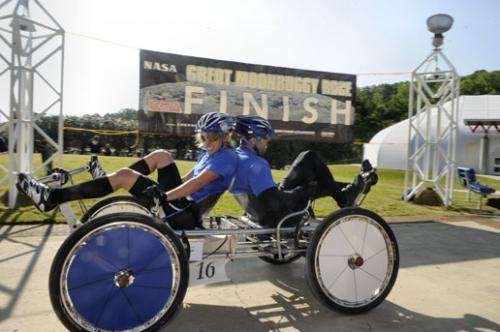
Registration is now open for the 20th annual NASA Great Moonbuggy Race, which challenges high school, college and university students around the world to build and race fast, lightweight "moonbuggies" of their own design.
The students' work will culminate in two days of competitive racing April 26-27, 2013, at the U.S. Space and Rocket Center in Huntsville, Ala. NASA created the event two decades ago to complement classroom learning, provide young thinkers and builders with real-world engineering experience and inspire them to consider careers in science, technology, engineering and mathematics—the STEM fields.
"It's our goal to keep the wheels turning," said Tammy Rowan, manager of the Academic Affairs Office at NASA's Marshall Space Flight Center in Huntsville, which organizes the race each year. "The ingenuity and enthusiasm we see among racers begins in the classroom. That first spark of interest—whether it's in basic chemistry or astronomy or the history of spaceflight—starts the wheels turning. The Great Moonbuggy Race helps sustain that momentum, turning interest into passion, and dreams into a lifelong pursuit of new answers and new horizons."
International registration for the 2013 race closes Jan. 7. Registration for U.S. teams closes Feb. 4. Participating high schools, colleges and universities each may register up to two teams and two vehicles. For complete rules and to register, visit: moonbuggy.msfc.nasa.gov
When Marshall created the race as a regional college challenge during the 1993-1994 school year, only eight teams participated. The high school division was added in 1996, and registration has swelled ever since.
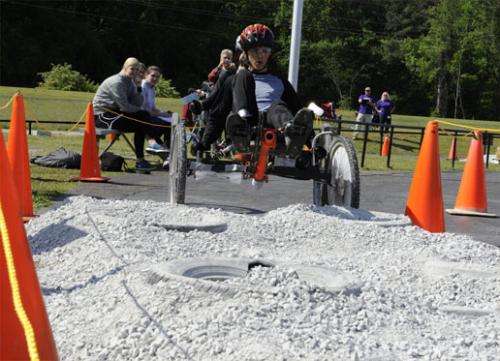
Racers compete to post the fastest vehicle assembly and race times in their divisions, while incurring the fewest penalties. Prizes are awarded to the three teams in each division that finish with the lowest final times. NASA and industry sponsors present additional awards for engineering ingenuity, team spirit, best debut by a rookie team and more.
The course, built each spring on the outdoor grounds of the Space and Rocket Center, comprises a winding half-mile of gravel embankments, sand pits and obstacles that mimic the harsh surface of the moon. The race's creators drew inspiration from conditions faced by the Apollo-era Lunar Roving Vehicles. Three rovers built at Marshall in the late 1960s were used on the moon during the Apollo 15, Apollo 16 and Apollo 17 missions in 1971 and 1972.
Today, the students' moonbuggies address many of the same design challenges NASA and industry engineers overcame to deliver those historic rovers. The vehicles dramatically expanded astronauts' reach across the lunar surface and enabled them to conduct much more scientific research during their brief stays on the moon.
In the most recent Great Moonbuggy Race, held in April 2012, more than 70 teams tackled the course. Petra Mercado High School in Humacao, Puerto Rico was first place in the high school division. The University of Alabama in Huntsville won first place in the college division. Petra Mercado, in only its second year in the competition, earned a completion time of 3 minutes and 20 seconds. The winning University of Alabama in Huntsville team finished in 4 minutes and 3 seconds.
To date, more than 5,000 students from around the world have participated in the races. Past winning teams have hailed from Alabama, Arizona, California, Illinois, Indiana, Kansas, Kentucky, Louisiana, Missouri, New Hampshire, New Jersey, New York, North Dakota, Ohio, Puerto Rico, Rhode Island, Tennessee, Utah and Wyoming—and from Canada and Germany. International racers have come from as far away as India, Italy, Romania, Russia and the United Arab Emirates.
Racers from Erie High School in Erie, Kan., have held the record for the best course-completion time since 2008. Their best overall time of 3 minutes and 17 seconds earned the first-place trophy in the high school division that year.
More than 350,000 people watched live and archived coverage of the spring 2012 race on NASA TV and on UStream. For archived footage of the competition, visit: www.ustream.tv/channel/nasa-msfc .
More information: For images and additional information about past races, visit: www.nasa.gov/moonbuggy.
Provided by NASA


