Scientists pioneer method to predict environmental collapse
Nov 19, 2012
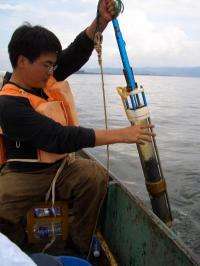
Researcher Enlou Zhang takes a core sample from the bed of Lake Erhai in China. Credit: University of Southampton

Scientists at the University of Southampton are pioneering a technique to predict when an ecosystem is likely to collapse, which may also have potential for foretelling crises in agriculture, fisheries or even social systems.

The researchers have applied a mathematical model to a real world situation, the environmental collapse of a lake in China, to help prove a theory which suggests an ecosystem 'flickers', or fluctuates dramatically between healthy and unhealthy states, shortly before its eventual collapse.

Head of Geography at Southampton, Professor John Dearing explains: "We wanted to prove that this 'flickering' occurs just ahead of a dramatic change in a system – be it a social, ecological or climatic one – and that this method could potentially be used to predict future critical changes in other impacted systems in the world around us."

A team led by Dr Rong Wang extracted from sediment at the bottom of Lake Erhai in Yunnan province, China and charted the levels and variation of fossilised algae (diatoms) over a 125-year period. Analysis of the core sample data showed the algae communities remained relatively stable up until about 30 years before the lake's collapse into a turbid or polluted state. However, the core samples for these showed much fluctuation, indicating there had been numerous dramatic changes in the types and concentrations of algae present in the water – evidence of the 'flickering' before the lake's final definitive change of state.

Rong Wang comments: "By using the algae as a measure of the lake's health, we have shown that its eco-system 'wobbled' before making a critical transition – in this instance, to a turbid state.

"Dramatic swings can be seen in other data, suggesting large external impacts on the lake over a long time period – for example, pollution from fertilisers, sewage from fields and changes in water levels – caused the system to switch back and forth rapidly between alternate states. Eventually, the lake's ecosystem could no longer cope or recover – losing resilience and reaching what is called a 'tipping point' and collapsing altogether."

The researchers hope the method they have trialled in China could be applied to other regions and landscapes.

Co-author Dr Pete Langdon comments: "In this case, we used algae as a marker of how the lake's ecosystem was holding-up against external impacts – but who's to say we couldn't use this method in other ways? For example, perhaps we should look for 'flickering' signals in climate data to try and foretell impending crises?"

Explore further: Chinese, Indian airlines face EU pollution fines

More information: lickering gives early warning signals of a critical transition to a eutrophic lake state, Nature, 18 November 2012.

Related Stories

Lake Erie algae, ice, make a nice mix in winter

Jan 11, 2012

Clarkson University Biology Professor Michael R. Twiss has been working with colleagues and students from Ohio, Pennsylvania, Tennessee and Ontario, to study Lake Erie over the past five winters during mid-winter, ...

Loss of 'lake lawnmowers' leads to algae blooms

Sep 28, 2011

Unprecedented algae growth in some lakes could be linked to the decline of water calcium levels and the subsequent loss of an important algae-grazing organism that helps keep blooms at bay.

Recommended for you

Chinese, Indian airlines face EU pollution fines

12 hours ago

Eight Chinese and two Indian airlines face fines of up to several million euros for not paying for their greenhouse gas emissions during flights within the bloc, the European Commission said on Friday.

Fracking risks to ground water assessed

May 17, 2013

(Phys.org) —Extraction of "unconventional" gas from sedimentary rocks such as shale could provide a clean energy source and help some regions to become energy independent, but concerns have been raised ...

Caribbean talks conservation on Branson's island

May 17, 2013

(AP)—Surrounded by a turquoise sea and a menagerie of exotic animals on a billionaire's private island, political and business leaders gathered Friday to back an initiative aimed at expanding protection ...

User comments : 1

Adjust slider to filter visible comments by rank

Display comments: newest first

StarGazer2011
1 / 5 (1) Nov 20, 2012
seems to me that they have demonstrated that at least one complex system exhibited punctuated equilibria and fluctuated between two stable states before settling on one, according to a single measurement.
Not sure why they characterise the former as 'good' and the latter as 'bad'; seems a bit unscientific and preachy. Perhaps there are species which prefer turbidity, just not the algae they had fossils for?

More news stories

Galaxy's Ring of Fire

Johnny Cash may have preferred this galaxy's burning ring of fire to the one he sang about falling into in his popular song. The "starburst ring" seen at center in red and yellow hues is not the product of ...

Alaska volcano shoots ash 15,000 feet into the air

(AP)—One of Alaska's most restless volcanoes has shot an ash cloud 15,000 feet into the air in an ongoing eruption that has drawn attention from a nearby community but isn't expected to threaten air traffic.

Chinese, Indian airlines face EU pollution fines

Eight Chinese and two Indian airlines face fines of up to several million euros for not paying for their greenhouse gas emissions during flights within the bloc, the European Commission said on Friday.

US psychiatry gets makeover in new manual

The latest makeover to a massive psychiatric tome honored by some, reviled by others and even called the "Bible" of mental disorders is being released Saturday with a host of new changes.

Morocco to harness the wind in energy hunt

Morocco is ploughing ahead with a programme to boost wind energy production, particularly in the southern Tarfaya region, where Africa's largest wind farm is set to open in 2014.