New bright and blue supernova in NGC 1365
Nov 14, 2012 by Nancy Atkinson, Universe Today
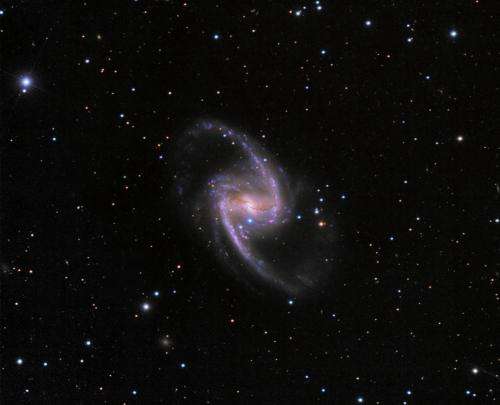
Supernova 2012fr in NGC 1365. It is the bright blue “star” directly below the galaxy core. Credit: Rolf Wahl Olsen

A very bright supernova has shown up NGC 1365, the galaxy also known as the Great Barred Spiral Galaxy, visible now for southern hemisphere observers. This already elegant galaxy lies about 56 million light-years away in the constellation Fornax. The supernova, a type Ia, was discovered by Alain Klotz with the TAROT telescope at the La Silla Observatory in Chile on October 27, 2012. "The supernova is a very nice addition to the already highly photogenic galaxy," said Rolf Wahl Olsen, who took the gorgeous image above. "I'm amazed by how blue it is; it's really intense."

Supernova 2012fr is the bright and intensely blue star directly below the galaxy core. Olsen said that as of November 10, 2012 the supernova appeared to be nearing its peak, with an R magnitude of 11.90.

"To get an idea of how bright this event is we can calculate the absolute magnitude M of the supernova using the following formula where m is the apparent magnitude and D the distance in : M = m – 5(log10(D) – 1)," Olsen wrote. "This gives an absolute magnitude of -19.27 for SN2012fr. This means that if the supernova had occurred at a distance to us similar to Betelgeuse (643 light years), then its apparent magnitude would be -12.80, same as the !"

Details about Olsen's image:
Date: 7th and 9th November 2012
Exposure: LRGB: 205:57:56:51m, total 6hrs 9mins @ -30C
Telescope: 10″ Serrurier Truss Newtonian f/5
Camera: QSI 683wsg with Lodestar guider
Filters: Astrodon LRGB E-Series Gen 2
Taken from his observatory in Auckland, New Zealand

See more of Olsen's astrophotography at his Flickr page.

Explore further: A blue whirlpool in The River: Tranquil galaxy home to violent events

add to favorites email to friend print save as pdf

Related Stories

The purple rose of Virgo

Mar 27, 2007

Until now NGC 5584 was just one galaxy among many others, located to the West of the Virgo Cluster. Known only as a number in galaxy surveys, its sheer beauty is now revealed in all its glory in a new VLT image. ...

Space image: New supernova remnant lights up

Sep 13, 2011

(PhysOrg.com) -- Using the Hubble Space Telescope, astronomers are witnessing the unprecedented transition of a supernova to a supernova remnant, where light from an exploding star in a neighboring galaxy, ...

Watching a star explode

Mar 23, 2012

NASA's Astronomy Picture of the Day for March 22 features a snapshot of a supernova - a massive star explosion - discovered only a week ago.

10-year-old girl discovers a supernova

Jan 04, 2011

A ten-year old girl from Canada has discovered a supernova, making her the youngest person ever to find a stellar explosion. The Royal Astronomical Society of Canada announced the discovery by Kathryn Aurora ...

Image: Going supernova

Jan 14, 2011

While searching the skies for black holes using NASA's Spitzer Space Telescope, astronomers discovered a giant supernova that was smothered in its own dust.

Recommended for you

Three centaurs follow Uranus through the solar system

7 hours ago

Astrophysicists from the Complutense University of Madrid have confirmed that Crantor, a large asteroid with a diameter of 70 km has an orbit similar to that of Uranus and takes the same amount of time to ...

Final curtain for Europe's deep-space telescope

Jun 17, 2013

The deep-space telescope Herschel took its final bow on Monday, climaxing a successful four-year mission to observe the birth of stars and galaxies, the European Space Agency (ESA) said.

Hubble spots a very bright contortionist

Jun 17, 2013

(Phys.org) —The contorted object captured by Hubble in this picture is IRAS 22491-1808, also known as the South America Galaxy. It is an ultra-luminous infrared galaxy (ULIRG) that emits a huge amount of ...

Study explains decades of black hole observations

Jun 14, 2013

(Phys.org) —A new study by astronomers at NASA, Johns Hopkins University and Rochester Institute of Technology confirms long-held suspicions about how stellar-mass black holes produce their highest-energy ...

User comments : 0

More news stories

Respect may be the key to stopping patient 'no shows'

People with HIV are more likely to keep their scheduled medical appointments—and their disease under control—if they feel their physician listens, explains things clearly and knows them as a person, not just a "case," ...