Baiting mosquitoes with knowledge and proven insecticides
Nov 13, 2012 by Sandra Avant
Baiting mosquitoes with knowledge and proven insecticides
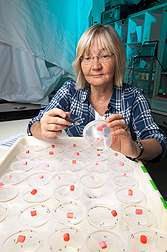
ARS entomologist Sandra Allan has found that five different classes of insecticides can be mixed with a sugar bait to attract and kill mosquitoes. Credit: Stephen Ausmus

While one team of U.S. Department of Agriculture (USDA) scientists is testing the effectiveness of pesticides against mosquitoes, another group is learning how repellents work.

At the Agricultural Research Service (ARS) Center for Medical, Agricultural and Veterinary Entomology (CMAVE) in Gainesville, Fla., entomologist Sandra Allan is using toxic sugar-based baits to lure and kill . Allan and her CMAVE cooperators are evaluating insecticides and designing innovative technology to fight biting insects and arthropods. ARS is USDA's principal intramural scientific research agency.

Allan studied 10 different commercial pesticides that contain additives that enable the pesticides to be dissolved in water and ingested by mosquitoes. Pesticides were combined with a sucrose solution and fed to females of three mosquito species that transmit pathogens such as and arboviruses. While only females feed on blood, all mosquitoes need to feed on sugar and will potentially be attracted to—and ingest—the toxic sugar bait.

Compounds from five different classes of insecticide-active ingredients—pyrethroids, phenylpyroles, pyrroles, neonicotinoids and macrocyclic lactones—were found to be toxic against all three mosquito species, Culex quinquefasciatus, Anopheles quadrimaculatus and Aedes taeniorhynchus.

Scientists at the ARS Henry A. Wallace Beltsville Agricultural Research Center in Beltsville, Md., are learning more about how mosquito repellents work. Entomologist Joseph Dickens and post-doctoral research associate Jonathan Bohbot found that several repellents—DEET, 2-undecanone, IR3535 and picaridin—affect specific odorant receptors in mosquitoes differently, thereby scrambling the insect's ability to detect chemical attractants.

In experiments, they injected with odorant receptor genes. within the eggs allowed these receptors to be reproduced in the outer cell membrane of the egg. Researchers then placed electrodes in the outer cell membrane and recorded electrical responses of the to chemical solutions.

Explore further: Mosquitoes -- how we smell is why they bite, research shows

add to favorites email to friend print save as pdf

Related Stories

Montana mosquito season is extended

Sep 14, 2006

Unusually long-lasting hot weather conditions in Montana have prompted U.S. scientists to extend the season for mosquitoes that carry the West Nile virus.

Device targets mosquitoes with deadly nectar

May 06, 2009

(AP) -- The ProVector Bt may not look too much like a real flower, but the artificial device sports bright, finely tuned colors and sweet nectar that can lure and kill mosquitoes that potentially carry diseases.

Recommended for you

Unlocking secrets of cell reproduction

10 minutes ago

Research published in Open Biology today identifies, for the first time, nearly all the genes required for reproduction of a cell in a living organism.

Scientists announce Top 10 New Species from 2012

2 hours ago

An amazing glow-in-the-dark cockroach, a harp-shaped carnivorous sponge and the smallest vertebrate on Earth are just three of the newly discovered top 10 species selected by the International Institute for ...

What the smallest infectious agents reveal about evolution

12 hours ago

Radically different viruses share genes and are likely to share ancestry, according to research published in BioMed Central's open access journal Virology Journal this week. The comprehensive phylogenomic analysis compar ...

User comments : 0

More news stories

Unlocking secrets of cell reproduction

Research published in Open Biology today identifies, for the first time, nearly all the genes required for reproduction of a cell in a living organism.

Scientists announce Top 10 New Species from 2012

An amazing glow-in-the-dark cockroach, a harp-shaped carnivorous sponge and the smallest vertebrate on Earth are just three of the newly discovered top 10 species selected by the International Institute for ...

US teen birth rate drops to record low

US teen births have dropped to a record low, but the country still has one of the highest rates among developed nations, the US Centers for Disease Control and Prevention said Thursday.

Very Large Telescope celebrates 15 years of success

(Phys.org) —With this new view of a spectacular stellar nursery ESO is celebrating 15 years of the Very Large Telescope—the world's most advanced optical instrument. This picture reveals thick clumps ...

US House sends message on Keystone pipeline

US lawmakers agreed to a bill that would speed construction of a Canada-US oil pipeline and circumvent the need for President Barack Obama's approval for the $5 billion project.

Be prepared for weather extremes

Unsettled weather is an Iowa mainstay, and so is Inside's annual reminder of the university's severe weather safety and preparedness guidelines—for storms, extreme heat, flooding and more.