Astronomers clash over the distance to the famed North Star
Nov 30, 2012
Credit: Canadian Astronomical Society

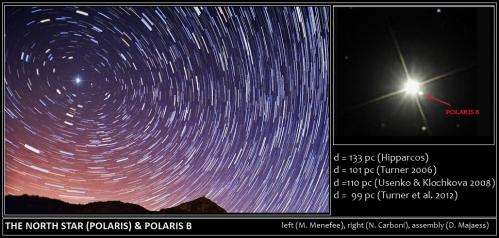
(Phys.org)—The North Star (Polaris) has played an important role in human history, yet knowledge of its fundamental parameters is unsatisfactory. That problem is attributable in large part to uncertainties tied to the star's distance, which have now been resolved in a paper by David Turner and colleagues.

Polaris is the nearest designated as a Cepheid variable. Solid knowledge of the distance to Polaris will facilitate efforts to determine the and constrain parameters for the mysterious dark energy. A reliable distance to Polaris would enable further calibration of the famed Cepheid relations, which lie at the heart of establishing the cosmic distance scale.

The ambiguity concerning the distance to Polaris, or rather the stars that constitute the Polaris system (there exist at least two companions), stems from the fact that the Hipparcos satellite measured its distance to be 133 pc (434 light-years), whereas some other studies placed it closer to the Sun. Turner's paper in the advocates a distance of 99 pc (323 light-years).

The new distance established for Polaris by David Turner and collaborators relies on a high-resolution spectral analysis. The discrepancy between the various distance estimates for Polaris translates into a 30% relative uncertainty, which ironically implies that astronomers know the distances to certain galaxies orbiting the Milky Way (i.e., the ) to better relative accuracy, despite their being some 500 times more distant than Polaris.

"Polaris presents certain anomalies that have so far defied a straightforward interpretation," noted Turner. He went on to add, "Our high-resolution spectroscopic observations of Polaris may signal the beginning of a new era in understanding the star."

Explore further: Scientists work out way to use pulsars to provide self navigation to spacecraft in solar system

More information: A preprint of the article, which will appear in the Astrophysical Journal Letters, is available here: arxiv.org/abs/1211.6103

Related Stories

The Polaris Cluster

May 28, 2010

(PhysOrg.com) -- A Cepheid star is one whose mass and age results in physical conditions that generate periodic oscillations in its photosphere. A Cepheid thus varies regularly in brightness, with a period ...

There's More to the North Star Than Meets the Eye

Jan 09, 2006

We tend to think of the North Star, Polaris, as a steady, solitary point of light that guided sailors in ages past. But there is more to the North Star than meets the eye - two faint stellar companions. The ...

Cepheids and their 'cocoons'

Feb 28, 2006

Using ESO's Very Large Telescope Interferometer (VLTI) at Cerro Paranal, Chile, and the CHARA Interferometer at Mount Wilson, California, a team of French and North American astronomers has discovered envelopes ...

The little Cepheid that stopped

Jan 14, 2011

When Hubble first discovered a Cepheid variable in the galaxy M31, the universe grew. Previously, many astronomers had held that the fuzzy “spiral nebulae” were small patches of gas and dust within ...

Moving Closer to the Grand Spiral

Aug 01, 2005

An international team of astronomers from Chile, Europe and North America is announcing the most accurate distance yet measured to a galaxy beyond our Milky Way's close neighbours. The distance was determined ...

Recommended for you

Hubble reveals the ring nebula's true shape

16 hours ago

(Phys.org) —The Ring Nebula's distinctive shape makes it a popular illustration for astronomy books. But new observations by NASA's Hubble Space Telescope of the glowing gas shroud around an old, dying, ...

A hidden population of exotic neutron stars

21 hours ago

(Phys.org) —Magnetars – the dense remains of dead stars that erupt sporadically with bursts of high-energy radiation - are some of the most extreme objects known in the Universe. A major campaign using ...

Very Large Telescope celebrates 15 years of success

May 23, 2013

(Phys.org) —With this new view of a spectacular stellar nursery ESO is celebrating 15 years of the Very Large Telescope—the world's most advanced optical instrument. This picture reveals thick clumps ...

User comments : 0

More news stories

Strong earthquake at exceptional depth

This morning at 05:45 CEST, the earth trembled beneath the Okhotsk Sea in the Pacific Northwest. The quake, with a magnitude of 8.2, took place at an exceptional depth of 605 kilometers. Because of the great ...

NASA ships sensors for seafaring satellite to France

(Phys.org) —Three NASA-built instruments that are integral components of the next in a series of U.S./European ocean altimetry satellites have arrived in France for integration with their spacecraft in ...