NASA's TRMM satellite sees very heavy rains in fading Tropical Storm Prapiroon
Oct 18, 2012
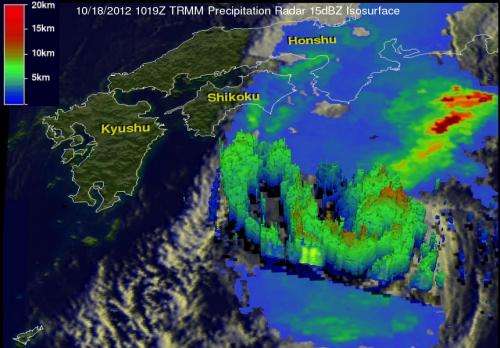
Prapiroon's winds had dropped to less than 35 knots (~40 mph) when the TRMM data were collected on Oct. 18. Despite the drop in wind speed, some powerful thunderstorms around Prapiroon's center were still reaching heights above 12 kilometers (~7.6 miles). Credit: SSAI/NASA, Hal Pierce

Heavy rainfall returned to Typhoon Prapiroon for a brief time on Oct. 18 when NASA's TRMM satellite passed overhead. Prapiroon is battling strong wind shear and is expected to transition into an extra-tropical storm in the next day.

NASA's Tropical Rainfall Measuring Mission (TRMM) satellite captured rainfall data on Prapiroon twice on Oct. 18 when it passed overhead. The first orbit was at 0845UTC and the second at 1019 UTC. TRMM's (TMI) and (PR) data show that rain associated with Prapiroon was falling at a rate of over 75mm/hour (~3 inches) in a feeder band northwest of the center of circulation.

Some of the rainfall occurring over Japan on Oct. 18 was being caused by a frontal system that was interacting with tropical Storm Prapiroon.

At NASA's Goddard Space Flight Center in Greenbelt, Md., Hal Pierce of the TRMM team created a 3-D image of the storm using TRMM PR data received with the 1019 UTC (6:19 a.m. EDT) orbit. Prapiroon was once a powerful typhoon with winds of 100 knots (~115 mph). Prapiroon's winds had dropped to less than 35 knots (~40 mph/65 kph) when the were collected. Despite the drop in wind speed, some powerful thunderstorms around Prapiroon's center were still reaching heights above 12 kilometers (~7.6 miles).

By 1500 UTC on Oct. 18, Prapiroon's maximum sustained winds dropped near 35 knots (40 mph/65 kph). Tropical storm Prapiroon was, located approximately 325 nautical miles south-southwest of yokosuka, japan, near 30.9 North latitude and 138.9 East longitude. The storm has accelerated northeastward at 33 knots (38 mph/62 kph) .

Just five hours after the second overpass, the Joint noted that "animated showed deep central convection has unraveled and sheared north of the low level circulation center."

Prapiroon is undergoing transitioning while battling strong wind shear and is expected to become extra-tropical by Oct. 19.

Explore further: NASA satellite indicates Tropical Storm Prapiroon's rains mostly south of center

add to favorites email to friend print save as pdf

Related Stories

NASA eyes Typhoon Prapiroon intensifying

Oct 09, 2012

Typhoon Prapiroon is the twenty-second tropical cyclone of the western North Pacific Ocean, making for a very active season. NASA's Terra satellite passed over the storm as it was intensifying into a typhoon ...

NASA eyes Typhoon Prapiroon's U-turn

Oct 10, 2012

Typhoon Prapiroon is making a U-turn in the Philippine Sea, changing direction from northwest to northeast. NASA's Aqua satellite captured an image of the typhoon as it began turning. Visible satellite imagery ...

Recommended for you

Russia evacuates drifting Arctic research station

5 hours ago

Russia has ordered the urgent evacuation of the 16-strong crew of a drifting Arctic research station after ice floe that hosts the floating laboratory began to disintegrate, officials said Thursday.

Bacterium from Canadian High Arctic and life on Mars

7 hours ago

(Phys.org) —The temperature in the permafrost on Ellesmere Island in the Canadian high Arctic is nearly as cold as that of the surface of Mars. So the recent discovery by a McGill University led team of ...

User comments : 0

More news stories

A hidden population of exotic neutron stars

(Phys.org) —Magnetars – the dense remains of dead stars that erupt sporadically with bursts of high-energy radiation - are some of the most extreme objects known in the Universe. A major campaign using ...

Solar Kettle allows for boiling water off the grid

(Phys.org) —A company called Contemporary Energy has unveiled a new device it calls the Solar Kettle. It looks very much like a normal coffee thermos, but has flaps on one side that open to allow for collecting ...

Ferrets, pigs susceptible to H7N9 avian influenza virus

Chinese and U.S. scientists have used virus isolated from a person who died from H7N9 avian influenza infection to determine whether the virus could infect and be transmitted between ferrets. Ferrets are often used as a mammalian ...

Scientists develop cheaper, more efficient fuel cells

(Phys.org) —Using the Canadian Light Source (CLS) synchrotron, researchers have discovered a way to create cheaper fuel cells by dividing normally expensive platinum metal into nanoparticles (or even single ...