NASA satellite reveals some strong rainfall in meandering Typhoon Prapiroon
Oct 15, 2012
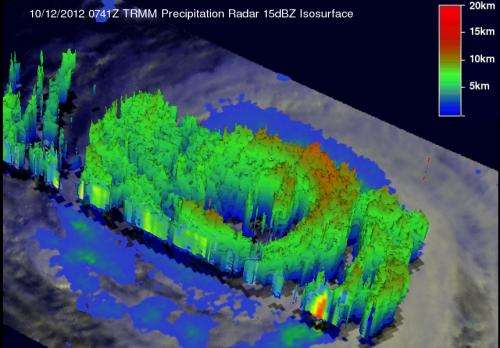
This 3-D view of Typhoon Prapiroon was taken from the northwest on Oct. 12, 2012, and clearly shows the vertical structure of Prapiroon's precipitation. The strongest rainfall (50 mm/2 inches per hour) was found in the southeastern side of Prapiroon's eye wall. Credit: SSAI/NASA, Hal Pierce

Typhoon Prapiroon has been meandering in the western North Pacific Ocean over the weekend of Oct. 13 and 14, and NASA's TRMM satellite was able to identify where the strongest rainfall was occurring in the storm.

The Measuring Mission (TRMM) satellite passed directly above weakening Typhoon Prapiroon in the western Pacific Ocean on October 12, 2012 at 0741 UTC (3:41 a.m. EDT). At that time, Typhoon Prapiroon was a powerful category two typhoon on the Saffir-Simpson scale with winds slightly less than 95 knots (~109 mph).

A 3-D image of the storm was created at NASA's Goddard Space Flight Center in Greenbelt, Md. using data on Oct. 12 gathered from TRMM's data. The view, taken from the northwest, clearly showed the vertical structure of Prapiroon's precipitation and cloud heights. The strongest rainfall was found in the southeastern side of Prapiroon's eye wall and was falling at a rate of 50 mm/2 inches per hour. tops in that vicinity were as high as 15 kilometers (9 miles), indicating strong storms. To see a flyby video of the Prapiroon in 3-D: http://trmm.gsfc.nasa.gov/trmm_rain/Events/prapiroon_12_october_2012_0741_utc_trmm_radar_animated.gif

On Oct. 15 at 1500 UTC (11 a.m. EDT) Prapiroon was still quasi-stationary. It was weaker, though, packing near 75 knots (86.3 mph/138.9 kph) and was located near 22.4 North latitude and 131.0 East longitude. That put the storm's center about 305 nautical miles (403 miles/648 km) southeast of Kadena Air Base, Okinawa, Japan.

on Oct. 15 showed that the cloud top temperatures around Prapiroon's eye had warmed, indicating that there was not as much power or uplift within the storm. Warming cloud top temperatures mean that the thunderstorms that make up the tropical cyclone are lower in the atmosphere than they were before, and they're weaker than before.

After another day of meandering, Prapiroon is expected to start tracking to the north-northeast because a ridge (elongated area) of high pressure is building in from the east and its air flow in a clockwise direction, will push Prapiroon around it and toward the northeast. Once it starts moving, Prapiroon's center is expected to stay over open water. However, the storm's western fringes are expected to brush eastern Japan later in the week of Oct. 15.

Explore further: NASA sees heaviest rainfall near Typhoon Prapiroon's center

add to favorites email to friend print save as pdf

Related Stories

NASA eyes Typhoon Prapiroon intensifying

Oct 09, 2012

Typhoon Prapiroon is the twenty-second tropical cyclone of the western North Pacific Ocean, making for a very active season. NASA's Terra satellite passed over the storm as it was intensifying into a typhoon ...

NASA eyes Typhoon Prapiroon's U-turn

Oct 10, 2012

Typhoon Prapiroon is making a U-turn in the Philippine Sea, changing direction from northwest to northeast. NASA's Aqua satellite captured an image of the typhoon as it began turning. Visible satellite imagery ...

Recommended for you

Alaska volcano shoots ash 15,000 feet into the air

May 18, 2013

(AP)—One of Alaska's most restless volcanoes has shot an ash cloud 15,000 feet into the air in an ongoing eruption that has drawn attention from a nearby community but isn't expected to threaten air traffic.

NASA sees Cyclone Mahasen hit Bangladesh

May 17, 2013

NASA's Tropical Rainfall Measuring Mission satellite known as TRMM measured Cyclone Mahasen's rainfall rates from space as it made landfall on May 16. Mahasen has since dissipated over eastern India.

Rapid climate change ruled out ice age trees

May 17, 2013

Short, sharp fluctuations in the Earth's climate throughout the last ice age may have stopped trees from getting a foothold in Europe and northern Asia, scientists say.

User comments : 0

More news stories

Mice, gerbils perish in Russia space flight

A number of mice and eight gerbils sent into space in a Russian capsule destined to find out how well organisms can withstand extended flights perished during their journey, scientists said Sunday as the ...

Bold action, big money needed to curb Asia floods

Asia's flood-prone megacities should fund major drainage, water recycling and waste reduction projects to stem deluges and secure clean supply for their booming populations, experts said Sunday.

Honeybees trained in Croatia to find land mines

(AP)—Mirjana Filipovic is still haunted by the land mine blast that killed her boyfriend and blew off her left leg while on a fishing trip nearly a decade ago. It happened in a field that was supposedly ...

Heat-related deaths in Manhattan projected to rise

Residents of Manhattan will not just sweat harder from rising temperatures in the future, says a new study; many may die. Researchers say deaths linked to warming climate may rise some 20 percent by the 2020s, ...