NASA's LADEE spacecraft gets final science instrument installed
Oct 26, 2012 by Rachel Hoover
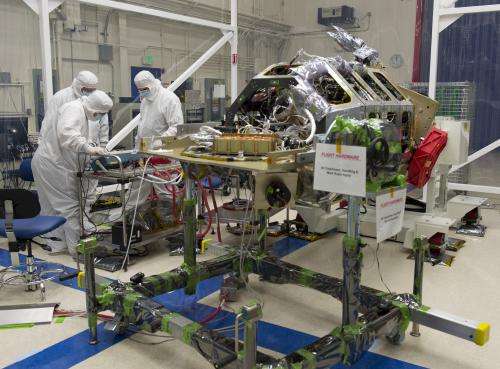
A team of engineers at NASA's Ames Research Center, Moffett Field, Calif., tests an electrical interface on the Lunar Atmosphere and Dust Environment Explorer (LADEE) spacecraft to ensure all of the cable pins are in the correct location and that it is safe to connect. Credit: NASA/Ames – Eric James

Engineers at NASA's Ames Research Center, Moffett Field, Calif., have installed the third and final science instrument that will fly onboard NASA's Lunar Atmosphere and Dust Environment Explorer (LADEE).

LADEE is a robotic mission that will orbit the moon to gather detailed information about the lunar atmosphere, conditions near the surface and environmental influences on .

"The installation of the final science instrument to LADEE's flight structure in the clean room at Ames is an important step toward completing the spacecraft build and testing," said Butler Hine, LADEE project manager at Ames. "Now that the three science instruments are fully integrated onto the spacecraft, it has become a full-fledged, high-precision ."

In addition to LADEE's science instruments, a technology demonstration also will fly onboard. The science instruments include the Ultraviolet and Visible Light Spectrometer (UVS), which will examine the composition of the lunar atmosphere by analyzing light signatures of materials it finds; the Neutral Mass Spectrometer (NMS), set to measure variations in the over multiple lunar orbits with the moon in different space environments and the Lunar Dust Experiment (LDEX), which will collect and analyze samples of any lunar dust particles in the tenuous atmosphere. The technology demonstration payload is called the Lunar Laser Communications Demonstration, and will enable the LADEE spacecraft to use lasers instead of to achieve broadband speeds to communicate with Earth.

"We now have our full science suite, and LADEE has the tools it needs to address mysteries and questions that have lingered since Apollo," said Rick Elphic, LADEE project scientist. "Was electrostatically lofted lunar dust responsible for the horizon glow that the astronauts observed? LDEX and UVS will settle that question once and for all. What makes the exotic, tenuous atmosphere of the moon breathe and change? NMS and UVS will tell us where the different species come from, how they move and how they are lost. A mission like LADEE has been needed since Apollo, which left us with tantalizing hints about the dust and an exotic, tenuous atmosphere."

LADEE now begins its environmental test phase and will undergo tests simulating the conditions it will face during launch and operations in space. These tests include acoustic (the loud roar of the rocket), vibration (the shaking of the rocket), shock (the jolt when stages separate), and thermal-vacuum (the hot and cold vacuum conditions of deep space).

LADEE's launch in August 2013 will mark several firsts. It will be the first payload to launch on a U.S. Air Force Minotaur V rocket integrated by Orbital Sciences Corp., and the first deep space mission to launch from NASA's Goddard Space Flight Center's Wallops Flight Facility in Virginia.

Explore further: Mice, gerbils perish in Russia space flight

More information: www.nasa.gov/ladee

add to favorites email to friend print save as pdf

Related Stories

LADEE closer to exploration of lunar environment

Apr 10, 2012

NASA's Lunar Atmosphere and Dust Environment Explorer (LADEE) has received its integrated propulsion system that will enable the spacecraft to reach the moon. Achieving this milestone means the LADEE observatory is one step ...

LADEE Mission to Study the Moon's Fragile Atmosphere

Oct 26, 2009

Right now, the Moon is a ghost town. Nothing stirs. Here and there, an abandoned Apollo rover — or the dusty base of a lunar lander — linger as silent testimony to past human activity. But these days, ...

NASA to demonstrate communications via laser beam

Sep 23, 2011

It currently takes 90 minutes to transmit high-resolution images from Mars, but NASA would like to dramatically reduce that time to just minutes. A new optical communications system that NASA plans to demonstrate ...

Model Helps Search for Moon Dust Fountains

Jun 10, 2010

(PhysOrg.com) -- In exploration, sometimes you find more than what you're looking for, including things that shouldn’t be there. As the Apollo 17 astronauts orbited over the night side of the moon, with ...

Recommended for you

Mice, gerbils perish in Russia space flight

15 hours ago

A number of mice and eight gerbils sent into space in a Russian capsule destined to find out how well organisms can withstand extended flights perished during their journey, scientists said Sunday as the ...

Mars rover Opportunity examines clay clues in rock

May 18, 2013

(Phys.org) —NASA's senior Mars rover, Opportunity, is driving to a new study area after a dramatic finish to 20 months on "Cape York" with examination of a rock intensely altered by water.

NASA's STEREO detects a CME from the sun

May 17, 2013

On 5:24 a.m. EDT on May 17, 2013, the sun erupted with an Earth-directed coronal mass ejection or CME, a solar phenomenon that can send billions of tons of solar particles into space that can reach Earth ...

Nine-year-old Mars rover passes 40-year-old record

May 17, 2013

While Apollo 17 astronauts Eugene Cernan and Harrison Schmitt visited Earth's moon for three days in December 1972, they drove their mission's Lunar Roving Vehicle 19.3 nautical miles (22.210 statute miles ...

Bright explosion on the Moon

May 17, 2013

For the past 8 years, NASA astronomers have been monitoring the Moon for signs of explosions caused by meteoroids hitting the lunar surface. "Lunar meteor showers" have turned out to be more common than anyone ...

User comments : 0

More news stories

Heat-related deaths in Manhattan projected to rise

Residents of Manhattan will not just sweat harder from rising temperatures in the future, says a new study; many may die. Researchers say deaths linked to warming climate may rise some 20 percent by the 2020s, ...

Mice, gerbils perish in Russia space flight

A number of mice and eight gerbils sent into space in a Russian capsule destined to find out how well organisms can withstand extended flights perished during their journey, scientists said Sunday as the ...

Kinks and curves at the nanoscale

One of the basic principles of nanotechnology is that when you make things extremely small—one nanometer is about five atoms wide, 100,000 times smaller than the diameter of a human hair—they are going ...

Honeybees trained in Croatia to find land mines

(AP)—Mirjana Filipovic is still haunted by the land mine blast that killed her boyfriend and blew off her left leg while on a fishing trip nearly a decade ago. It happened in a field that was supposedly ...