The Helix nebula: Bigger in death than life
Oct 04, 2012 by Whitney Clavin
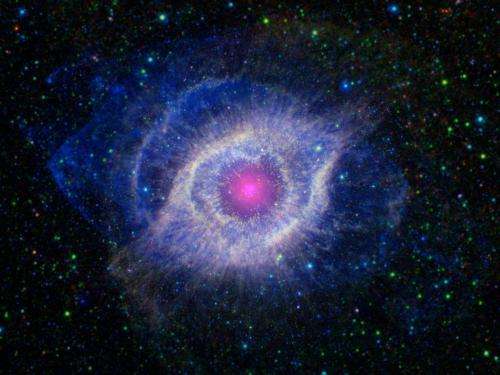
A dying star is throwing a cosmic tantrum in this combined image from NASA's Spitzer Space Telescope and the Galaxy Evolution Explorer (GALEX), which NASA has lent to the California Institute of Technology in Pasadena. In death, the star's dusty outer layers are unraveling into space, glowing from the intense ultraviolet radiation being pumped out by the hot stellar core. Credit: NASA/JPL-Caltech

(Phys.org)—A dying star is refusing to go quietly into the night, as seen in this combined infrared and ultraviolet view from NASA's Spitzer Space Telescope and the Galaxy Evolution Explorer (GALEX), which NASA has lent to the California Institute of Technology in Pasadena. In death, the star's dusty outer layers are unraveling into space, glowing from the intense ultraviolet radiation being pumped out by the hot stellar core.

This object, called the , lies 650 light-years away in the constellation of Aquarius. Also known by the catalog number NGC 7293, it is a typical example of a class of objects called planetary nebulae. Discovered in the 18th century, these cosmic works of art were erroneously named for their resemblance to gas-giant planets.

Planetary nebulae are actually the remains of stars that once looked a lot like our sun. These stars spend most of their lives turning hydrogen into helium in massive runaway nuclear fusion reactions in their cores. In fact, this process of fusion provides all the light and heat that we get from our sun. Our sun will blossom into a when it dies in about five billion years.

When the hydrogen fuel for the fusion reaction runs out, the star turns to helium for a fuel source, burning it into an even heavier mix of carbon, nitrogen and oxygen. Eventually, the helium will also be exhausted, and the star dies, puffing off its outer gaseous layers and leaving behind the tiny, hot, dense core, called a white dwarf. The white dwarf is about the size of Earth, but has a mass very close to that of the original star; in fact, a teaspoon of a white dwarf would weigh as much as a few elephants!

The from the white dwarf heats up the expelled layers of gas, which shine brightly in the infrared. GALEX has picked out the ultraviolet light pouring out of this system, shown throughout the nebula in blue, while Spitzer has snagged the detailed of the dust and gas in red, yellow and green. Where red Spitzer and blue GALEX data combine in the middle, the nebula appears pink. A portion of the extended field beyond the nebula, which was not observed by Spitzer, is from NASA's all-sky Wide-field Infrared Survey Explorer (WISE). The white dwarf star itself is a tiny white pinprick right at the center of the nebula.

Explore further: Galaxy's Ring of Fire

More information: More information about Spitzer is online at spitzer.caltech.edu and www.nasa.gov/spitzer . More information about GALEX is at www.galex.caltech.edu .

Related Stories

A cosmic inkblot test

Aug 11, 2011

(PhysOrg.com) -- If this were an inkblot test, you might see a bow tie or a butterfly depending on your personality. An astronomer would likely see the remains of a dying star scattered about space -- precisely ...

The Colorful Demise of a Sun-Like Star

Feb 13, 2007

This image, taken by NASA's Hubble Space Telescope, shows the colorful "last hurrah" of a star like our Sun. The star is ending its life by casting off its outer layers of gas, which formed a cocoon around ...

The Last Confessions of a Dying Star

Mar 04, 2008

Probing a glowing bubble of gas and dust encircling a dying star, NASA's Hubble Space Telescope reveals a wealth of previously unseen structures.

The Helix Nebula in new colors

Jan 19, 2012

(PhysOrg.com) -- ESO's VISTA telescope, at the Paranal Observatory in Chile, has captured a striking new image of the Helix Nebula. This picture, taken in infrared light, reveals strands of cold nebular gas ...

Image: A chameleon sky

Sep 03, 2010

The sands of time are running out for the central star of this the Hourglass Nebula.

One Star's Life Ends With A Ring

Aug 19, 2004

A new image from NASA's Spitzer Space Telescope shows the shimmering embers of a dying star, and in their midst a strange doughnut-shaped ring. "Spitzer's infrared vision has revealed what could not be seen before - a m ...

Recommended for you

Galaxy's Ring of Fire

May 18, 2013

Johnny Cash may have preferred this galaxy's burning ring of fire to the one he sang about falling into in his popular song. The "starburst ring" seen at center in red and yellow hues is not the product of ...

4C+29.30: Black hole powered jets plow into galaxy

May 15, 2013

(Phys.org) —This composite image of a galaxy illustrates how the intense gravity of a supermassive black hole can be tapped to generate immense power. The image contains X-ray data from NASA's Chandra X-ray ...

A space-time magnifying glass

May 15, 2013

(Phys.org) —Bright arcs are smeared around the heart of galaxy cluster Abell S1077 in this image taken by the NASA/ESA Hubble space telescope. The arcs are stretched images of distant galaxies distorted ...

User comments : 2

Adjust slider to filter visible comments by rank

Display comments: newest first

cantdrive85
1 / 5 (4) Oct 04, 2012
As usual, describing the behavior of plasma with mechanical interactions, contrary to all laboratory experimentation and observation. Whoever calls astrophysics an "applied" science are clearly unaware of how to apply the appropriate laws and when/where to apply them.
Fleetfoot
not rated yet Oct 07, 2012
Since the mechanical effects dominate in this case, it is appropriate. If there were significant magnetic fields involved, the situation might be different. You need to learn to discriminate instead of blindly preaching your religion all the time.

More news stories

Heat-related deaths in Manhattan projected to rise

Residents of Manhattan will not just sweat harder from rising temperatures in the future, says a new study; many may die. Researchers say deaths linked to warming climate may rise some 20 percent by the 2020s, ...

Mice, gerbils perish in Russia space flight

A number of mice and eight gerbils sent into space in a Russian capsule destined to find out how well organisms can withstand extended flights perished during their journey, scientists said Sunday as the ...

Kinks and curves at the nanoscale

One of the basic principles of nanotechnology is that when you make things extremely small—one nanometer is about five atoms wide, 100,000 times smaller than the diameter of a human hair—they are going ...

Honeybees trained in Croatia to find land mines

(AP)—Mirjana Filipovic is still haunted by the land mine blast that killed her boyfriend and blew off her left leg while on a fishing trip nearly a decade ago. It happened in a field that was supposedly ...