Bright object on Mars is likely plastic from rover
Oct 10, 2012
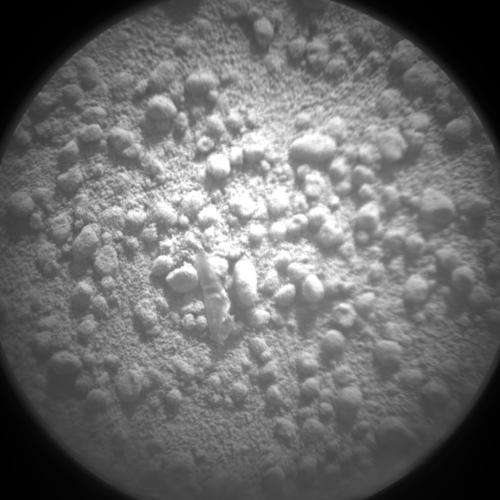
This image was taken by ChemCam: Remote Micro-Imager (CHEMCAM_RMI) onboard NASA's Mars rover Curiosity on Sol 62 (2012-10-08 22:00:04 UTC). Credit: NASA/JPL-Caltech/LANL

NASA says a small bright object detected on Mars is likely a piece of plastic from the Curiosity rover.

The six-wheel spacecraft captured an image of the puzzling object Monday after scooping up Martian sand and dust over the weekend.

In a statement Tuesday, the says the plastic bit that fell off the rover is "benign." While plans are continuing to positively identify it, NASA says it is not "Martian material."
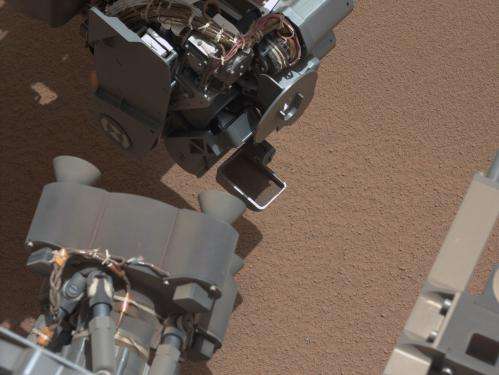
This image from the right Mast Camera (Mastcam) of NASA's Mars rover Curiosity shows a scoop full of sand and dust lifted by the rover's first use of the scoop on its robotic arm. In the foreground, near the bottom of the image, a bright object is visible on the ground. The object might be a piece of rover hardware. This image was taken during the mission's 61st Martian day, or sol (Oct. 7, 2012), the same sol as the first scooping. After examining Sol 61 imaging, the rover team decided to refrain from using the arm on Sol 62 (Oct. 8). Instead, the rover was instructed to acquire additional imaging of the bright object, on Sol 62, to aid the team in assessing possible impact, if any, to sampling activities. For scale, the scoop is 1.8 inches (4.5 centimeters) wide, 2.8 inches (7 centimeters) long. Image credit: NASA/JPL-Caltech/MSSS

will continue taking pictures of its surroundings as the project team decides the next move.

Curiosity landed in an ancient crater in August on a two-year mission to determine whether the environment was ever favorable for . It started driving toward its first science destination after a month checking out its instruments.

Explore further: Mars rover Curiosity scoops, detects bright object

More information:

NASA's statement:

Curiosity's main activity in the 62nd sol of the mission (Oct. 8, 2012) was to image a small, bright object on the ground using the Remote Micro-Imager of the Chemistry and Camera (ChemCam) instrument.

The rover team's assessment is that the bright object is something from the rover, not Martian material. It appears to be a shred of plastic material, likely benign, but it has not been definitively identified.

To proceed cautiously, the team is continuing the investigation for another day before deciding whether to resume processing of the sample in the scoop. Plans include imaging of surroundings with the Mastcam.

A sample of sand and dust scooped up on Sol 61 remains in the scoop. Plans to transfer it from the scoop into other chambers of the sample-processing device were postponed as a precaution during planning for Sol 62 after the small, bright object was detected in an image from the Mast Camera (Mastcam).

A Sol 62 raw image from ChemCam, at 1.usa.gov/R1fZHt, shows the object in question just to left of center of the image.

Sol 62, in Mars local mean solar time at Gale Crater, will end at 12:23 a.m. Oct. 9, PDT (3:23 a.m., EDT).

5 /5 (6 votes)
add to favorites email to friend print save as pdf

Related Stories

Next Mars rover nears completion

Apr 07, 2011

(PhysOrg.com) -- Assembly and testing of NASA's Mars Science Laboratory spacecraft is far enough along that the mission's rover, Curiosity, looks very much as it will when it is investigating Mars.

Mars rover Curiosity prepares for test drive (Update)

Aug 21, 2012

Scientists on Tuesday prepared to send Curiosity on its first test drive over the billion-year-old rocks of Mars and said a busted wind sensor won't jeopardize its mission of determining whether life could ...

Recommended for you

Forecast for Titan: Wild weather could be ahead

May 22, 2013

(Phys.org) —Saturn's moon Titan might be in for some wild weather as it heads into its spring and summer, if two new models are correct. Scientists think that as the seasons change in Titan's northern hemisphere, ...

SDO observes mid-level solar flare

May 22, 2013

UPDATE 16:30 p.m. EDT: The M7-class flare was also associated with a coronal mass ejection or CME, another solar phenomenon that can send billions of tons of particles into space. While this CME was not Ea ...

User comments : 7

Adjust slider to filter visible comments by rank

Display comments: newest first

Picard
4 / 5 (3) Oct 10, 2012
And so it begins ... polution.
antialias_physorg
3 / 5 (4) Oct 10, 2012
And so it begins ... polution.

Ah. So losing small patch of plastic worries you - but the 43kg of plutoniumdioxide didn't until now?
Doug_Huffman
3 / 5 (3) Oct 10, 2012
I wonder, is the definition of POLLUTION like the definition of (radioactive) contamination, "the unwanted presence of (radioactive material)."?

In any case, on Mars too, the solution to pollution is dilution.
Doug_Huffman
4 / 5 (4) Oct 10, 2012
Now litter is another matter. The object is tentatively identified as a fragment of a Mars candybar wrapper.
antialias_physorg
3.8 / 5 (5) Oct 10, 2012
In any case, on Mars too, the solution to pollution is dilution.

'Solution by dilution' is actually unlawful in most all countries - especially when it comes to nuclear waste (otherwise all countries would just dump all their garbage into the oceans. currently - to my knowledge - only Russia sinks their nuclear reactors on purpose)
jagan
3 / 5 (1) Oct 11, 2012
Let the Mars mission continue and discover more to the next generation, ofcourse if we have to gain some thing then loose some thing... go ahead

rwinners
5 / 5 (1) Oct 11, 2012
On Mars, radiation is an everyday part of the environment, much more so than on Earth.

More news stories

A hidden population of exotic neutron stars

(Phys.org) —Magnetars – the dense remains of dead stars that erupt sporadically with bursts of high-energy radiation - are some of the most extreme objects known in the Universe. A major campaign using ...

Century-old science helps confirm global warming

(Phys.org) —Ocean measurements taken more than 135 years ago during the scientific expedition of HMS Challenger have provided further confirmation of human-produced global warming over the past century.

Hubble reveals the ring nebula's true shape

(Phys.org) —The Ring Nebula's distinctive shape makes it a popular illustration for astronomy books. But new observations by NASA's Hubble Space Telescope of the glowing gas shroud around an old, dying, ...

Spheres can form squares

Everybody who has tried to stack oranges in a box knows that a regular packing of spheres in a flat layer naturally leads to a hexagonal pattern, where each sphere is surrounded by six neighbours in a honeycomb-like ...