Sorghum eyed as a southern bioenergy crop
Sep 17, 2012 by Jan Suszkiw
Sorghum eyed as a southern bioenergy crop
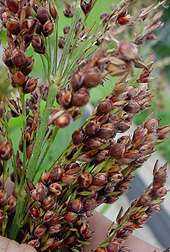
ARS researchers are developing ways to improve sorghum's potential as a source for biofuel, including crossbreeding cultivated sorghum with an African sorghum bicolor species. Photo courtesy of Richard Old, XID Services, Inc., Bugwood.org

Sweet sorghum is primarily grown in the United States as a source of sugar for syrup and molasses. But the sturdy grass has other attributes that could make it uniquely suited to production as a bioenergy crop, U.S. Department of Agriculture (USDA) studies suggest.

Sorghum is an ideal candidate because of its , adaptability to diverse growing conditions, low requirements, and high biomass (plant material) content, according to Scott Sattler and collaborator Jeff Pedersen with USDA's Agricultural Research Service (ARS). It also produces soluble sugar that can be converted to biofuel. Residual fibers left over from the juice extraction process also can be burned to generate electricity.

Sattler and Pedersen's studies of sorghum are part of a larger effort by ARS—USDA's principal intramural scientific research agency—to answer a government mandate calling for the production of up to 36 billion gallons of biofuel by 2022. Approximately 15 billion gallons of that total will come from grain ethanol, with the remaining 21 billion gallons to come from other sources, or "feedstocks," including sorghum, sugarcane, other grasses like switchgrass, and oilseed crops like rapeseed and soybean.

Sorghum and sugarcane are top candidates for production in the southeastern United States because they are complementary crops that can extend the biofuel production season and utilize the same equipment, note Sattler and Pedersen, who work at the ARS Grain, Forage and Bioenergy Research Unit in Lincoln, Neb. However, they are not the only team examining 's energy potential.

At the ARS and Unit in Tifton, Ga., geneticist William Anderson and his colleagues are working to identify desirable sweet sorghum genes and their functions so improved varieties can be developed. In studies, they selected 117 genotypes from the ARS sorghum germplasm collection at Griffin, Ga., and evaluated them for their ability to mature quickly and resist fall armyworms and the fungal disease anthracnose.

Explore further: Researchers conduct first genomic survey of human skin fungal diversity

More information: Read more about this and other bioenergy research in the September 2012 issue of Agricultural Research magazine.

add to favorites email to friend print save as pdf

Related Stories

Growing sorghum for biofuel

Nov 10, 2010

Conversion of sorghum grass to ethanol has increased with the interest in renewable fuel sources. Researchers at Iowa State University examined 12 varieties of sorghum grass grown in single and double cropping systems. The ...

Versatile compound examined in crops

Aug 02, 2011

Detergent-like compounds called saponins are best known for their cleansing properties, but U.S. Department of Agriculture (USDA) scientists are studying these compounds' potential for helping protect plants from insect attack.

OSU 'sweet' biofuels research goes down on the farm

Aug 29, 2007

Oklahoma State University’s sorghum-related biofuels research is taking a localized approach, with the aim of making possible the effective production of ethanol in the farmer’s own field.

Recommended for you

Fast new, one-step genetic engineering technology

6 hours ago

A new, streamlined approach to genetic engineering drastically reduces the time and effort needed to insert new genes into bacteria, the workhorses of biotechnology, scientists are reporting. Published in ...

100K Pathogen Genome Project maps first genomes

6 hours ago

(Phys.org) —Striking a blow at foodborne diseases, the 100K Pathogen Genome Project at the University of California, Davis, today announced that it has sequenced the genomes of its first 10 infectious microorganisms, including ...

New DNA cattle test beefs up dairy and meat quality

6 hours ago

(Phys.org) —A genomics technique developed at Cornell to improve corn can now be used to improve the quality of milk and meat, according to research published online May 17 in the journal PLOS ONE.

Strawberry fields forever and fungus-free

6 hours ago

(Phys.org) —Strawberries are one of the most economically important berry crops in the world, and a high value export crop for the Australian horticultural industry.For the first time, researchers at The ...

User comments : 0

More news stories

Do songbirds hold key to stuttering?

A tiny Australian songbird may hold the answer to discovering the biological source of stuttering, which affects 3 million Americans and is notoriously difficult to treat.

Coral reefs 'ruled by earthquakes and volcanoes'

(Phys.org) —Titanic forces in the Earth's crust explain why the abundance and richness of corals varies dramatically across the vast expanse of the Indian and Pacific Oceans, a world-first study from the ...

Researchers rewrite obsolete blood-ordering rules

Johns Hopkins researchers have developed new guidelines—the first in more than 35 years—to govern the amount of blood ordered for surgical patients. The recommendations, based on a lengthy study of blood use at The Johns ...