The mysterious case of asteroid Oljato's magnetic disturbance
Sep 25, 2012
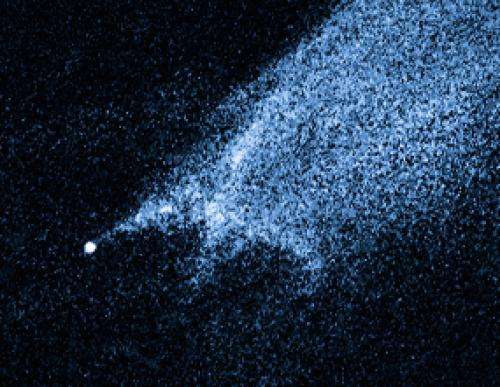
Close-up of Comet-like Asteroid P/2010 A2. Credit: NASA, ESA, and D. Jewitt (UCLA)

(Phys.org)—Back in the 1980s, the arrival of asteroid 2201 Oljato inside the orbit of Venus heralded a flurry of magnetic activity. Now, results from ESA's Venus Express spacecraft suggest that Oljato has lost its magnetic mojo. Dr Christopher Russell will present an explanation for Oljato's strange behaviour at the European Planetary Science Congress in Madrid on Tuesday 25th September.

Oljato orbits the Sun once every 3.2 years. During its lifetime, NASA's Pioneer Venus Orbiter observed three passages of Oljato between Venus and the Sun. Each time, there was a marked increase in the region of unusual magnetic peaks known as Interplanetary Field Enhancements (IFEs), both ahead and behind the asteroid.

Russell said, "This is not typical asteroidal behaviour! These magnetic increases are rare, occurring in Venus orbit about 10 times per year. Pioneer observed that when Oljato was just in front or just behind Venus, the rate of IFEs approximately trebled. And yet, in more recent observations with Venus Express, the occurrence of IFEs is now lower than the average we find outside this region."

Russell and his team believe that the answer to this discrepancy lies with collisions between Oljato and debris in its orbit. When objects collide in , they become electrically charged and are accelerated by the .

Russell explained, "At one point in time Oljato shed boulders – mostly a few tens of metres in diameter – into its orbit and they formed a debris trail in front and behind Oljato. These impactors then hit other targets as they passed between Venus and the Sun. The large amount of fine dust released by these collisions was picked up by the solar wind, producing the IFEs observed by Pioneer, and was accelerated out of the solar system."

The reduced rate of IFEs observed during the Venus Express epoch suggests that the collisions with Oljato's co-orbiting material have reduced the general debris in the region as well as the co-orbiting material shed by Oljato.

"The IFEs observed by Pioneer suggest that more than 3 tonnes of dust was being lost from the region each day. Effects associated with solar heating and gravitational perturbations have gradually nudged larger chunks of debris away from Oljato's . From once being unusually crowded, the region has become unusually clear and free of IFEs," said Russell.

Explore further: ESA: Unveiling Venus

Source: European Planetary Science Congress

4 /5 (6 votes)

Related Stories

Venus Express spacecraft fires main engine

Feb 20, 2006

One hundred days after its launch to Venus, the European Space Agency's Venus Express has successfully tested its main engine for the first time in space.

ESA: Unveiling Venus

May 25, 2012

With Venus about to get its day in the Sun — very much literally — the European Space Agency has assembled an excellent video about our planetary neighbor.

Earth, Venus lightnings produced by similar mechanisms

Sep 27, 2010

Despite the great differences between the atmospheres of Venus and Earth, scientists have discovered that very similar mechanisms produce lightning on the two planets. The rates of discharge, the intensity ...

ESA missions gear up for transit of Venus

Jun 04, 2012

(Phys.org) -- ESA’s Venus Express and Proba-2 space missions, along with the international SOHO, Hinode, and Hubble spacecraft, are preparing to monitor Venus and the Sun during the transit of Earth’s ...

Spacecraft Tandem Provide New Views of Venus

Jul 19, 2007

NASA's Mercury Surface, Space Environment, Geochemistry, and Ranging spacecraft, known as Messenger, and the European Space Agency's Venus Express recently provided the most detailed multi-point images of ...

Recommended for you

Mars rover Opportunity examines clay clues in rock

8 hours ago

(Phys.org) —NASA's senior Mars rover, Opportunity, is driving to a new study area after a dramatic finish to 20 months on "Cape York" with examination of a rock intensely altered by water.

NASA's STEREO detects a CME from the sun

21 hours ago

On 5:24 a.m. EDT on May 17, 2013, the sun erupted with an Earth-directed coronal mass ejection or CME, a solar phenomenon that can send billions of tons of solar particles into space that can reach Earth ...

Nine-year-old Mars rover passes 40-year-old record

May 17, 2013

While Apollo 17 astronauts Eugene Cernan and Harrison Schmitt visited Earth's moon for three days in December 1972, they drove their mission's Lunar Roving Vehicle 19.3 nautical miles (22.210 statute miles ...

Bright explosion on the Moon

May 17, 2013

For the past 8 years, NASA astronomers have been monitoring the Moon for signs of explosions caused by meteoroids hitting the lunar surface. "Lunar meteor showers" have turned out to be more common than anyone ...

User comments : 4

Adjust slider to filter visible comments by rank

Display comments: newest first

rkolter
5 / 5 (1) Sep 25, 2012
I would like more information - this sounds like a general answer for objects that shed material in their orbits - do comets generate more IFEs? why is this asteroid exhibiting unusual behavior - do other asteroids not shed material?
cantdrive85
1 / 5 (11) Sep 25, 2012
They almost go out of their way to ignore the electrical nature of the Sun's plasmasphere and all of the bodies within it. The display of ignorance is incredibly laughable.
jshloram
4 / 5 (1) Sep 25, 2012
Another attempt by the government to hide local alien activity???

;-)
Osiris1
1 / 5 (1) Sep 26, 2012
Which begs the question. How much shielding are we going to have to install on inner solar system exploration ships eventually. Or can we develop an avoidance system or junk repulsion system..a shielding field

More news stories

Galaxy's Ring of Fire

Johnny Cash may have preferred this galaxy's burning ring of fire to the one he sang about falling into in his popular song. The "starburst ring" seen at center in red and yellow hues is not the product of ...

Alaska volcano shoots ash 15,000 feet into the air

(AP)—One of Alaska's most restless volcanoes has shot an ash cloud 15,000 feet into the air in an ongoing eruption that has drawn attention from a nearby community but isn't expected to threaten air traffic.

Chinese, Indian airlines face EU pollution fines

Eight Chinese and two Indian airlines face fines of up to several million euros for not paying for their greenhouse gas emissions during flights within the bloc, the European Commission said on Friday.

Morocco to harness the wind in energy hunt

Morocco is ploughing ahead with a programme to boost wind energy production, particularly in the southern Tarfaya region, where Africa's largest wind farm is set to open in 2014.

US psychiatry gets makeover in new manual

The latest makeover to a massive psychiatric tome honored by some, reviled by others and even called the "Bible" of mental disorders is being released Saturday with a host of new changes.

New case of SARS-like virus in Saudi: ministry

A new case of the deadly coronavirus has been detected in Saudi Arabia where 15 people have already died after contracting it, the health ministry announced on Saturday on its Internet website.