Metop-B weather satellite is ready for launch
Sep 07, 2012

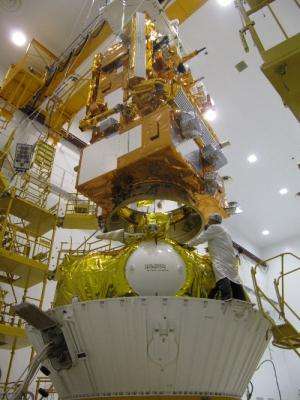
Metop-B, the European polar orbiting weather satellite, designed and manufactured by Astrium, is now ready to launch from the Baikonur cosmodrome in Kazakhstan.

From its polar orbit 817 kilometres above Earth, Metop-B will provide a broad range of measurements vital to weather forecasting and climate monitoring. The many components and instruments manufactured for Metop-B by at its sites in France, Germany, the Netherlands, Spain and the United Kingdom include the ASCAT radar, which will measure the speed and direction of ocean winds, and the Microwave Humidity Sounder (MHS), which will measure atmospheric humidity.

Metop-B is the second in a series of three weather satellites that the (ESA) and EUMETSAT, the European Organisation for the Exploitation of , have commissioned from Astrium. The satellites are being launched at intervals of five to six years; Metop-A was launched in 2006 and Metop-C is scheduled to join them in orbit at the end of 2017, thus ensuring that data will continue to be supplied until a new generation becomes available. Weighing 4,100 kg, Metop-B has been designed to operate in orbit for five years.

The EUMETSAT Polar System, which includes the three Metop satellites, represents the European contribution to a cooperative venture with the United States, providing data to monitor climate and improve weather forecasting. Each Metop satellite carries a set of 'heritage' instruments provided by the United States and a new generation of European instruments that offer improved remote sensing capabilities to both meteorologists and . In turn, the US NOAA satellites fly European instruments, including the Astrium built Microwave Humidity Sounder. Metop flies in a corresponding to local 'morning' while the US is responsible for 'afternoon' coverage.

Weather monitoring satellites, Metop-B being one of the most modern examples, are essential in guaranteeing the safety of citizens, infrastructure and industry in Europe and elsewhere. They alone possess the capability to provide weather and climate data spanning the whole planet and on a continual basis.

Explore further: Collisions of coronal mass ejections can be super-elastic

add to favorites email to friend print save as pdf

Related Stories

MetOp to be launched in October

Aug 07, 2006

MetOp, the first in the new European series of operational meteorological satellites in polar orbit, is now scheduled for launch on 7 October 2006. The new date was established last week following various planning ...

ESA sets MetOp-A launch date

Sep 14, 2006

The European Space Agency says the launch of MetOp-A, the first in a new European series of three meteorological satellites, will be Oct. 7.

Europe's next weather satellite gears up for launch

Mar 20, 2012

(PhysOrg.com) -- Following the safe arrival of the MetOp-B weather satellite in Kazakhstan, the sophisticated craft is now being carefully assembled and tested before launch on 23 May. MetOp-B will provide ...

MetOp satellite shipped to Baikonur on 18 April

Apr 19, 2006

The first MetOp meteorological satellite arrived yesterday at its launch site, the Baikonur Cosmodrome in Kazakhstan, following shipment from the industrial prime contractor, EADS Astrium in Toulouse, on board ...

ESA's MetOp launch again aborted

Oct 18, 2006

The launch of the European Space Agency's MetOp satellite was postponed Wednesday for the fifth time with 2 minutes, 35 seconds left in the countdown.

MetOp-B module passes crucial vacuum test

Aug 03, 2010

(PhysOrg.com) -- The Payload Module of ESA's latest meteorological satellite, MetOp-B, has been hauled out of the largest vacuum chamber in Europe: its ability to operate in the harsh conditions of space has ...

Recommended for you

Forecast for Titan: Wild weather could be ahead

17 hours ago

(Phys.org) —Saturn's moon Titan might be in for some wild weather as it heads into its spring and summer, if two new models are correct. Scientists think that as the seasons change in Titan's northern hemisphere, ...

SDO observes mid-level solar flare

17 hours ago

UPDATE 16:30 p.m. EDT: The M7-class flare was also associated with a coronal mass ejection or CME, another solar phenomenon that can send billions of tons of particles into space. While this CME was not Ea ...

NASA's IRIS mission readies for a new challenge

May 22, 2013

(Phys.org) —The time draws near. NASA is getting ready to launch a new mission, a mission to observe a largely unexplored region of the solar atmosphere that powers its dynamic million-degree outer atmosphere and drives ...

User comments : 0

More news stories

Century-old science helps confirm global warming

(Phys.org) —Ocean measurements taken more than 135 years ago during the scientific expedition of HMS Challenger have provided further confirmation of human-produced global warming over the past century.

Bacterium from Canadian High Arctic and life on Mars

(Phys.org) —The temperature in the permafrost on Ellesmere Island in the Canadian high Arctic is nearly as cold as that of the surface of Mars. So the recent discovery by a McGill University led team of ...

Chemists find new compounds to curb staph infection

(Phys.org) —In an age when microbial pathogens are growing increasingly resistant to the conventional antibiotics used to tamp down infection, a team of Wisconsin scientists has synthesized a potent new ...

Engineers pioneer flat spray-on optical lens

A University of British Columbia engineer and a team of U.S. researchers have made a breakthrough utilizing spray-on technology that could revolutionize the way optical lenses are made and used.