International project aims to develop water-efficient biofuel crops
Sep 25, 2012
International project aims to develop water-efficient biofuel crops
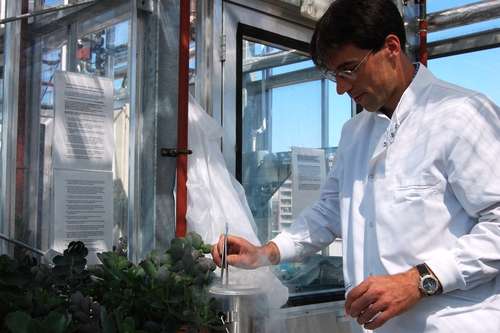
Dr. James Hartwell: “The technology may help us respond to the global food security crisis”.

Scientists from the University of Liverpool are part of an international research project to apply the properties of drought-adapted desert plants, like agave, to poplar trees, a recognised biofuel crop.

Dr James Hartwell, from the Institute of , is part of an £8.6million project, funded by the US Department of Energy that aims to explore the photosynthetic mechanisms of drought-tolerant and introduce these into poplar trees.

Climate change predictions suggest higher temperatures and more frequent severe , including droughts, for later this century. Simultaneously, the challenge of growing enough food to feed the expanding population requires that more productive farmland is used for food production rather than bioenergy. In the face of these combined challenges, there is an urgent and pressing need to improve the ability of biofuel plants to grow productively and sustainably on marginal land that is unsuitable for major food crops.

Unprecedented level of understanding

Dr Hartwell said: "The project will develop an unprecedented level of understanding of a highly water use efficient form of photosynthesis known as crassulacean acid metabolism (CAM), which is found in agaves, cacti and succulents. These plants capture carbon dioxide at night when the potential for water loss is lower. With our collaborators, we will identify the optimal 'parts-list' for CAM to function efficiently, and colleagues in the US will use this knowledge to engineer to grow productively and sustainably in low-rainfall regions."

He added: "Longer-term, it may be possible to build on our discoveries to increase the water use efficiency of other bioenergy and . The technology may help us to respond to the global food security crisis by developing crops better adapted to the drier and warmer world predicted by climate change models."

Explore further: Water-wise biofuel crop study to alter plants metabolic, photosynthesis process

add to favorites email to friend print save as pdf

Related Stories

Desert plant may hold key to surviving food shortage

Jun 19, 2008

The plant, Kalanchoe fedtschenkoi, is unique because, unlike normal plants, it captures most of its carbon dioxide at night when the air is cooler and more humid, making it 10 times more water-efficient than major crops such ...

Genomics of wood for biofuels production investigated

Nov 07, 2011

A team of Virginia Tech researchers is working to characterize the genes involved in wood formation in poplar trees with the goal of improving the quality and quantity of wood as a feedstock for biofuels production.

Scientists ID Bacterial Genes that Improve Plant Growth

May 13, 2010

You might think bacteria that "invade" trees are there to cause certain destruction. But like the helpful bacteria that live within our guts, some microbes help plants thrive. To find out what makes these ...

Recommended for you

Fast new, one-step genetic engineering technology

18 hours ago

A new, streamlined approach to genetic engineering drastically reduces the time and effort needed to insert new genes into bacteria, the workhorses of biotechnology, scientists are reporting. Published in ...

100K Pathogen Genome Project maps first genomes

19 hours ago

(Phys.org) —Striking a blow at foodborne diseases, the 100K Pathogen Genome Project at the University of California, Davis, today announced that it has sequenced the genomes of its first 10 infectious microorganisms, including ...

New DNA cattle test beefs up dairy and meat quality

19 hours ago

(Phys.org) —A genomics technique developed at Cornell to improve corn can now be used to improve the quality of milk and meat, according to research published online May 17 in the journal PLOS ONE.

Strawberry fields forever and fungus-free

19 hours ago

(Phys.org) —Strawberries are one of the most economically important berry crops in the world, and a high value export crop for the Australian horticultural industry.For the first time, researchers at The ...

User comments : 0

More news stories

Theorists weigh in on where to hunt dark matter

(Phys.org) —Now that it looks like the hunt for the Higgs boson is over, particles of dark matter are at the top of the physics "Most Wanted" list. Dozens of experiments have been searching for them, but ...