Intel unveils Rosepoint—CPU and WiFi on same chip
Sep 17, 2012 by Bob Yirka report
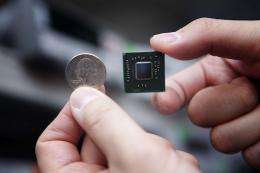
Rosepoint chip combines CPU with WiFi. Credit: Intel

(Phys.org)—Justin Rattner, Chief Technology Officer at Intel, got up on stage at a recent Developer Forum sponsored by the company and talked about some of the communications technology it's working on; chiefly a chip it calls Rosepoint, a System on a Chip (SoC) that has a dual core Atom processor along with a WiFi radio transceiver. It's the culmination of ten years of research he told the audience, in trying to integrate digital processing with analog radio signals.

The presentation by Rattner made clear a major problem computer hardware makers are facing; as chips are made ever smaller, faster and less energy intensive, radio have lagged. Making them smaller causes them to work less well because they are analog based. They also tend to cause interference with other digital parts which has forced hardware makers to keep the different types of components separated. For Intel, this has been a problem that needed to be overcome as they made clear in their presentation that they believe the day will come when virtually every computer enabled device will need to talk wirelessly, with every other. What needed to happen, they said, was for radio to go all digital and that's what they've done. Rosepoint is, a "Moore's Law Radio" they say, a radio that can be made smaller without loss of .

To make a , Intel engineers had to go back to the very basics of how works and reinvent new ways to build each part; digital phase modulators, power amps, frequency synthesizers, etc. The last, one, the synthesizer, is the part that deals with interference, canceling it on the fly and preventing it from interfering with Atom digital processors.

None of the Intel speakers gave any indication as to when Rosepoint might begin showing up in actual products, but by showcasing the new technology, Intel has demonstrated their willingness to invest heavily in technology aimed mostly at handheld devices, an area where Intel has not been nearly as dominant as they have been in desktop and laptop computers.

The company also gave a few details about other projects it's working on, such as a way to allow laptops or ultrabooks to seem as always "on" as smartphones, a next generation wireless standard they call WiGig, and biometrics technology that hopefully will offer consumers a better way to protect themselves from those trying to gain access to their personal data, e.g. devices that read palm signatures rather than rely on passwords.

Explore further: A wireless future where everything that computes is connected

Related Stories

Intel launches chip for tablet computers

Apr 11, 2011

Intel Corp. has launched a new chip for tablet computers, Atom processor Z670 based platform, as the world's most powerful semiconductor company aims to become a contender in the market for mobile chips.

Intel's plans for quadcore SoC chips discovered

Aug 29, 2012

(Phys.org)—Intel, long dominant on the PC/Windows platform has not been quite so successful in getting its chips inside other machines such as Apple's line of computers, RISC machines, and more recently ...

Intel workers have Android Jelly Bean on Atom phones

Sep 14, 2012

(Phys.org)—Intel watchers by now understand the quick version of Intel's to-do list: Join and grow up in smartphone market universe, fire up Ultrabooks and, by both means, show better profit outlook. Intel ...

Intel lines up 14 Ivy Bridge processors

Jun 02, 2012

(Phys.org) -- A new lineup of 14 Ivy Bridge processors are out of the bag from Intel. Thursday’s announcement by Intel involves new processors for mobile computers and desktops, but special attention ...

Recommended for you

First Look: New Xbox elegant, but much unknown

20 hours ago

Will gamers want One? After four years of development, Microsoft unveiled the Xbox One entertainment console and touted it as an all-in-one solution for playing games, watching TV and doing everything in ...

The new consoles from Microsoft, Nintendo and Sony

May 21, 2013

Microsoft is the last of the three big video game console makers to unveil its latest gaming system. Tuesday's unveiling comes nearly eight years after the Xbox 360 went on sale. It follows last fall's de ...

Microsoft readies new Xbox as entertainment hub

May 21, 2013

Microsoft offers a glimpse Tuesday at a new-generation Xbox as videogame consoles evolve into home entertainment centers and adapt to competition from smartphones and tablets.

Finnish start-up launches smartphone to rival giants

May 20, 2013

A group of ex-Nokia employees who quit over the company's decision to abandon the planned MeeGo operating system in favour of Windows presented their own smartphone on Monday, hoping to rival the sector's ...

User comments : 4

Adjust slider to filter visible comments by rank

Display comments: newest first

antialias_physorg
not rated yet Sep 17, 2012
Could this be usefull for having massively parallel computers without any wirework in between? Just plug more chips close to the ones already in the machine to augment the machine capabilities?
Or would the transmission speeds be too low for that?
nathj72
not rated yet Sep 17, 2012
This would be impractical due to the size of antennas that are needed. Further, data rates are directly related to bandwidth. At the frequencies these devices currently function, you could not get the high data throughput needed by many of todays computers. You would most likely need a 60GHz(a lower frequency would work, but this is an ism band currently under development for high speed secure wireless data transfer) radio to make this practical, which cannot be done digitally at this time and will likely remain in the realm of analog radio for many years.
Bowler_4007
1 / 5 (1) Sep 18, 2012
i don't like the idea of this wifi cpu, wifi will one day be redundant (or just totally different than what it currently is) and then you have 1 piece of the cpu sitting dead in the water, not to mention that with the wifi portion taking up bandwidth the cpu will be slowed down and that bandwidth could be better used for processing data while a seperate wifi device deals with the networking
GSwift7
not rated yet Sep 18, 2012
Could this be usefull for having massively parallel computers without any wirework in between? Just plug more chips close to the ones already in the machine to augment the machine capabilities?
Or would the transmission speeds be too low for that?


Think of it as being exactly like your current wifi capable smartphone, only smaller and I would assume, using less power.

I think the likely use is just making more room inside the smartphone for other things such as battery and memory. Or, conversely, make the device smaller. Perhaps one step closer to practical, wearable networked devices, like the supposed google glasses. Something like this also has an obvious application in modern military devices, such as helmet mounted soldier-to-soldier communication and battlefield unit integration. The digital radio they mentioned would serve that function very well due to the security that allows.

More news stories

First Look: New Xbox elegant, but much unknown

Will gamers want One? After four years of development, Microsoft unveiled the Xbox One entertainment console and touted it as an all-in-one solution for playing games, watching TV and doing everything in ...

Expectations high for next Xbox

It's almost time for a new Xbox. Eight years have passed since Microsoft unveiled the Xbox 360, double the amount of time between the original Xbox debut in 2001 and its high-definition successor's launch ...

Congress gets mixed advice on regulating drones

(AP)—The growing use of unmanned surveillance "eyes in the sky" aircraft raises a thicket of privacy concerns, but the U.S. Congress is getting mixed advice on what, if anything, to do about it.

The new consoles from Microsoft, Nintendo and Sony

Microsoft is the last of the three big video game console makers to unveil its latest gaming system. Tuesday's unveiling comes nearly eight years after the Xbox 360 went on sale. It follows last fall's de ...