Chinese dust cloud 'improves smelly Japanese dish'
Sep 04, 2012
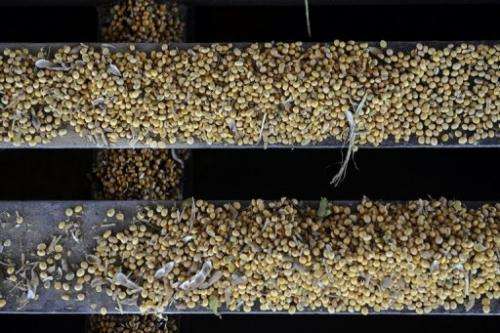
Picture of soybeans taken in Argentina in 2008. Natto, the Japanese breakfast dish of fermented soybeans, has a smell likened to sweaty feet but researchers have come up with an unlikely way of making it less whiffy—using bacteria from Chinese dust clouds.

Natto, the Japanese breakfast dish of fermented soybeans, has a smell likened to sweaty feet but researchers have come up with an unlikely way of making it less whiffy—using bacteria from Chinese dust clouds.

found in the yellow fug that drifts over from China are almost identical to the reagent usually added to the beans to start the , said Teruya Maki, an assistant professor at Kanazawa University.

The end result, labelled "Sky Natto", tastes like normal natto but doesn't have the overpowering smell that puts off so many first timers and divides Japan into those who love the protein-rich dish and those who hate it.

"We spotted this bacteria which is the same as that used for making natto," said Maki, who was studying the organisms in the Chinese dust cloud for their potential risks to human health.

After a test batch, Maki and his team persuaded a local natto manufacturer to adopt the recipe and produce Sky Natto for sale at the university, with an eye on cracking the local market.

Sky Natto has a much less overwhelming smell than regular natto and has greater nutritional value because it contains more magnesium and calcium, he said.

Clouds of travel from during Spring when winds whip up sand and transport it thousands of miles (kilometres), sometimes shrouding parts of Japan and the .

Natto, while not widely known outside Japan, can be found in health food shops in the West.

Explore further: Diversifying populations of Japanese men used in study plotting their risk to prostate cancer reveals a potential dietar

add to favorites email to friend print save as pdf

Related Stories

Soy found protective against localized prostate cancer

Mar 15, 2007

The largest study examining the relationship between the traditional soy-rich Japanese diet and development of prostate cancer in Japanese men has come to a seemingly contradictory conclusion: intake of isoflavone chemicals, ...

S.Korea issues warning against 'yellow dust'

Dec 25, 2009

South Korea's weather service Friday issued a warning against airborne pollution known as "yellow dust", advising residents in western areas to avoid outdoor activities.

Recommended for you

Intestinal bacteria protect against E. coli O157:H7

15 hours ago

A cocktail of non-pathogenic bacteria naturally occurring in the digestive tract of healthy humans can protect against a potentially lethal E. coli infection in animal models according to research presented today at the 11 ...

Explainer: What are stem cells?

20 hours ago

In a paper published in Cell yesterday, scientists from the US and Thailand have, for the first time, successfully produced embryonic stem cells from human skin cells. ...

Cattle disease bacteria widespread in the UK

21 hours ago

A new study has found that bacteria responsible for chronic intestinal inflammation in cattle, which have also been implicated in Crohn's disease in humans, are widespread in the UK countryside.

Mapping a route to stem cell therapies

22 hours ago

Monash University researchers are shedding light on the complex processes that underpin the creation and differentiation of stem cells, bringing closer the promise of 'miracle' therapies.

X-ray tomography on a living frog embryo

May 16, 2013

Classical X-ray radiographs provide information about internal, absorptive structures of organisms such as bones. Alternatively, X-rays can also image soft tissues throughout early embryonic development of ...

User comments : 0

More news stories

Slow pokes: Acupuncture helps hypothermic turtles

Two endangered sea turtles that are shells of their former selves after getting stranded on Cape Cod during a cold spell are getting some help easing back into the wild—from an acupuncturist.

No new H7N9 cases in China for a week

No new human cases of the H7N9 virus have been recorded in China for a week, national health authorities said, for the first time since the outbreak began in March.